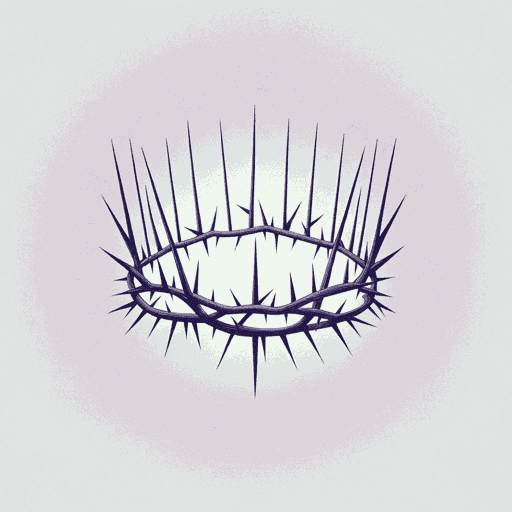
Prince of Thorns
52 pages • 1-hour read
Mark LawrencePrince of Thorns
A modern alternative to SparkNotes and CliffsNotes, SuperSummary offers high-quality Study Guides with detailed chapter summaries and analysis of major themes, characters, and more.
Important Quotes
“War my friends, is a thing of beauty. Those as says otherwise are losing.”
(Chapter 1, Page 2)
Almost immediately the reader is bluntly informed of Jorg’s “winner take all” view of life. From the outset Jorg is established as a ruthless and ambitious young man who is perfectly at home amidst slaughter.
“Fifteen! I’d hardly be fifteen and rousting villages. By the time fifteen came around, I’d be King!”
(Chapter 1, Page 4)
In this quote, the reader discovers that Jorg is not yet even 15 years old, so that his hardened and bloodthirsty nature is belied by his youth. Moreover, although Jorg may be engaged in small-scale plundering, his ambition far outruns his current station. Given the willingness to kill, maim, and rape that Jorg has shown already in the first chapter, the reader quickly senses that Jorg considers little if anything to be off the table in his pursuit of power.
“‘The ones who built this road…if they’d make me a castle—’ Thunder in the east cut across my words. ‘If the Road-men built castles, we’d never get in anywhere,’ Makin said. ‘Be happy they’re gone.’”
(Chapter 3, Page 12)
The general attitude towards the Builders is best described as ambivalent. As Jorg’s wish shows, the Builders have left durable and useful infrastructure upon which the current civilization depends—both the Tall Castle and the Castle Red are housed in Builder ruins. On the other hand, their technical skill is terrifying since it allowed them to self-immolate and poison the world.
“A knife is a scary thing right enough, held to your throat, sharp and cool. The fire too, and the rack. And an old ghost on the Lichway. All of them might give you pause. Until you realize what they are. They’re just ways to lose the game. You lost the game, and what have you lost? You’ve lost the game.”
(Chapter 4, Page 19)
Jorg’s ability to think of his perilous quest for power as a game helps him to ignore the dangers he faces. Since death is just losing “the game,” no means of death is different from another.
“The thorns taught me the game. They let me understand what all those grim and serious men who’ve fought the Hundred War have yet to learn. You can only win the game when you understand that it is a game. Let a man play chess, and tell him that every pawn is his friend. Let him think both bishops holy. Let him remember happy days in the shadows of his castles. Let him love his queen. Watch him lose them all.”
(Chapter 4, Page 21)
In this passage, Jorg lays out the implications for viewing war as a game. Just as in chess a player must be willing to sacrifice lesser units to protect the king, a real king cannot be too attached to anyone around him. He must be prepared to allow his friends, his holy men, and even his wife to die if it advances his cause.
“Lying on bloody sheets in the Healing Hall I discovered doors within my mind that I’d not found before, doors that even a child of nine knows should not be opened. Doors that never close again.”
(Chapter 5, Page 22)
The ordeal in the briar patch and the arduous recovery following it have changed Jorg irrevocably. Whatever innocence he had remaining was stripped from him and his moral compass forever scrambled.
“Count Renar? I had a name. A black crow on a red field. The insignia flashed across my eyes, seared deep by the lightning of last night’s storm. A fire lit within me, and the pain from a hundred hooks burned in every limb. A groan escaped me. My lips parted, dry skin tearing. And Reilly found me.”
(Chapter 5, Page 23)
From this moment onwards, desire for revenge is the driving force in Jorg’s life. He is ready to give up and die on the briars until he hears the attackers identified. Even the slim chance of avenging his mother and brother rekindles his desire to live.
“I learned from Tutor Lundist that the friar would not attend me after the first week. Friar Glen said a devil was in me. How else could a child speak such horror? In the fourth week I slipped the bonds that held me to my pallet, and set a fire in the hall. I have no memory of the escape, or my capture in the woods. When they cleared the ruin, they found the remains of Inch, with the poker from the hearth lodged in his chest.”
(Chapter 5, Page 26)
Although he has not yet been placed under Corion’s direct control, Friar Glen attributes Jorg’s violence to demonic possession. It may be that Corion has some sort of connection to the hook-briar and already has limited control of Jorg.
“Hate will keep you alive where love fails.”
(Chapter 5, Page 26)
Here, Jorg is referring to how his desire to kill Renar buoyed his will to survive during his long fever. The sentiment will be more literally expressed following his stabbing by Olidan. Jorg has the opportunity to possess eternal happiness by dying or return to life by refusing to let go of his hate.
“‘Pick your fights,’ Makin said. ‘I’ll pick my ground,’ I said. ‘I’ll pick my ground, but I’m not running. Not ever. That’s been done, and we still have the war. I’m going to win it, Brother Makin, it’s going to end with me.’”
(Chapter 6, Page 28)
Jorg is speaking figuratively when he speaks of picking his ground rather than his battles, but he puts it into practice quite literally. He routs a much larger force of Renar’s men in Norwood by picking out spots to hide the brothers in ambush. The Castle Red is considered impregnable so, instead of making a frontal attack, Jorg “picks his ground” in the armory underneath the fortress. Finally, for the tourney at The Haunt, Jorg positions the brothers and the Forest Watch in such a way to cause mayhem and quickly seize key positions.
“Maybe it was something to do with having an old ghost haunt its way through to the very marrow of my bones, but today my headaches felt more like somebody prodding me with a stick, herding me along, and it was really beginning to fuck me off.”
(Chapter 6, Page 33)
As Jorg comes closer to Ancrath and Corion’s hold over him begins to slip, Corion tries to impose his will on Jorg more forcefully. His manipulation becomes cruder, and Jorg begins to sense that there is a foreign influence at work.
“I looked at Makin…He’s my knight, I thought. Gomst is my bishop, the Tall Castle my rook. Then I thought of my Father. I needed a king. You can’t play the game without a king.”
(Chapter 6, Page 34)
This is a rather subtle foreshadowing of the degree to which Jorg’s thought patterns have been molded by Corion. Within “the game” Jorg sees himself as a player manipulating the king—i.e. that role that Sageous and Corion occupy—rather than the actual ruler as represented by the king.
“I had an explanation for Renar’s actions, but as to my own, like Father Gomst, I wasn’t sure I understood either. Whatever strength I had on the road, it came to me through a willingness to sacrifice. It came on the day I set aside my vengeance on Count Renar as a thing without profit.”
(Chapter 8, Page 49)
Despite vowing to take revenge on Renar, Jorg quickly desists and spends the next four years pillaging with the brothers. Here, he rationalizes his decision by thinking of his revenge as being “a thing without profit” that he set aside in pursuit of power. Jorg eventually learns that he changed course due to the influence of Corion, but at this point he still believes it was his decision.
“Part of me longed for a surrender, to take the gift Lundist held before me. I cut away that portion of my soul. For good or ill, it died that day.”
(Chapter 9, Page 61)
Jorg usually discusses sacrifice in terms of using other people in pursuit of his goals. In this instance, however, he shows his willingness to also sacrifice parts of himself. In joining the brothers and leaving Lundist—presumably to die—Jorg has affirmatively chosen to give up tenderness or sentimentality.
“‘It’s not a game, Sir Makin. You teach these boys to play by the rules, and they’re going to lose. It’s not a game.’”
(Chapter 11, Page 83)
Given Jorg’s constant talk of “the game,” this quote appears odd at first. To Jorg, “the game” is about strategic decisions; the combat those decisions result in is not a game, however. A fight to the death doesn’t have rules.
“‘Anything you cannot sacrifice pins you. Makes you predictable, makes you weak.’”
(Chapter 14, Page 102)
This is the most succinct distillation of Jorg’s philosophy of sacrifice. Judging him by his own standard, Katherine and Makin are his weaknesses since he shows a reluctance to either kill the former or abandon the latter to death.
“I saw her for the same weakness I’d recognized when first we rode back into the green fields of Ancrath. That soft seduction of need and want, an equation of dependence that eases under the skin, so slow and sweet, only to lay a man open at the very time he most needs his strength.”
(Chapter 21, Page 163)
Since the death of his mother, Jorg has known no softness or tenderness and has learned to find strength and even comfort in his pain and the rage it induces. He has an inherent suspicion of anything, person or place, that might induce him to find some lasting pleasure and peace.
“That last voice—it could have been mine, or the briar, they started to sound the same.”
(Chapter 24, Page 182)
Jorg has some sense that a foreign influence is at work upon him but has not yet discovered its true source. Even when he does uncover the source of the briar’s “voice,” he is unable to fully determine the degree to which it has caused him to behave as he has on the road.
“‘There’s more than that. You have a dark hand on your shoulder. A hole in your mind. A hole. In your memories. A hole—a hole—pulling me in—pulling—’”
(Chapter 28, Page 213)
Jane, who can read Jorg’s mind, confirms his suspicions that there is some foreign power controlling him. That Jane is immediately noticed and attacked by Corion indicates the strength of the connection he is able to maintain to Jorg.
“There’s a door to death, a veil between worlds, and we push through when we die. But on the Day of a Thousand Suns so many people had to push through at once, they broke the door. The veils are thin now. It just takes a whisper and the right promise, and you can call the dead back.”
(Chapter 28, Page 217)
Jorg’s reading of Plato, references to the pope in Rome, and the cache of nuclear weapons he finds all indicate that the story is set in our own world in the far future. A nuclear war explains the postapocalyptic landscape and regression to a feudal social structure, but this passage explains why supernatural forces now operate in the world.
“‘I could go with you, Lady. I could take what you offer. But who would I be then? Who would I be if I let go the wrongs that have shaped me?’”
(Chapter 38, Page 300)
After bringing himself back from the brink of death on the strength of his desire for vengeance, Jorg cannot separate himself from his sense of injury and the motivation he takes from it.
“‘Nations won’t follow monsters like me. They’ll follow a lineage, divine right, the spawn of kings. So we who have taken our power from the places where others fear to reach…we play the game of thrones with pieces like Count Renar, pieces like your father. Pieces like you, perhaps.’”
(Chapter 40, Page 307)
“Until you realize what they are. They’re just ways to lose the game. You lost the game, and what have you lost? You’ve lost the game. Corion had told me about the game. How many of my thoughts were his? How much of my philosophy was filth from that man’s fingers?”
(Chapter 41, Page 313)
With his recovery of his missing memories, Jorg realizes that he been playing “the game” on Corion’s behalf. Now that he knows that he has been a pawn for the past four years, he considers playing differently in the future.
“Play the game. Sacrifice knight, take castle. That old dry voice again. I’d listened to it so long I couldn’t tell if it were mine or Corion’s.”
(Chapter 42, Page 321)
Jorg now doubts some of the maxims by which he has been living his life, wondering if he adopted them on his own account or if Corion programmed them into his psyche. His reluctance to sacrifice Makin, his knight, appears to be a sign of Jorg’s own psyche reasserting itself.
“On the road I did things that men might call evil. There were crimes. They talk about the bishop most often, but there were many more, some darker, some more bloody. I wondered once if Corion had put that sickness in me, if I were the tool and he the architect of that violence and cruelty.”
(Chapter 49, Page 371)
With time to reflect following his seizure of the Renar Highlands, Jorg has more time to meditate on his deeds over the past several years. In the end, he concludes that Corion may have directed him to some degree but that the capability for the violence and cruelty the sorcerer unleashed within him came from himself.

Unlock every key quote and its meaning
Get 25 quotes with page numbers and clear analysis to help you reference, write, and discuss with confidence.
- Cite quotes accurately with exact page numbers
- Understand what each quote really means
- Strengthen your analysis in essays or discussions