Stig of the Dump
44 pages • 1-hour read
Clive KingStig of the Dump
A modern alternative to SparkNotes and CliffsNotes, SuperSummary offers high-quality Study Guides with detailed chapter summaries and analysis of major themes, characters, and more.
Chapters 8-9Chapter Summaries & Analyses
Chapter 8 Summary: “Midsummer Night”
On Midsummer Night, Barney lies awake in his hot bedroom, frustrated at being sent to bed during daylight hours. His grandmother has explained that darkness will not fall until after ten o’clock, too late for an eight-year-old’s bedtime. Determined to stay awake all night, Barney thinks about Stig and wonders how old he might be before accidentally drifting off. Later, Barney wakes and sees bright moonlight. He decides to sneak out to visit Stig. As he creeps downstairs, Dinah the spaniel, who sleeps downstairs, barks but quiets when hushed. Lou spots Barney from her window and persuades him to let her join the adventure. She brings Dinah as a bodyguard.
Barney and Lou venture through the moonlit garden and paddock, where Flash the pony snorts at them before returning to grazing. Reaching the copse’s edge at midnight, marked by distant church chimes, they find the familiar woods transformed into a deep, shadowy forest. Both Dinah and Flash react nervously, sensing something in the darkness just before a great stag appears in a moonlit glade. Dinah chases it, and the children impulsively leap onto Flash’s back to follow.
The pony plunges across a shallow depression where the deep chalk pit can usually be found. Endless forest and heath have replaced modern fields and farms. After a wild chase, they find Dinah and climb to a vantage point on the North Downs. The modern world has vanished, replaced by a primeval wilderness with only three distant campfires visible.
Approaching the nearest fire cautiously, they tie Dinah to a tree with some string and climb the massive beech to observe. Below is a tribal camp with beehive huts and wild-haired people. Musicians perform beside the fire: one scraping a jawbone, another drumming on a log, a singer acting out a hunt, and a fourth playing a crude harp made from an animal skull with gut strings. When the song ends, the harpist continues playing and is met with jeers and a thrown bone. Barney recognizes him as Stig.
Stig walks toward their hiding place, and Dinah’s barking alerts the alarmed tribe, who grab weapons and advance into the woods. Barney decides they must escape by crossing to another tree via overlapping branches. He successfully navigates underneath a thin branch, hanging like a sloth while a hunter passes below. However, as he transfers to the second tree, a dead branch breaks beneath him, and he crashes to the forest floor.
Chapter 9 Summary: “The Standing Stones”
Barney lies dazed on the ground, recalling his first fall and meeting with Stig. Lou climbs down to check on him. Stig and other tribespeople approach through the trees, and Barney introduces Stig to his surprised sister. After Stig speaks to the others, who lower their weapons, they escort the children to camp. Dinah, initially wary, licks Stig’s hand and calms.
At the tribal gathering, the crowd parts to reveal an elderly chief wearing furs, necklaces of teeth, and bangles. When the prehistoric tribespeople prostrate themselves, Lou curtsies awkwardly and Barney bows. Stig makes a long speech to the chief, apparently about the children, and the chief responds majestically. Realizing they must also speak, Barney convinces Lou to address the assembly. She delivers a grand-sounding speech drawn from school assemblies, Shakespeare, and nursery rhymes, which satisfies the chief. He invites them to sit nearby and gently examines Dinah.
The tribe waits expectantly. Barney and Lou are served beer in horns, which they dislike and discreetly dispose of, and roasted meat, which they feed to Dinah. After the meal, Barney hears rhythmic thumping through the ground. The sound grows louder, accompanied by wailing chants. The tribe gathers at the edge of the hillside to watch a dark shape heave from the valley mist. Lou and Barney pinch each other to confirm they are awake. Stig appears beside them, unconcerned. Dinah bolts in terror with Lou chasing after her.
Stig leads Barney and other weaponless men down the hill. The monster is revealed as a massive stone slab being moved by crews using poles and ropes. Teams lever the stone upright, then pull it forward in coordinated rhythm, creating the thumping sound. Barney joins the rope-pulling alongside Stig, learning the wordless communal chant. Tired of the activity, he tries to suggest alternative methods, but falls silent when Stig treads on his toe. Barney soon realizes that by pulling together, the group is making good progress. They haul the stone up a slanting track to the hilltop.
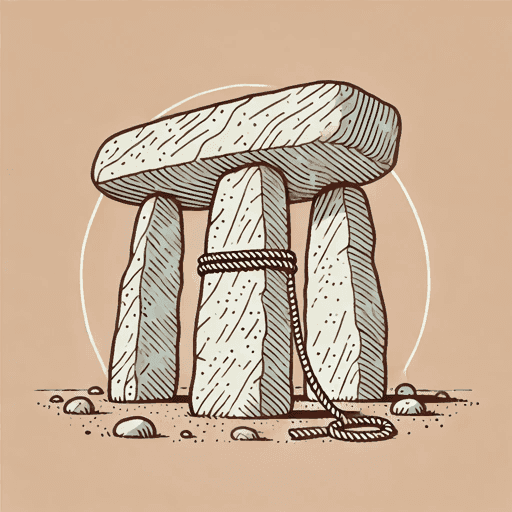
Near the chief, they halt and prostrate themselves. The chief raises his arm, and Barney realizes their goal: to move the capstone along a raised mound and place it atop three standing stones below. As dawn approaches, the chief urgently signals them to continue. The crew begins lowering the massive slab down the mound, with Barney and Stig manning the brake rope to prevent it from tumbling uncontrollably.
At the critical moment, Dinah runs beneath the descending stone. Lou follows, shouting a warning that there is a baby underneath, and vanishes from view. The stone begins slipping, dragging the brake-rope crew forward. Barney spots a scrubby thorn tree, and Stig grabs its trunk while gripping the rope. Barney wraps the rope end around the tree, halting the stone’s descent. Lou emerges carrying the baby. The chief shouts urgently, pointing at the lightening sky.
Barney releases the rope, and the great slab falls perfectly into place across the three uprights. At that precise instant, the sun breaks over the horizon, and the prehistoric world dissolves. Modern landmarks—church spires, farms, pylons, roads—reappear. The tribe, huts, and fires vanish, but the weathered standing stones remain.
Lou awakens against the stones, convinced it was a dream. Barney, feeling genuine exhaustion in his muscles, insists it was real. Walking to the stones’ entrance, he finds Stig still there, unlike the others. They catch Flash the pony and ride home half-asleep through the empty lanes with Stig walking beside them, falling into their beds to wake late on Midsummer Day.
The narrative jumps forward. During a family picnic at the stones, Barney’s parents debate their origin. Barney reveals that the stones were transported there using the “heave-ho” method, surprising everyone with his knowledge. Both children wonder aloud how the baby got there—a mystery no one can answer.
The chapter closes by suggesting that Stig has moved from the increasingly full dump. However, he is still occasionally sighted in the area, working at a car scrapyard and mending fences in the countryside.
Chapters 8-9 Analysis
In the final chapters, the novel’s fantastical elements draw on folklore and seasonal tradition, collapsing the boundaries between past and present entirely. King sets the climactic events on Midsummer Night, a time when, according to myth and legend, the veil between the human and supernatural worlds is thin. The novel draws on the tropes of time-slip fiction, as Barney and Lou notice the familiar landscape change: the well-known copse becomes a “deep forest” (137), and the chalk pit, the initial portal to Stig’s world, is now a mere “scratch in the ground” (138). These alterations in the setting convey the temporal shift as the children are transported from the modern world into a primeval past. The narrative presents this journey as a shared, tangible experience, providing the ultimate context for Stig’s existence and resolving the mystery of his identity.
These chapters clarify Stig’s symbolic function as a timeless, archetypal figure who bridges the past and the present. Barney’s early musing, “How old was Stig? About eight? Eighty? Eight hundred? Eight thousand?” (134), is reframed from childish speculation into a central thematic question. Within the prehistoric tribe, Stig is an integrated member of a community, demonstrating his connection to the origins of human society. His survival into the modern world, confirmed when he alone does not vanish with the sunrise, establishes him as an embodiment of enduring human resourcefulness. The standing stones, the permanent monument created during the night, echo Stig’s own permanence—like the stones, he is a living relic. The narrative’s conclusion, which describes sightings of Stig in modern scrap yards and rural back lanes, portrays him as a fundamental human spirit who adapts and persists, visible to those, like Barney, who are open to perceiving the ancient within the modern.
The stone-moving sequence brings the theme of Forming Unexpected Relationships Through Empathy to its full realization, expanding the connection between Barney and Stig to encompass an entire community. The tribe’s collective effort is coordinated by a primal, rhythmic chant and shared physical exertion. When Barney attempts to introduce modern, language-based problem-solving, Stig silences him by treading on his toe, a gesture that enforces the primacy of instinctual, non-verbal cooperation. This idea is further explored through Lou’s speech to the chief. Her oration, a patchwork of school assembly rhetoric, Shakespeare, and nursery rhymes, is received with approval. The success of her speech demonstrates that the intent and ritual of communication are more significant than semantic content. The tribe responds to the performance of respect and fellowship, not the literal meaning of her words, reinforcing that connection is built through shared values rather than a common language.
Barney and Lou’s supernatural experience resolves the theme of The Divide Between Childhood Perception and Adult Skepticism. Throughout the novel, Lou has occupied a liminal space, unwilling to believe in Stig’s existence until she confronts him face-to-face. Her journey into the past makes her a co-participant in Barney’s reality, validating his perspective. Lou’s presence at the stones upon waking confirms the event’s tangibility, distinguishing it from a private dream. In the final scene, this first-hand experience of history is contrasted with adults who debate the stones’ origins in abstract historical terms. When Barney states that “[it] was the heave-ho that did it” (173), his experiential knowledge eclipses his parents’ academic speculation. The narrative privileges the children’s direct, magical perception over the adults’ detached, rational analysis, affirming a worldview rooted in wonder and the acceptance of the inexplicable.

Unlock all 44 pages of this Study Guide
Get in-depth, chapter-by-chapter summaries and analysis from our literary experts.
- Grasp challenging concepts with clear, comprehensive explanations
- Revisit key plot points and ideas without rereading the book
- Share impressive insights in classes and book clubs