The Diamond as Big as the Ritz
49 pages • 1-hour read
F. Scott FitzgeraldThe Diamond as Big as the Ritz
A modern alternative to SparkNotes and CliffsNotes, SuperSummary offers high-quality Study Guides with detailed chapter summaries and analysis of major themes, characters, and more.
Symbols & Motifs
Content Warning: This section of the guide includes discussion of racism, emotional abuse, physical abuse, and death.
Diamonds
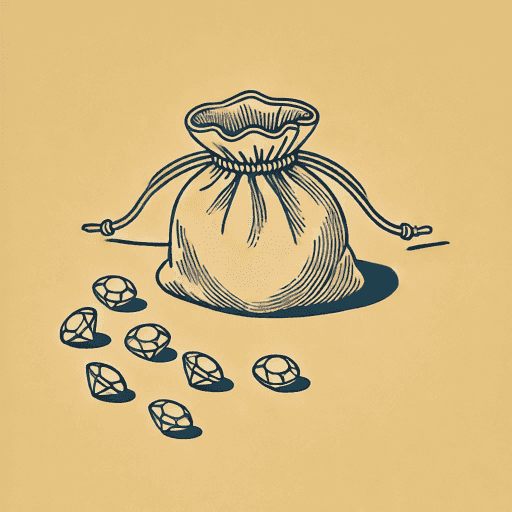
Diamonds represent the seductive brilliance and inherent emptiness of extreme wealth. On a literal level, the Washington family’s fortune derives from a mountain composed almost entirely of diamond, an exaggeration that pushes material abundance beyond plausibility. Symbolically, this excess strips diamonds of their conventional associations with value, romance, and permanence. Instead, they become instruments of isolation and moral decay, illustrating Wealth as a Destructive Force. The narrative emphasizes this paradox when Percy explains that the diamond’s value cannot be calculated because selling it would collapse global markets, leaving Braddock Washington “the richest man that ever lived—and yet was he worth anything at all” (107). Wealth, like the diamond, exists in overwhelming quantity but resists meaningful use.
The Chateau
The Washington chateau represents the artificial construction of perfection and the fragility of The Illusion of the American Dream. Rising from the edge of a lake and embedded into the mountainside, the chateau appears timeless, harmonious, and organically integrated into its surroundings. Yet its splendor is entirely manufactured and performative. Designed with cinematic excess, filled with impossible materials, and maintained through secrecy and coercion, the chateau functions as a physical manifestation of the Washingtons’ worldview, which prioritizes luxury over ethics. Its rooms—lined with gold, diamonds, and precious stones—place spectacle over function, reinforcing the idea that wealth exists primarily to be seen.
The destruction of the chateau exposes the hollowness of this illusion. When it “literally threw itself into the air” and collapsed into a “great featureless pile” of marble dust (136), the estate’s grandeur evaporates instantly. The understated description of its ruin emphasizes how little remains once illusion is stripped away. The chateau’s collapse mirrors the collapse of the Washington empire itself, underscoring the unsustainability of the family’s wealth and excess.
Airplanes
Airplanes, or “aeroplanes” in the text, are a symbol of oversight, visibility, and the inescapable threat of exposure in a world built on secrecy. Their very existence threatens the Washingtons because they undermine the family’s ability to remain unseen. Percy explicitly identifies airplanes as the one danger his father truly fears, acknowledging that the family’s immense resources are devoted to preventing aerial discovery through anti-aircraft guns, surveillance, and violent deterrence. In this way, airplanes symbolize the limits of absolute control in an increasingly interconnected world, implying that as the world modernizes, the type of secrecy and isolationism that the Washington family practices will no longer be an option.
The final aerial assault confirms the inevitability of oversight and the collapse of the secret world of the wealthy. When the planes determine that the Washingtons have “no further resources” (130), they land, marking the end of a regime that relied entirely on concealment. The novella thus uses airplanes to illustrate the central irony that wealth so vast that it must remain hidden is inherently unstable and susceptible to exposure.
Luxury and Sleep
Luxury and sleep operate together as a motif of passivity and moral disengagement. The narrative repeatedly presents extreme comfort as something that dulls awareness and suppresses resistance, creating an atmosphere in which characters are physically relaxed and ethically unconscious. John’s first experiences at the Washington estate involve being bathed, dressed, and fed without effort, often while he remains motionless or drowsy. He “lay quietly” as people remove his clothing and later drifts into sleep amid jewels, fabrics, and wine that “blurred before his eyes into a sweet mist” (102-3). These scenes link indulgence directly to surrender, suggesting that luxury is more than just pleasure; it is a mechanism of control.
Sleep reinforces this dynamic by rendering characters vulnerable and compliant. Guests are drugged while sleeping, the estate operates silently at night, and John narrowly avoids execution only because an external disturbance interrupts the routine of murder under the cover of night. The text repeatedly associates sleep with danger rather than rest, implying that those who allow themselves to be lulled by comfort become easy to manage. Even John’s moral hesitation is repeatedly postponed by physical exhaustion and sensory overload, illustrating how wealth delays ethical reckoning by keeping its beneficiaries docile.
By pairing luxury with sleep, the novella critiques the way extreme wealth produces a dreamlike detachment from reality. Comfort becomes anesthetic, allowing violence, enslavement, and murder to coexist seamlessly with beauty and refinement. The motif culminates in John’s final disillusionment, when sleep becomes less a product of indulgence and more a fragile escape from consciousness itself. In this way, luxury and sleep together reveal how wealth both corrupts and tranquilizes.
Captivity
Captivity recurs throughout the novella in multiple forms, revealing how control is central to the maintenance of wealth. The most overt example is the enslavement of Black people on the Washington estate, who are kept isolated, manipulated, denied freedom, and subjected to rigid discipline. The novella’s language—filtered through the Washingtons’ perspective—emphasizes how normalized this system has become, presenting enslavement not as a moral violation but as an administrative necessity. This normalization exposes The Role of Exploitation in Building and Maintaining Wealth, in which human lives are reduced to property.
The motif extends beyond enslavement to include the imprisoned aviators, whose captivity demonstrates that anyone who threatens secrecy becomes expendable. Even John experiences a subtler form of captivity as a guest who gradually realizes that he cannot leave alive. The novella presents captivity as a spectrum rather than a single condition, illustrating how systems of wealth rely on varying degrees of manipulation, coercion, and silencing. The motif reinforces the novel’s idea that secrecy-driven power structures cannot tolerate autonomy, requiring constant containment of both bodies and knowledge.

Unlock the meaning behind every key symbol & motif
See how recurring imagery, objects, and ideas shape the narrative.
- Explore how the author builds meaning through symbolism
- Understand what symbols & motifs represent in the text
- Connect recurring ideas to themes, characters, and events