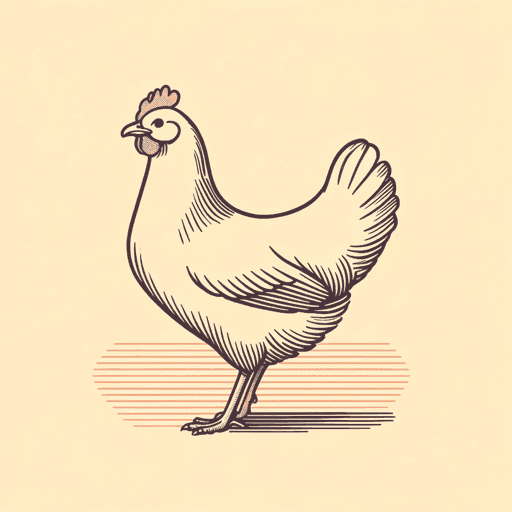
The Hen Who Dreamed She Could Fly
37 pages • 1-hour read
Sun-Mi HwangThe Hen Who Dreamed She Could Fly
A modern alternative to SparkNotes and CliffsNotes, SuperSummary offers high-quality Study Guides with detailed chapter summaries and analysis of major themes, characters, and more.
Chapters 5-8Chapter Summaries & Analyses
Chapter 5 Summary: “A Farewell and a Greeting”
Straggler brings Sprout a fish every day. When the moon is bright, he performatively flaps his wings, quacks, and runs around. Sprout talks to the egg or sings it lullabies.
Sprout asks why Straggler dances every night. She also asks where the white duck is and what happened to Straggler’s right wing; Straggler becomes angry and tells Sprout not to talk about it. He warns Sprout that the weasel gets hungry when the moon wanes. Sprout works out that Straggler’s demonstrations at night are because of the weasel. She wonders why he would risk his life for her.
Straggler tells Sprout that she’s a wonderful mother. Sprout plans to tell Straggler that it isn’t actually her egg but then doesn’t. They discuss the fact that the egg will hatch soon.
Straggler seems to go to sleep, rather than dancing as usual, with his head under his wing and whispering to himself. In the middle of the night, Sprout is startled by Straggler screaming. The weasel breaks his neck and takes him into the night, giving Sprout a terrifying, cold stare before going.
The egg hatches in the morning. Sprout is delighted and amazed, embracing the tiny creature, whom she calls Baby: “Baby, you’re here!” (59).
Chapter 6 Summary: “A Disgrace to the Comb”
Sprout leads Baby toward the barn. The animals are surprised that she has a chick. Sprout notices that the other chicks are yellow, whereas Baby is brown; she assumes that Baby will change color in time, but then the rooster calls Baby a duckling.
Suddenly, Sprout understands that she was roosting the white duck’s egg and that Straggler was the egg’s father and gave his life so that Baby could live. She realizes that Straggler’s advice to go to the reservoir, not the barn, was to avoid the weasel.
The other animals mock and insult Sprout for hatching a baby of another kind. The farmer and his wife are pleased that a well-fed hen and a duckling have appeared in the yard and suggest putting them in the barn. The animals in the barn are divided about this: The hen worries that the strange situation will be a bad influence on her chicks, but the ducks argue that the duckling should stay.
Sprout overhears the farmer telling his wife that they should boil Sprout for dinner and clip Baby’s wings the next day, so Sprout and Baby creep out of the barn at dawn, heading for the relative safety of the reservoir.
Chapter 7 Summary: “Certainly a Duck”
Sprout and Baby stop to rest on the way to the reservoir. The ducks come across them and admonish Sprout for taking Baby away. The leader assures Sprout that having Baby’s wings clipped wouldn’t hurt him and would stop him from flying away, but Sprout refuses.
After finding a good hiding place among a thatch of reeds, Sprout starts making a nest. She’s nervous when Baby excitedly hops out across lily pads into the middle of the reservoir but relieved to see that he’s able to swim when he falls in.
Baby grows, continuing to become a stronger swimmer. He sleeps under Sprout’s wing each night. She fears the weasel and often has sleepless nights keeping watch.
The leader of the ducks follows Baby back to Sprout and Baby’s nest and happily announces that Baby is growing up strong and knows the ways of ducks despite not being raised by them. His superior tone irritates Sprout, but Baby looks at him with interest. Sprout tells the duck to go away, lest he attract the weasel to their hiding place.
Sprout decides that given the ruckus the duck made near their hiding place they should leave. She destroys their nest and leads Baby into the trees, digging a hole for them to sleep in. During the night, Sprout watches the weasel go to their old hiding place, attacking and eating a mother reed warbler and her unhatched eggs.
The next morning, Sprout is upset to see the devastation of the reed warbler’s nest and the grief of the male reed warbler. Baby swims.
Chapter 8 Summary: “Joining the Brace”
Rains flood the reservoir, and Sprout struggles to find dry spots for them to sleep. She’s thin and sick from all the moving around and the dampness. Meanwhile, Baby, who Sprout names Greentop, continues to grow. He sometimes seems moody but won’t confide in Sprout.
They go to a cave to sleep. Suddenly, the weasel appears. Sprout runs to confront it, ready to sacrifice her life to save Greentop, who is flapping his wings in fear and fright. Sprout launches herself at the weasel, who wants Greentop, not scrawny Sprout, and the two roll down the hill together. Sprout is badly scratched and pecks at something soft on the weasel. The weasel retreats.
Greentop calls from above: He’s flying. He comes down and embraces Sprout lovingly. He confides in his mother that he wants to join the other ducks in the barn. Sprout, distraught, tries to convince him to stay, reminding him of how much they love each other. She watches from a distance as Greentop tries to join the ducks, but they exclude him; he trails after them.
Chapters 5-8 Analysis
This section explores The Self-Sacrificial Nature of Parenting as a theme, first through Straggler’s sacrificing himself to the weasel to save his unhatched child. The text again uses dramatic irony by emphasizing Sprout’s naivete; she wonders what Straggler means when he whispers to himself, “I’m okay. If he’s full he’ll be quiet for a while. It’s okay, as long as the egg hatches. I’m ready” (57). The text conveys that Straggler intentionally makes himself vulnerable by sleeping (or pretending to sleep) where the weasel will see him, essentially saving Baby by ensuring that the weasel’s belly will be full for enough time to allow Sprout and her adopted baby to escape the area.
Likewise, Sprout demonstrates self-sacrificial behavior, which typifies her as a loving and selfless mother. She channels Straggler’s strength of character in these moments, such as when she determinedly leaves the barn to save Baby and herself: “Sprout asked Straggler to give her courage. She had to protect Baby until he was grown” (75). The text establishes Sprout and Straggler as the parental team who protect and raise Baby, given the white duck’s premature death. Sprout jeopardizes her own health to continually move her nest each night, protecting Baby from the weasel. The selfless nature of motherhood is evident in the symbolism of Baby growing and strengthening through Sprout’s efforts, as Sprout herself languishes: “She suffered from a continuous cold. She had become very thin because they changed nests every day and she didn’t sleep well at night. Still, Baby was growing and looking quite duckish, a little more like Straggler every day” (89). Sprout obviously justifies her ailing health as an acceptable and necessary sacrifice for Baby’s continued growth and safety.
Sprout reacts with admirable courage when the weasel threatens Baby. Although she’s an old, thin chicken at this point, Sprout determinedly confronts the terrifying antagonist: “Sprout tensed her claws. She could sense the shadow of the frightening hunter approaching” (83). This moment dramatically illustrates her commitment to prioritizing Baby’s life and well-being over her own, as she’s prepared to sacrifice her own life to ensure his survival: “‘Don’t you dare!’ she threatened, prepared to die” (91). Sprout reflects on Straggler’s death and the hatching of Baby the next morning: “Sometimes a farewell and a greeting happened at the same time” (59). This reflection thematically refers to Nature’s Cycle of Death and Rebirth; Straggler dies to help ensure that the egg hatches safely and that Sprout and the hatchling can escape the weasel if necessary. Again, the text foreshadows Sprout’s death, once her role of raising Baby is concluded, to help ensure the survival of the baby weasels.
These chapters continue to emphasize the conformity of the farm animals to strict rules and how their behavior contrasts with Sprout’s independence; they mock her for hatching Baby, a duckling: “‘I’ll say,’ the dog taunted. ‘A chicken hatching a duck! What a ridiculous sight!’” (66). The farm animals are narrow-minded, accepting behavior and family structures established as normal in their highly regulated, human-controlled community, while fiercely mocking and rejecting all others for behavior that differs, such as Sprout’s escape from her role as an egg-laying hen in the coop and her raising of Baby the duckling. The novella continues to make allegorical comments on human nature via the conservative concerns of the barn animals, particularly the hen, who selfishly wants to exclude Sprout and her baby from the safety of the barn in order to protect her chicks from Sprout and Baby’s allegedly alarming presence:
‘I’m also worried about the chick’s education. I know they’ll keep asking, “Why does he quack and call a hen Mom? Why is he different from us?” Some of them might even quack. I can’t raise my chicks in a chaotic environment like that’ (68).
The hen’s concerns satirize conservatives who oppose same-sex marriage, transgender rights, often citing the need to protect their children from purported social “chaos” to defend their biases and desire to exclude minorities from society.
In addition, the text reveals that Baby’s growing independence is distressing to Sprout. Her distress explores the challenges inherent in parenthood, as children, who were once completely reliant on their parents, grow into independence, which can leave parents feeling bereft and empty, especially if their children’s choices are challenging or unexpected, like Baby’s desire to join the brace of ducks. Thus, the purpose and happiness that Sprout gained in becoming Baby’s mother is threatened by his increasing independence: “Her baby had grown up too fast. Sprout was restless all night. She didn’t know what to do. She was useless now, even as a protector, since the weasel didn’t come looking for them anymore” (96). Sprout feels “useless” because she shaped her identity around her role as a mother. Her distress is compounded by witnessing Baby’s cruel rejection by the ducks, which continues to illustrate the conservative values of the farm animals, who resent challenges to traditional roles: “They were cold to him. They yelled at him. The leader even attacked him. But Greentop kept hanging around” (96).

Unlock all 37 pages of this Study Guide
Get in-depth, chapter-by-chapter summaries and analysis from our literary experts.
- Grasp challenging concepts with clear, comprehensive explanations
- Revisit key plot points and ideas without rereading the book
- Share impressive insights in classes and book clubs