The Knight and the Moth
62 pages • 2-hour read
Rachel GilligThe Knight and the Moth
A modern alternative to SparkNotes and CliffsNotes, SuperSummary offers high-quality Study Guides with detailed chapter summaries and analysis of major themes, characters, and more.
Part 3Chapter Summaries & Analyses
Content Warning: This section of the guide includes discussion of graphic violence, death, physical abuse, emotional abuse, and sexual content.
Part 3: “The Seacht”
Part 3, Chapter 10 Summary: “Young, and Rather Old”
Six struggles to ride Rory’s horse, Fig, as she’s never been on horseback before. He tries to tell her to relax and hold onto him, but Six feels uncomfortable—she now believes Rory to be the Artful Brigand due to his possession of the coin. She hopes that there is an alternate explanation, as Rory seems to be flesh and blood.
Rory and Six reach the bridge into the Seacht that crosses the Tenor River. Rory approaches the scribe at the tollbooth to pay for their crossing. The scribe sees Six’s Diviner shroud and asks her if his spilled ink is a good omen. Six gives him a vague answer, which pleases him.
The bat-like gargoyle lands from the sky, and Six takes it to look in the river. They see a sprite, and Six reaches out to it, but it bites her. The scribe pours ink on the sprite, burning it, as he explains to Six that the sprites eat the plant that the scribes use to make their scrolls, but ink is poisonous to them. Six thinks it’s wrong to deprive the sprites, who are clearly starving. Rory throws some scroll paper to the sprite, much to the scribe’s chagrin, and then the group passes over the bridge and into the hamlet.
As Rory, Six, and the gargoyle walk across the bridge, people stare at Six because of her Diviner shroud. Rory tells her to take it off, but she refuses. Rory asks her what she saw when she divined for him, but the coin makes her mistrust him, so she doesn’t say. He asks her how long she’s been a Diviner, and she tells him that she’s been at Aisling for almost 10 years, though she doesn’t remember anything from before that time, nor does she know how old she is. Rory is 26, and he thinks that Six looks about his age.
When they reach the Seacht, Six notes how meticulously laid out the hamlet is, especially in contrast to the haphazard tents of Coulson Faire. Everywhere, people are manufacturing parchment. Rory finds it shocking that a hamlet so steeped in the keeping of knowledge and history still believes in the Omens, but Six thinks that people can be more than one thing at once. They walk past a school for foundling children. Six realizes that this is where the Diviners are chosen from and is where she or her fellow Diviners could have come from.
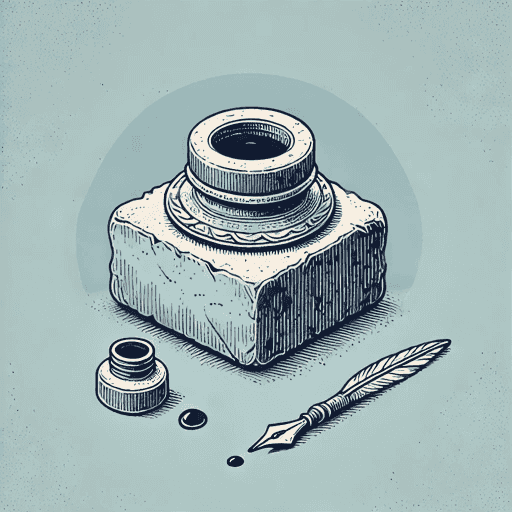
The trio bumps into Benji and Maude. Rory is upset that they planned to visit the man they were looking for without Rory. Six and the gargoyle insist on going to see the mysterious person with them, so Maude and Benji lead the way. After a long walk down a corridor, they open a door to a windowless room with a glass dome, the walls lined with bookshelves. In the middle of the room, a man reclines on a rug. He looks up with stone eyes and has a stone inkwell in his hand.
Part 3, Chapter 11 Summary: “The Harried Scribe”
Six is in shock that she’s looking at the Harried Scribe, especially given that he appears mortal apart from his stone eyes. Six notes that he seems like a mere man, but the Harried Scribe uses his inkwell to magically appear in front of her, noting that he wields both magic and knowledge like a god.
Benji tells the Harried Scribe that he’s seeking to take up the mantle and has come to challenge the Harried Scribe at his craft. The group offers to be at the Scribe’s mercy if they fail; if they win, they earn the inkwell. The Scribe accepts before using the inkwell to grab Six and transport her with him to the top of one of his bookshelves.
Six scrabbles for purchase on the shelf before asking the Scribe what taking up the mantle is. The Scribe explains that it is when the king decides to obtain all five stone objects and take the power of the Omens for himself. The Scribe’s craft is knowledge, so he will ask Rory, Maude, and Benji three questions. To win, they must answer one question correctly and then ask the Scribe a question he cannot answer. Six wants to get down, but the Scribe refuses. He sniffs Six’s neck and remarks that Aisling has never sent him a Diviner like this; he’s never felt a Diviner’s pulse.
The Scribe asks questions oriented around the virtues of the knighthood: love, faith, and war. The first question he poses is “[W]hat, according to the Seacht’s poet laureate, Ingle Taliesin, does a king gift his bride upon their wedding night?” (134). Benji answers with a dower of land and wealth, but the answer is his penis, as the poem is meant to be sexual and satirical. The second question asks for the name of the first Diviner, the foundling child who journeyed to Aisling in the spring. The trio doesn’t know the answer, as the name has never been spoken. The third question is based on a poem that the Scribe wrote himself, which describes a weapon. The Scribe asks what the weapon is, and both Six and Rory realize that it’s the hammer and chisel, the very object that Six brought with her from Aisling. Benji answers correctly, which upsets the Scribe.
For their question, the trio asks the Scribe what Six’s name is. The Scribe cannot answer, and when he realizes that he’s lost, he begins using his inkwell as a weapon, flinging ink on the trio to burn them. Six manages to knock the inkwell out of the Scribe’s hand, but he cuts her. He says that he can smell Aisling’s waters in Six’s blood, and he licks her blood off the floor before trying to pull her closer by the ankle.
Rory grabs the Scribe and uses the coin to make the Scribe explode into chunks of flesh and stone. Six asks him again about the coin, and Rory tells her that he killed the Artful Brigand five days prior; he is not an Omen—he is killing them.
Part 3, Chapter 12 Summary: “Our Feet Will Take Us Where We Need to Go”
Rory doesn’t stop Six as she runs out of the Harried Scribe’s lair. The gargoyle follows her without question, and they make their way through the Seacht. Six says that she needs time to think. They stop, and Six reflects on her previous beliefs about Aisling and the Omens. She previously thought that she was better than the gargoyle and better than other people because of her status as a Diviner. Now, she wonders what is even true and where she fits in the world. Six and the gargoyle find an abandoned forge to sleep in.
Six wakes, and the gargoyle has stolen food for her. She eats, and then they set out into the Seacht again. As night falls, Six sees poverty for the first time. Despite no longer being insulated from the world, she and the gargoyle feel content. They make their way to a foundling school, and Six questions the schoolmaster about the other Diviners. The schoolmaster mentions an investment by the abbess but not any of the other Diviners.
Six and the gargoyle visit the other foundling schools, but no one there has seen the other Diviners, either. Discouraged, Six tells the gargoyle that she thought the people of Traum would love her and the other Diviners for their work, but she realizes that they’ll only ever view the women as holy, not human.
Two young girls pass by the alley, and Six watches as a group of men follow them with bad intentions. Six and the gargoyle confront the men, and it turns violent. Six and the gargoyle beat the men up before running away. They are stopped by guards, who tell Six that there is a warrant out for her arrest. They take Six and the gargoyle to a walled compound.
Inside, Six finds the king’s knights, including Rory. The guards tell Rory that Six was brawling with men in the streets, and Six explains that she was defending two girls. Rory questions why she’s still here, as she and the gargoyle could’ve escaped. Six wants to know more about the Omens, and Rory promises to tell her after a bath and some rest.
Part 3, Chapter 13 Summary: “Take Up the Mantle”
After a bath and fresh clothes from Maude, Six goes to speak to the king. He speaks as if he feels uncertain, demonstrating his youth and inexperience. He explains that the five stone objects have transportive powers and destructive powers and that he seeks to collect them all. Benji shows Six the journal of his grandfather, King Benedict Castor the First.
Benji tells Six the history of Traum. Two hundred thirty years ago, before the construction of Aisling Cathedral, five craftsmen came to the tor: a merchant, a scribe, an oarsman, a forester, and a weaver. Traum was in chaos, as there was no ruler, and the five people could not agree who should rule. A sixth figure came with a foundling child and brought the five people to drink from the spring, to enter a strange dream. The sixth figure, the Moth, gave the other five their stone objects.
Benji reveals that the sixth figure is the abbess. Six is shocked, but Benji explains that the Omens are identifiable by their stone eyes, and the abbess keeps her entire face covered. He reveals that the Omens were made; they were simply mortals who drank from Aisling’s spring. Part of the abbess’s story is true; a foundling child did enter the spring, leading to the practice of divination, and the Omens do dwell in their chosen hamlets. However, they are not as godlike as people believe.
King Benedict the First was obsessed with the history of Traum, and he sought to discover if the Omens were real. He found Rory in the streets of Coulson Faire, a thief working for the Artful Brigand. The Artful Brigand was boastful and told Rory about how the Omens can live forever if they drink the spring’s water; the abbess pays them to lurk in the hamlets and live as watchful gods.
Benedict told Maude, who was also his knight, and she killed the Faithful Forester for him. He then sought to destroy the rest of the Omens, starting with the Artful Brigand. The nobles didn’t like Benedict’s implication that the Omens were a lie, so they accused him of taking up the mantle. He was forced to endure divination with five bad portents before he was stoned to death.
Six asks Benji if his grandfather wrote anything about what happens to Diviners, but his grandfather did not discover the truth about them, though Benji worries that the Diviners could turn to stone. He asks Six to help him overthrow the old gods and dismantle Aisling and the system of divination. Six’s role as a Diviner will help keep suspicion off Benji, as people won’t suspect him of heresy if he’s with her. He offers to send 10 knights to search for the missing Diviners, and he says that Six can search herself as they travel through the hamlets to find the remaining Omens. Six tells him that she’ll think about it, but when she sees Maude afterward, she tells the knight that she’ll join them.
Six goes outside and watches Rory spar. She finds the sight of him fighting another knight in the dirt filthy and ignoble, but she can’t look away. Rory asks her if Benji answered her questions, and Six says that she will join them in their quest. Rory tells Six that he will fit her with armor.
Part 3, Chapter 14 Summary: “Wax”
Rory takes Six to the forge to make a wax mold of her body to send to Petula Hall, Maude’s home in the Chiming Wood, so that the blacksmith can make Six custom armor. Rory mentions Hamelin, and Six admits that she didn’t have sex with him—she only wanted to upset Rory, who apologizes for being rude and antagonistic toward her.
Rory cleans Six’s mouth cut from the Harried Scribe’s attack. He touches her lip sensually and asks her about the street brawl. Six reiterates that she sought to protect the young girls from the men, and Rory agrees that young girls are vulnerable in society, hinting at his disdain for Aisling’s abuse of foundling girls. Six reflects and realizes that the abbess starves the Diviners for affection, giving them just enough to keep them loyal and supplicant. Now, Six only thinks that she’s lovable if she’s useful.
Rory sews Six’s Diviner dress tightly to her body. As he sews, Six asks him about his earrings, which seem to be from Coulson Faire, and the charcoal around his eyes, which seems to be from the Chiming Wood. Rory tells her that he lived with the Artful Brigand in Coulson Faire as a child and later with Maude in the Chiming Wood. He was knighted even though he was not a nobleman.
When he finishes sewing, Rory begins pouring the hot wax over the dress. When he kneels in front of Six to mold her legs, the energy in the room becomes sensual. Though Six attempts to tell Rory that she doesn’t like him, Rory tells her that her desire to denigrate him stems from her desire for him. He leaves the rest of the molding for Maude to finish.
Part 3 Analysis
The Seacht chapters of The Knight and the Moth continue the development of the theme of The Influence of Faith, as they finally reveal the truth about the Omens. Six encounters an Omen when Rory, Maude, and Benji challenge the Harried Scribe. The physical manifestation of the Harried Scribe and his human-like appearance fracture Six’s faith. The efficacy of the Omens stems from their absence, as Six notes, “Gods that couldn’t be seen, even in dreams, were effective. You never knew when they were watching” (113). At the beginning of the narrative, Six feels as if the Omens are always watching her. When Six faces an Omen for the first time, she realizes that the Omens seem mortal, though they have stone eyes. This confrontation and the physicality of the Scribe challenge Six’s faith as never before.
The stone eyes are a marked difference, but in these chapters, the Harried Scribe is revealed to be otherwise just a man. Six’s fealty to the Omens is challenged, even as the Harried Scribe attempts to assert his control over Six, telling her, “You belong to Aisling. To the Omens. That’s what I know, and what I know is ever the truth” (137). The Harried Scribe truly believes that he’s a god and that his knowledge is the uncontested truth. However, Six’s faith cracks under the realization that the gods can lie and perhaps even are a lie. The gargoyle further complicates Six’s understanding of the truth, telling Six, “Even your dreams may not show you the truth […] I cannot remember it ever being proven that gods are more honest than anyone else” (143). The gargoyle knows the truth about the Omens, and though he cannot say it, he hints at it. The gargoyle suggests that the gods can lie and that Six should not trust the gods or her dreams in the spring, undermining the very foundations of her disintegrating faith.
Six’s crisis of identity intersects with her crisis of faith, developing the theme of The High Cost of Power. As she discusses her experience with the Harried Scribe with the gargoyle, she states, “We will only ever be Diviners. […] People will want us without ever wishing to know us. A daughter of Aisling is not a real daughter, just as the abbess is not a real mother. Diviners are but the tools of the craft of Divination. Holy, not human” (148). Six doesn’t know where she belongs in the world or who she is outside of Aisling Cathedral. People only see her as a sacred relic, a tool by which they can glimpse into their futures. Six does not feel like a real human being, nor does she know how to act like a real human being. Her tenure in Aisling has kept her from learning how to exist in the world and engage with others, demonstrating another cost of her use of magic. Divination has cost Six her identity.
Gillig also examines the idea of power and its corruption through the character of Benji, connecting to the theme of The Powers of Fate and Free Will. After their encounter with the Harried Scribe, Benji tells Six that she “believed a story, and that story was a lie. The Omens are not divine. They are mortals who are paid like kings to live like gods. Imagine where all that money for Divination might go if it wasn’t spent filling Aisling’s coffers or wasted in the hamlets on the Omens” (168). Benji clearly outlines the corruption of the entire societal structure of the Stonewater Kingdom: Divination is not real, the Omens are not gods, and all the money that funds the religious system is kept by the same religious system. The abbess, the sixth Omen herself, has crafted a system in which everything she wants to happen is “fated,” which keeps her in control of the entire kingdom. She has convinced the people of the kingdom that divination is real, charges them heavily for it, and then uses that money to further enrich herself, doling out some of the money to the other Omens to keep them loyal and satiated, willing to continue play-acting as gods to keep the system running. Six begins to realize that her work as a Diviner, which she has committed to despite its inherent pain, is not fate, as the abbess would have her believe, and this revelation leads her further along her journey toward independence and free will.

Unlock all 62 pages of this Study Guide
Get in-depth, chapter-by-chapter summaries and analysis from our literary experts.
- Grasp challenging concepts with clear, comprehensive explanations
- Revisit key plot points and ideas without rereading the book
- Share impressive insights in classes and book clubs