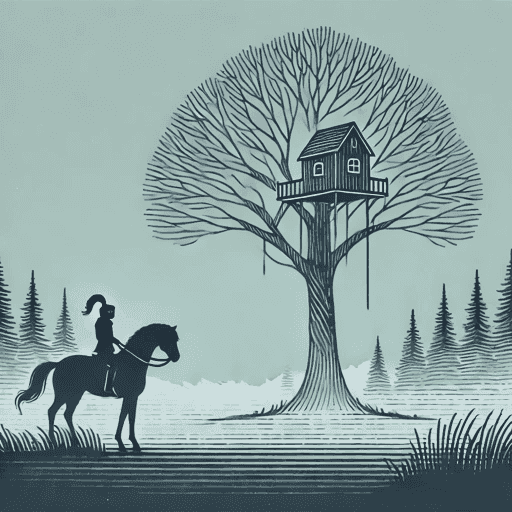
The Knight at Dawn
38 pages • 1-hour read
Mary Pope OsborneThe Knight at Dawn
A modern alternative to SparkNotes and CliffsNotes, SuperSummary offers high-quality Study Guides with detailed chapter summaries and analysis of major themes, characters, and more.
Background
Series Context: The Magic Tree House Series
The Knight at Dawn is the second book in Mary Pope Osborne’s Magic Tree House series of historical fiction adventures for children. The series contains over 40 novels, and Osborne has also published several nonfiction supplements called Fact Trackers, including a companion piece to this novel entitled Knights and Castles.
The Knight at Dawn builds upon the series’ debut, Dinosaurs Before Dark, in which Jack and Annie first discover the time-traveling tree house and journey back to the Cretaceous Period. The Knight at Dawn begins after they return, early the next morning. Although Annie is eager for more adventures, the siblings’ recent encounter with the Tyrannosaurus Rex makes Jack hesitant to return to the tree house at the start of this story.
The first four books of the series explore the Mystery of the Tree House, a longer story arc in which Jack and Annie put together clues to discover the magic tree house’s creator. Each presents an adventure in which Jack and Annie travel to a different time period, and these individual stories are linked by the siblings’ search. In The Knight at Dawn, Jack finds a bookmark that matches the gold medallion he and Annie discover in Dinosaurs Before Dark. The initial ‘M’ on both objects foreshadows the eventual revelation that Morgan Le Fay, the sorceress from the Arthurian legends, built the magic tree house. In the fourth book, Pirates Past Noon, the shapeshifting enchantress introduces herself to the children and reveals that they have already met while she was in various guises, including the knight who helps the children in The Knight at Dawn, Henry the Pteranodon who rescues Jack in Dinosaurs Before Dark, the black cat who guides them out of a pyramid in Mummies in the Morning, and Polly the parrot, who leads them to safety in Pirates Past Noon.
As the second entry in the series, The Knight at Dawn helps establish some of the series’ familiar storyline patterns and develops Jack and Annie as characters. It also highlights the siblings’ relationship dynamic and how they differ, illustrating, with the contrast between Jack’s caution and Annie’s boldness, how very different people can work together as a team. The Magic Tree House books have been adapted into graphic novels, theatrical productions, and an animated film.
Historical Context: Courtly Life in Europe During the Middle Ages
Set in a medieval castle, The Knight at Dawn introduces children to historical concepts about life in the Middle Ages. This historical period lasted from about 500 to 1500 CE, beginning with the fall of the Roman Empire and ending with the start of the Renaissance. During the Middle Ages, feudalism shaped Europe’s social hierarchy and economy. In this structure, a lord bestowed a piece of land called a fief to a recipient known as a vassal, in exchange for military service. The fiefs were tilled by peasants, called serfs, who were bound to the land. In The Knight at Dawn, the duke who owns the castle is the lord, and the knights of his court are his vassals.
The period from the 11th to the 15th century is sometimes referred to as the Age of Chivalry, due to the prominent role of knights in society. The code of chivalry emphasized courage, loyalty, religious piety, and gentle manners. These ideals had a profound influence on literature, as seen in Arthurian legends by writers Geoffrey of Monmouth (The History of the Kings of Britain) and Chrétien de Troyes (Perceval, Yvain, Erec and Enide). The enchantress Morgan Le Fay appears in both of their writings and is a major figure in Osborne’s Magic Tree House books, indicating the lasting appeal of romanticized depictions of medieval knights and courtly values.
The novel offers a glimpse into the elite lifestyle of knights and nobles during the Middle Ages. For example, Chapter 4 contains a lavish feast in which jugglers and musicians entertain the duke and his guests. The diners enjoy a historically accurate meal, including a peacock served with its feathers. Wine, game meats like boar, and spices were other status symbols that adorned the tables of the wealthy during this era.
Annie and Jack’s adventure in this story also offers a tour of a medieval castle and its defensive structures, such as the moat. Although Jack and Annie fear that there are ravenous reptiles in the water, the idea of crocodiles in moats is a myth popularized by fiction. Instead, moats might be used to raise fish and eels for food in addition to their main defensive purpose. By weaving historical details into a fantasy adventure story, The Knight at Dawn reflects audiences’ continued fascination with the Middle Ages.

Unlock all 38 pages of this Study Guide
Get in-depth, chapter-by-chapter summaries and analysis from our literary experts.
- Grasp challenging concepts with clear, comprehensive explanations
- Revisit key plot points and ideas without rereading the book
- Share impressive insights in classes and book clubs