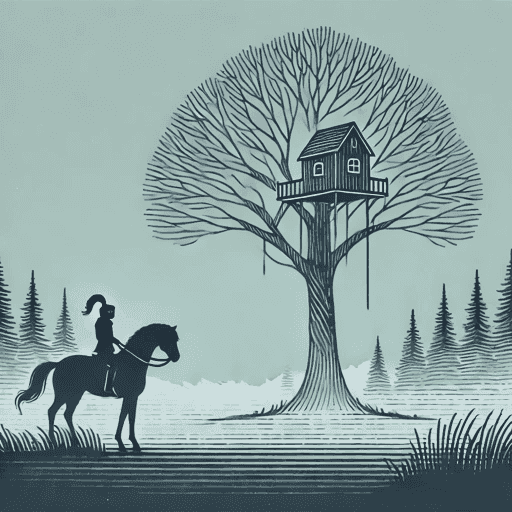
The Knight at Dawn
The Knight at Dawn
A modern alternative to SparkNotes and CliffsNotes, SuperSummary offers high-quality Study Guides with detailed chapter summaries and analysis of major themes, characters, and more.
Summaries & Analyses
Quizzes
NEWReading Tools
Themes
Learning Through The Excitement of Discovery
The Knight at Dawn blends historical fiction and fantasy to celebrate the excitement of discovery and the way that it opens up learning opportunities. One of the hallmarks of the Magic Tree House series is the way that Osborne educates her young audience about the places and time periods that Jack and Annie visit. In this story, she uses suspenseful chase scenes to provide a tour of a medieval castle’s armory, dungeon, storeroom, and moat. The pacing of the action and the inclusion of factual historical details reflect the author’s goal of teaching young readers the excitement of discovery.
Osborne also uses the longer arc of the Mystery of the Tree House, which develops over the first four books of the series, to explore this theme through the siblings’ search for the identity of the time-traveling tree house’s creator. For instance, Jack feels a thrill when he discovers the connection between the medallion and the bookmark: “Now this was an amazing new fact” (56). The clues that Jack and Annie gather in their first trips to the tree house point the way to even greater revelations and accomplishments later in the series. This long arc infuses the novel with an additional sense of discovery as Annie and Jack piece together clues, taking on the role of investigators.
The novel also highlights how the excitement of discovery is connected to learning through direct experience, through Jack’s gradual embrace of this new way of learning. At the start of this novel, Jack is still trying to make sense of this discovery and the new possibilities the tree house opens. His hesitation to reenter the tree house in Chapter 2 illustrates his characteristic reticence to engage in new experiences. This trait is further demonstrated by his rapt attention to the book about castles even when there’s a real castle right in front of him: “‘Look at the real one, Jack,’ said Annie. Not the one in the book’” (19). At the beginning of the novel, Jack sees reading as a safe and inviting way to broaden his knowledge, even when it means he is missing out on real life.
However, Jack’s adventure in the castle helps him gain the confidence he needs to discover things first-hand, instead of through a book. For example, he feels the thrill of discovery through his amazement at the medieval celebration: “‘The feast in the Great Hall!’ whispered Jack. He held his breath as he stared in awe” (25). Although Jack is an observer of the feast rather than a participant, the scene marks an important development in the theme and Jack’s characterization. He takes another step forward in Chapter 5, when he tries on the helmet, engaging with the piece of armor in real life and observing its weight for himself. His new-found excitement over learning through discovery and direct experience culminates when Jack rides on the knight’s horse, a thrilling and inspiring moment that makes him hungry for more new adventures: “[Jack] felt as if he could ride forever on this horse, with this mysterious knight, over the ocean, over the world, over the moon” (49). The excitement of discovery encourages Jack to venture beyond his comfort zone, empowering him to gain remarkable experiences and valuable lessons.
Through Jack’s transformation, Osborne illustrates the joy of learning through discovery, and by taking readers on a tour of a medieval castle alongside Jack and Annie, she seeks to bring that same understanding to her audience. By combining entertaining adventure stories, educational historical fiction, and elements of fantasy and mystery, Osborne aims to illustrate how the excitement of discovery intersects with the joy of learning.
The Value of Teamwork and Problem-Solving
In The Knight at Dawn, Jack and Annie are siblings, but they are also a team. At first, they appear to be an unlikely match because they are so different. However, through their adventures, Osborne explores the importance of teamwork and problem-solving by showing how they work together and using their differences to balance each other. Thus, the novel emphasizes that the ways they are different are part of the reason that they work so well together.
Osborne emphasizes the value of teamwork and problem-solving by giving Jack and Annie very different, but complementary, personalities. Annie is imaginative and outgoing, whereas Jack is shy and prefers facts to fantasy. He likes to think things through, while she prefers to charge ahead. Initially, these differences cause some frustration between the two characters, such as when Annie asks the tree house to take them to the Middle Ages without consulting her brother first. However, Osborne shows that the siblings’ contrasting qualities can be a strength, as both characters’ skills are necessary for the children to achieve success. For example, the methodical Jack finds the secret passage because he takes the time to consult the book; when Annie is in a rush, saying, “We have to go! […] Before they come back!” Jack takes a characteristic moment to look at a map and slows her down, pointing out a trapdoor (50). Likewise, Annie solves a problem in a creative way that would not have occurred to Jack when she frightens the guards with her “magic wand”: “Annie fiercely pointed her light at Squinty, then at Mustache, and then at Red. Each howled and covered his face” (36). Osborne celebrates the value of teamwork and problem-solving by making both Annie’s quick thinking and imagination and Jack’s careful, studious approach essential to the children’s escape from the castle.
In addition to highlighting the children’s individual strengths and problem-solving skills, Osborne upholds the value of teamwork by giving Jack and Annie opportunities to cooperate. The siblings must work in sync to evade the guards and find an escape route. For example, the “slab of stone” that covers the trapdoor is too heavy for either of the children to move on their own (40), emphasizing the necessity of collaboration. The author further advances the theme when the children show each other loyalty and support as they make the frightening swim across the moat in Chapter 8. Jack encourages Annie to keep moving, and Annie helps Jack exit the moat safely: “‘Take my hand!’ said Annie. Jack grabbed her hand. She pulled him to the edge of the moat” (58). The knight’s role in facilitating the story’s happy ending also demonstrates the value of teamwork and problem-solving: Enlisting the help of a trustworthy adult allows the children to return to the magic tree house and, ultimately, their home.
Jack and Annie’s adventures show that people can solve problems more effectively when they work together and value each other’s strengths. With their example, Osborne shows young readers that teamwork comes from an understanding and celebration of different skills and talents, as well as a willingness to collaborate.
The Journey Toward Overcoming Fear
Over the course of The Knight at Dawn, Jack embarks on a journey to overcome his fear. Osborne uses third-person limited narration to give the reader access to Jack’s thoughts and emotions, an authorial decision that makes the boy’s trepidation at the beginning of the novel clear. In the first chapter, he feels afraid of the dark woods and of being alone, and he worries that he and Annie might anger the tree house’s unknown owner: “What if the ‘magic person’ was mean? What if he or she didn’t want the kids to know about the tree house?” (5). At times, Jack’s caution is a helpful trait, as demonstrated when his meticulous attention to detail helps him locate the hidden trapdoor. However, excessive fear and hesitation hinder his confidence and engagement with his surroundings. Jack’s initial trepidation gives his later bravery more significance, showing his transformation throughout the novel.
The novel’s other characters, particularly Annie, motivate Jack on his journey and help him find his courage. Annie’s tendency to leap into action propels him to take risks that he likely wouldn’t, such as when he follows her into the castle in Chapter 2: “He couldn’t leave without her. Besides, he sort of wanted to take a peek himself” (14). Annie also offers motivation and encouragement during times of peril, such as when she helps Jack persevere and reach safety after his “heart almost stopped” when he thinks he’s being chased by crocodiles (45). Keeping Annie safe is a motivation for Jack to step out of his comfort zone, but her curiosity also spurs his own, and her courage provides a model for Jack to access his bravery.
Jack’s love for his sister motivates him to confront his fears, but the opponents and obstacles he faces also play an important role in his journey. For example, the guards force him to be brave so that he and Annie can escape the castle. When Jack leads the way down the “damp, creepy tunnel” in Chapter 7, this is a notable example of the boy’s growing courage and a marked shift from his actions at the start of the novel when he reluctantly tagged behind his sister (51). The knight also advances the theme by symbolizing the Age of Chivalry, with its ideals like courage. Riding with the knight is a transformative experience for Jack, who feels “very brave and very powerful” on his black steed (49). By ending the novel with Jack’s dream of riding with the knight and his sister “beyond the outer wall of the castle,” “up over a moonlit hill,” and “into the mist” (56), the author emphasizes how his adventure inspires him to be less afraid of new experiences. Jack continues to work on finding a healthy balance between his natural caution and his budding courage in future Magic Tree House books, reinforcing the message that the process of overcoming fear is a gradual journey rather than a one-time event.

Unlock every key theme and why it matters
Get in-depth breakdowns of the book’s main ideas and how they connect and evolve.
- Explore how themes develop throughout the text
- Connect themes to characters, events, and symbols
- Support essays and discussions with thematic evidence