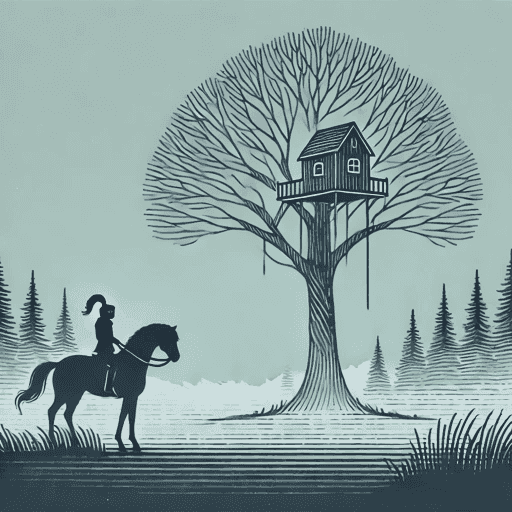
The Knight at Dawn
38 pages • 1-hour read
Mary Pope OsborneThe Knight at Dawn
A modern alternative to SparkNotes and CliffsNotes, SuperSummary offers high-quality Study Guides with detailed chapter summaries and analysis of major themes, characters, and more.
Chapters 1-3Chapter Summaries & Analyses
Chapter 1 Summary: “The Dark Woods”
The story opens the morning after Jack and Annie’s first adventure in the magic tree house, which Osborne tells in Dinosaurs Before Dark. The children found a tree house in the woods near their home in Frog Creek, Pennsylvania, and it transported them into the prehistoric era when they opened one of the books inside, pointed to a picture of a Pteranodon, and made a wish. The children returned home by finding a book with a picture of Frog Creek and making another wish.
Unable to sleep, Jack reviews the notes he took when he and his little sister traveled back in time to the Cretaceous Period. Jack doesn’t think his parents or his third-grade teacher, Ms. Watkins, will believe what he experienced.
Annie comes to her brother’s room because she can’t sleep either. She suggests that Jack make a few additions to his notes, such as the gold medallion with an ‘M’ that they found during their time in the Cretaceous Period. Annie asks, “Aren’t you going to write about the magic person?” (3). She points out that someone must have built the tree house and filled it with books, but Jack insists that he’ll only write down things that he knows for certain to be facts.
Annie suggests that they go to the treehouse and look for its owner, and Jack reluctantly agrees. He puts on some warm clothes, packs his pencil and notebook in his backpack, and meets his sister downstairs. Annie turns on a flashlight and says, “Ta-da! A magic wand!” (5). Jack shushes her with a reminder that they don’t want to wake up their parents.
Shortly before dawn, the children slip out of their home. The neighbor’s dog, Henry, barks at them, and they hurry into the Frog Creek woods. Jack is a little afraid of being in the forest while it’s dark, and he jumps when Annie shines her flashlight in his face.
Jack tells her to be serious, and she uses her flashlight to find the tree house atop the tallest tree in the woods. Without a moment’s hesitation, she climbs up the long rope ladder. Jack calls for her to come back, worried that someone else might already be in the tree house, but Annie continues to climb, leaving him alone in the dark forest.
Chapter 2 Summary: “Leaving Again”
Annie calls down to Jack, informing him that there’s no one else inside the tree house. The boy considers turning around and going home anyway, but the thought of the books in the magic tree house motivates him to climb inside.
The book about dinosaurs reminds Jack and Annie of the Tyrannosaurus Rex they saw on their last adventure. The children make sure that the book about Pennsylvania that brought them home to Frog Creek is still present. Despite Jack’s protests, Annie grabs a book about knights and castles and declares, “We wish we could go there” (11). A powerful wind starts to blow, and the tree house begins to spin. The children crouch down and close their eyes as it spins faster and faster.
When the tree house comes to a stop, Jack opens his eyes and shivers in the sudden cold. Looking out the window, the children see fog, a massive castle, and a knight on a black horse. Although Jack is awed by the sight, he says, “We have to go home and make a plan first” (12). He opens the book about Pennsylvania to the page with the red silk bookmark and points to the picture of Frog Creek.
Before he can make his wish, Annie grabs the book because she wants to explore the castle. Then she gives Jack the book back and tells him that he can go home without her. He can’t imagine leaving her behind. Jack puts the book about castles in his backpack and follows Annie down the rope ladder into the fog.
Chapter 3 Summary: “Across the Bridge”
The children watch the knight ride his horse to the castle. Using Annie’s flashlight to illuminate the book about castles, Jack reads that armor was so heavy that a “tournament helmet could weigh up to forty pounds” (15). This amazes Jack because he weighed 40 pounds when he was five, and he jots down a note in his notebook.
Annie observes out loud that the knight has crossed the bridge and disappeared, but Jack continues reading. He learns that the bridge across the moat is called a drawbridge, that crocodiles may have been kept in moats, that hawks were trained to hunt small prey and kept in a building called the hawk house, and that peacocks were sometimes served at great feasts.
Meanwhile, Annie listens to the sound of drums and horns coming from the castle. She tells her brother, “You can look at the book. I’m going to the real feast” (20). Jack asks her to wait, but she’s gone when he looks up. He catches sight of her running across the drawbridge and disappearing through the castle’s gate.
Chapters 1-3 Analysis
In The Knight at Dawn, Jack and Annie embark on their second educational adventure. Osborne’s children’s books weave fantasy elements, such as the time-traveling magic tree house that gives the series its title, into the historical fiction genre. The first three chapters teach historical facts about armor, the medieval diet, and the layout of castles as the children experience them first-hand. Osborne makes these facts directly relevant to the plot, as much of the information Jack gains by referencing the book about castles is crucial to their escape. For example, in Chapter 3, Jack reads, “Some people believe crocodiles were kept in the moat” (23). Although this detail is not historically accurate, it foreshadows the scene in Chapter 8 when Jack hears something pursuing him as he and Annie swim across the moat. In her signature style, Osborne teaches her young readers about the Middle Ages while also striving to entertain with an adventure story.
In these chapters, the author also establishes the magic tree house and its book collection as motifs to develop the theme of Learning Through the Excitement of Discovery. Because they found the tree house only the day before, the thrill of its discovery is highly fresh for Jack and Annie, and its quick unpredictability adds to this thrill. The magic tree house supports the theme because it whisks the children away on adventures across time, allowing them to learn about different eras while also discovering new things about themselves in the process. The mystery of the magic tree house’s creator is another source of considerable excitement for the children, as evidenced by Annie’s proposal that they sneak out of their house before dawn to “find out if the magic person is a fact” (8). Their investigative efforts to discover the identity of the owner support the theme differently, exploring the excitement of learning through solving a mystery.
Like the tree house itself, the books it contains support the theme of discovery. These volumes allow the children to choose where they want the tree house to take them and offer helpful information about their destinations. Compared to his sister, Jack finds books especially exciting, as demonstrated by their influence on his decision to enter the tree house in Chapter 2: “Jack thought about going home. Then he thought about all the books in the tree house” (14). One of the key differences between the siblings is that Jack likes to discover information by reading while Annie prefers a more hands-on approach. Osborne uses the scene with the castle in Chapter 2 to illustrate this contrast: “‘Look at the real one, Jack,’ said Annie. ‘Not the one in the book’” (19). Although books are a valuable source of knowledge, Jack gradually learns to take a page from his sister’s book and embrace the excitement of discovering things through direct experience over the course of the story, connecting his character’s development and arc to the theme of discovery.
Because Jack’s perspective is closely connected to the third-person limited omniscient narrator, the reader is given access to his interiority. Making Jack the story’s point of view character allows Osborne to examine the theme of The Journey Toward Overcoming Fear. The first chapter establishes that he is often hesitant and fearful; the boy frets, “What if the ‘magic person’ was mean? What if he or she didn’t want the kids to know about the tree house?” (5). In addition, he’s frightened of the dark and of being alone. Annie doesn’t share her brother’s struggle in this regard. If anything, she sometimes needs Jack’s caution to curb her impulsivity. At the same time, Annie helps Jack find his courage, as shown when he dismisses her invitation to return home without her in Chapter 2: “He couldn’t leave without her. Besides, he sort of wanted to take a peek himself” (14). Jack’s love for his sister helps him embark on his journey toward overcoming his fears, but once his curiosity is engaged, he gains the confidence to follow his interests.
In these opening chapters, Osborne also sets the theme of The Value of Teamwork and Problem-Solving in motion by establishing that the siblings’ cooperation has room for growth. Their goals aren’t aligned in these early chapters. For example, Annie makes the wish that transports them to the Middle Ages against her brother’s wishes: “‘We wish we could go there,’ Annie said. ‘No, we don’t!’ shouted Jack” (16). Jack tries to do something similar when he wants to take them back home immediately. In addition, Annie dashes ahead without Jack repeatedly in these chapters when he hesitates to take action. Still, Osborne makes the love and loyalty between the siblings apparent, such as when Jack has the opportunity to go home without Annie but doesn’t even consider doing so, and this dynamic lays the foundation for the siblings’ teamwork later in the story.
The titular knight, who appears immediately when the children appear near the castle, serves as a symbol of the values of chivalry and the Middle Ages. The magic tree house transports the children to the medieval era after Annie points to a “picture of a knight on a black horse” (15), illustrating how knights are synonymous with the Middle Ages in the children’s imaginations. Although the siblings catch only a brief glimpse of the knight before he rides his steed into the castle, he later plays a pivotal role in the narrative’s structure and the themes of discovery and overcoming fear.

Unlock all 38 pages of this Study Guide
Get in-depth, chapter-by-chapter summaries and analysis from our literary experts.
- Grasp challenging concepts with clear, comprehensive explanations
- Revisit key plot points and ideas without rereading the book
- Share impressive insights in classes and book clubs