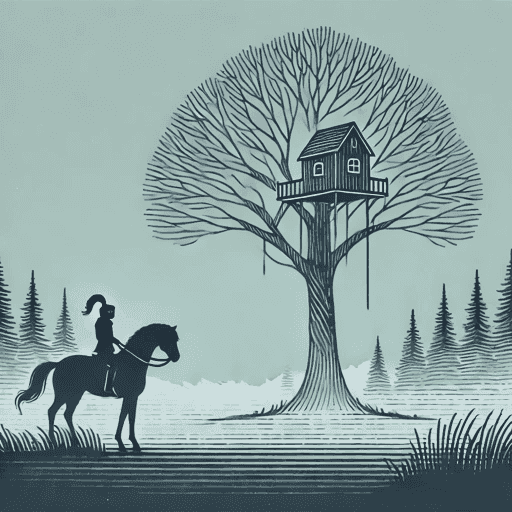
The Knight at Dawn
38 pages • 1-hour read
Mary Pope OsborneThe Knight at Dawn
A modern alternative to SparkNotes and CliffsNotes, SuperSummary offers high-quality Study Guides with detailed chapter summaries and analysis of major themes, characters, and more.
Important Quotes
“He picked up his notebook. He looked at the list he’d made before going to bed.
found tree house in woods
found lots of books in it
pointed to Pteranodon picture in book
made a wish went to time of dinosaurs.”
(Chapter 1, Page 1)
Osborne uses the list format to summarize Jack and Annie’s adventures in Dinosaurs Before Dark. This strategy quickly reviews what happened in the first book while also demonstrating Jack’s meticulous, academic personality. The third grader likes to break things down into tidy facts, even when he’s describing an extraordinary experience like traveling back to the “time of dinosaurs.” In a connection to one of the story’s major themes, Learning Through the Excitement of Discovery, the boy is reviewing these notes early in the morning because he can’t sleep due to the excitement he feels over his recent adventure.
“Jack looked out his window at the dark gray sky. It was almost dawn. He sighed. ‘Okay. Go get dressed. I’ll meet you at the back door. Be quiet.’
‘Yay!’ Annie whispered. She tiptoed away as quietly as a mouse.”
(Chapter 1, Page 5)
The visual imagery of the “dark gray sky” and the narrator’s observation that it’s “almost dawn” paint a picture of the scene. These details also foreshadow the dashing knight’s imminent appearance through their connection to the story’s title, The Knight at Dawn. The simile that describes Annie tiptoeing “as quietly as a mouse” emphasizes that the usually boisterous girl is making a concerted effort to be stealthy following Jack’s request.
“Jack and Annie slipped out the door into the cool early-morning air. Crickets were chirping. The dog next door barked. ‘Quiet, Henry!’ whispered Annie. […] Jack and Annie dashed across the dark, wet lawn and didn’t stop until they reached the Frog Creek woods.”
(Chapter 1, Page 6)
Imagery appeals to the senses and makes writing more engaging. In this passage, Osborne incorporates visual imagery with “the dark,” auditory imagery with the “chirping” crickets and the barking dog, and tactile imagery with “the cool early-morning air” and “wet lawn.” These details build up the dawn setting and create a hushed atmosphere to bolster the suspense. As a whole, the scene conveys the excitement of discovery as the children hurry back to the remarkable magic tree house while also preserving the sense of secrecy surrounding their early-morning adventure.
“The wind moaned louder. The leaves shook harder. Jack squeezed his eyes shut. The tree house started to spin. It spun faster and faster! Then everything was still. Absolutely still.”
(Chapter 2, Page 12)
The description of the tree house as it prepares to transport Jack and Annie back in time combines auditory imagery, such as “The wind moaned louder,” with repetition, such as “faster and faster” and “still. Absolutely still,” to build up this magical moment. The contrast between the spinning and the sudden stillness adds to the mood of excitement and anticipation. A passage like this appears each time the tree house takes Jack and Annie on an adventure, making it a familiar part of these stories.
“The air was damp and cool. The sound of a horse’s whinny came from below. Neeee-hhh! […] A huge castle loomed out of the fog. Jack looked around. The tree house was in a different oak tree.
‘Look!’ said Annie. Down below, a knight on a black horse was riding by.”
(Chapter 2, Page 12)
Osborne uses the onomatopoeia “Neeee-hhh!” to capture the sound of the horse’s whinny and signal that the magic tree house has carried the children back in time. The author’s use of tactile imagery, like the “damp and cool” air, and visual imagery like the “huge castle loomed out of the fog,” serves to make the scene more immersive. In addition, the appearance of the “knight on a black horse” foreshadows the moment near the end of the story when the knight and his steed help the children find their way back to the magic tree house.
“Knights wore heavy armor when they traveled long and dangerous distances. Armor was very heavy. A tournament helmet could weigh up to forty pounds. Wow. Jack had weighed forty pounds when he was five. It would be like riding a horse with a five-year-old on your head! he thought.”
(Chapter 3, Page 15)
The author’s usage of boldface and italics creates visual distinctions between the information in the book about castles that Jack consults, the usual narration, and Jack’s thoughts. The information in bold is structured in a way that’s easily digestible, reflecting Osborne’s overall goals for the Magic Tree House series, which offers educational value as well as entertainment. The comparison between wearing a tournament helmet and “riding a horse with a five-year-old on your head” presents a humorous image while providing further context for the historical detail about the helmet’s weight.
“Jack looked through the fog. He heard the real drums and the real horns. He saw the real hawk house, the real windmill, the real moat. He saw Annie dashing across the real drawbridge. Then she vanished through the gate leading to the castle.”
(Chapter 3, Page 20)
The repetition of the word “real” advances the theme of the excitement of discovery by underlining Jack’s movement from acquiring knowledge from books to learning through direct experience. The studious Jack is reluctant to leave his comfort zone, but the bold Annie prefers to learn from direct experience, as shown by the depiction of her “dashing across the real drawbridge” while Jack lingers under the tree house. Over the course of the story, Jack gradually learns to take a page from his sister’s book and embrace the excitement of discovering things for himself. The repetition of “He” at the start of the second, third, and fourth sentences is an example of anaphora, and this technique builds up to the chapter’s cliffhanger ending, in which Annie vanishes into the castle.
“Jack dashed across the bridge. He ran through the castle gate and into the courtyard. He heard the sounds of music, shouting, and laughter. Jack hurried to a dark corner and crouched down. He shivered as he looked for Annie.”
(Chapter 4, Page 21)
Osborne describes the castle and its occupants with imagery that appeals to the senses of sight, hearing, and touch. In addition, the contrast between the feast with its lively “music, shouting, and laughter” and the cold “dark corner” in which Jack hides emphasizes the boy’s fear and loneliness during his brief separation from Annie. It also reinforces the development of Jack’s character as fundamentally fearful, something that changes over the course of the story as he gains confidence in his skills, developing the theme of The Journey Toward Overcoming Fear.
“‘The feast in the Great Hall!’ whispered Jack. He held his breath as he stared in awe. A giant fireplace blazed at one end of the noisy room. Antlers and rugs hung on the stone walls. Flowers covered the floor. People in bright clothes and funny hats strolled among the crowd.”
(Chapter 4, Page 25)
The author utilizes an abundance of imagery to depict the majesty of a feast in the Middle Ages. The auditory imagery of the “noisy room” and the visual imagery of the crowd’s “bright clothes” add to the scene’s celebratory mood. Jack’s “awe” connects to the theme of the excitement of discovery as he witnesses a scene from history unfolding before his eyes.
“A man with a tray of pies was standing a few feet away. ‘Who art thou?’ he asked angrily.
‘Jack,’ squeaked Jack.
‘Annie,’ squeaked Annie. Then they ran as fast as they could down a dimly lit hallway.”
(Chapter 4, Page 25)
The author uses diction and dialogue to capture the historical era by having the server use the archaic “thou” rather than “you.” The repetition of the children’s names and the word “squeaked” provides humor while also conveying their fear. At the same time, the moment marks a suspenseful escalation of the plot and mood because the children’s presence inside the castle has been discovered.
“‘Turn off the flashlight!’ Jack’s voice echoed inside the metal helmet. He struggled to get the helmet off. Suddenly he lost his balance and went crashing into other pieces of armor. Metal plates and weapons clattered to the floor. Jack lay on the floor in the dark. He tried to get up. But his head was too heavy. He heard deep voices.”
(Chapter 5, Page 32)
Osborne raises the scene’s tension by focusing on sound, from the echoing of Jack’s voice to onomatopoeia like “crashing” and “clattered.” In particular, the “deep voices” add to the suspense because they indicate that Jack has been discovered by the castle’s guards. The narrative also adds a humorous reference to the weight of Jack’s helmet as he discovers firsthand how inhibiting it can be.
“In the torchlight, Jack saw three huge men standing over him. One with very squinty eyes held the torch. One with a very red face held Jack. And one with a very long mustache held onto Annie. […] Squinty, Annie, Mustache, Jack, and Red marched down the long, dark hallway. They marched down a narrow, winding staircase.”
(Chapter 6, Page 33)
The second, third, and fourth sentences are structured similarly, which gives the passage a sense of rhythm. Likewise, the structural similarities between the last two sentences reflect the steady pace of the guards as they march the children to the dungeon. The nicknames that the narrator gives the guards provide humor during a tense moment and offer an example of synecdoche. In this figure of speech, part of something represents the whole thing. For example, “Mustache” stands in for the man with “a very long mustache.”
“The fiery torch lit the dungeon. There were chains hanging from the filthy walls. Water dripped from the ceiling, making puddles on the stone floor. It was the creepiest place Jack had ever seen.”
(Chapter 6, Page 35)
As in Chapter 4, Osborne provides a detailed description of a space inside the castle. The previous description of the warm, festive, opulent Great Hall makes this passage about the dungeon seem even grimmer. Through precise adjectives like “filthy” and “creepiest,” the author uses diction to enhance the eerie and suspenseful mood.
“Jack and Annie jumped behind the door as it creaked open. Jack held his breath. A light from a torch danced wildly over the sacks and barrels. The light disappeared. The door slammed shut.”
(Chapter 7, Page 37)
The onomatopoeia of the word “creaked” and the visual imagery of the torch’s light dancing “wildly” help the author depict the moment in which the children narrowly escape detection by the castle’s guards. The brevity of the last two sentences, which are only three and four words respectively, adds to the scene’s taut, suspenseful mood.
“Jack put the flashlight on the floor. He worked his fingers under the thin slab of stone and tried to lift it. ‘Help,’ Jack said. ‘It’s heavy!’
Annie helped Jack lift the stone square out of its place. Underneath was a small wooden door. Jack and Annie tugged on the rope handle of the door. The door fell open with a thunk.”
(Chapter 7, Page 40)
Osborne uses italics on the onomatopoeia “thunk” to emphasize the loud, hollow sound the trapdoor makes. This passage also advances the theme of The Value of Teamwork and Problem-Solving: Jack finds the trapdoor by consulting his resources, namely the book about castles, and the siblings work together to uncover and open the escape route.
“Jack crouched down and began moving through the damp, creepy tunnel. The flashlight dimly flickered across the stone walls. He shook the light. Were the batteries going dead?”
(Chapter 7, Page 40)
The author utilizes a range of techniques to create suspense, including diction with the adjective “creepy,” the ominous visual and tactile imagery of the “damp” tunnel and the flashlight flickering “dimly,” and the question as Jack realizes their only source of light is failing. Maintaining the story’s suspense adds engagement and excitement for Osborne’s young audience.
“‘This must be the precipice!’ he called to Annie. ‘I can’t touch the ground. Pull me up!’
Annie reached for Jack’s hands. ‘I can’t hold you!’ she said. Jack felt his fingers slipping. Then down he fell through the darkness. SPLASH!”
(Chapter 7, Page 42)
The word “SPLASH!” is an example of onomatopoeia, and the combination of capitalization, italics, and an exclamation point emphasizes the loud sound Jack makes when he hits the moat. Osborne raises the story’s suspense by giving several chapters cliffhanger endings, as this excerpt illustrates. The Magic Tree House books are both exciting adventure stories and educational historical fiction for children. In keeping with these two genres, Osborne uses Jack’s precarious position to teach her audience the meaning of the word “precipice.”
“At first it seemed as if she was swimming in front of him. But then he heard a splash behind him. ‘Annie?’ he called.
‘What?’ Her voice came from in front. Not behind. Another splash. Behind. Jack’s heart almost stopped. Crocodiles?”
(Chapter 8, Page 45)
The author makes frequent use of sound effects throughout the story, including onomatopoeia like the word “splash” in this passage. Although Jack doesn’t see any crocodiles, their presence is strongly implied through the sound effects. Osborne’s usage of italics and fragments further emphasizes the scene’s tension. This scene is foreshadowed when the book about castles mentions a theory that there might be crocodiles in the moat back in Chapter 3.
“They were trapped, but not in a dungeon. They were trapped in the still, cold darkness. Neeee-hhh! A horse’s whinny echoed through the night. The clouds parted. A full moon was shining in the sky. A pool of light spread through the mist. Jack and Annie saw a shadowy figure just a few feet away. It was the knight.”
(Chapter 8, Page 46)
Osborne creates a tense, anxious mood at the start of the passage through diction and repetition with the word “trapped.” The horse’s whinny cuts through the narrator’s ominous observations, creating a tone shift and signaling that the knight has come to the children’s rescue. The onomatopoeia “Neeee-hhh!” was used when the knight and his steed first appeared in Chapter 2, and here it signifies the knight’s return to the narrative before this is confirmed in the final sentence. The second half of the passage fosters a hopeful mood through words like “shining” and “light” and the image of the clouds parting.
“The black horse cantered beside the moonlit water of the moat. Jack rocked back and forth in the saddle. The wind blew his hair. He felt very brave and very powerful. He felt as if he could ride forever on this horse, with this mysterious knight, over the ocean, over the world, over the moon.”
(Chapter 9, Page 49)
Osborne creates a mystical mood and communicates Jack’s feeling that he’s been transformed through phrases that employ repetition, such as “very brave and very powerful” and “over the ocean, over the world, over the moon.” The visual imagery of the “black horse” cantering “beside the moonlit water of the moat” enhances the scene’s serenity, indicating that the children’s trials are behind them.
“Jack heard the wind begin to blow softly. ‘I hope I pointed to the right picture in the right book,’ said Annie.
‘What?’ Jack looked back at her. ‘Right picture? Right book?’ The tree house began to rock. The wind got louder and louder.”
(Chapter 9, Page 52)
Osborne provides both humor and suspense with the repetition of “Right picture? Right book?” The auditory imagery of the wind blowing “softly” at first and then “louder and louder” indicates that the magic tree house is preparing to travel, whether Jack is ready or not. This moment highlights the siblings’ distinct personality traits by juxtaposing Jack’s caution with Annie’s impetuousness.
“‘Stop!’ Jack shouted at the tree house. Too late. The tree house started to spin. It spun faster and faster! Then everything was still. Absolutely still.”
(Chapter 9, Page 52)
The descriptions of the wind blowing and the tree house spinning before everything falls still bring the story full circle, as the same thing happens when the magic tree house transports the children to the Middle Ages. In another parallel, Jack is alarmed at Annie’s wish but unable to stop it from taking effect, just as he was in Chapter 2. The fragment “Too late” raises the scene’s suspense by underlining that the children aren’t certain where—or when—the tree house is taking them this time.
“The air was warm. It was dawn. Far away a dog barked. ‘I think that’s Henry barking!’ Annie said. Jack and Annie both looked out the tree house window. ‘We’re home!’ said Annie. ‘Yay!’”
(Chapter 10, Page 54)
The short, simple sentences add to the passage’s calm tone, signaling that the excitement of the adventure has passed and that the children are safely back home. The short sentences also serve to emphasize the children’s distinct sensory impressions, such as the tactile imagery of the “warm” air. The imagery offers clues that Jack and Annie are safely back home before this is officially confirmed, because the descriptions in this excerpt contrast with the cold night at the castle. Henry offers another cue that the book is approaching the resolution because the children shushed the dog when they snuck out of their house in Chapter 1.
“They reached the ground and took off running between the gray-black trees. They left the woods and ran down their quiet street. They got to their yard and crept across the lawn. They opened the front door carefully and slipped inside their house.”
(Chapter 10, Page 55)
This is an example of anaphora, with each sentence in the excerpt beginning with the word “They.” The literary device lends a sense of rhythm to the narrator’s description of the children’s journey from the tree house to their home. Osborne also uses specific words like “crept” and “slipped” to emphasize the continued secrecy of the children’s journey.
“Their house was so different from the dark, cold castle. It was safe and cozy and friendly.”
(Chapter 10, Page 55)
Osborne’s diction emphasizes the differences between the castle and the children’s home through the contrasting adjectives “dark, cold” and “safe and cozy and friendly.” The repetition of ‘and’ in the latter phrase is an example of polysyndeton, the stylistic addition of coordinating conjunctions where none are grammatically necessary. In this example, Osborne uses polysyndeton to emphasize the positive attributes of Jack and Annie’s home. The technique supports the story’s happy ending by fostering an atmosphere of peace and safety.

Unlock every key quote and its meaning
Get 25 quotes with page numbers and clear analysis to help you reference, write, and discuss with confidence.
- Cite quotes accurately with exact page numbers
- Understand what each quote really means
- Strengthen your analysis in essays or discussions