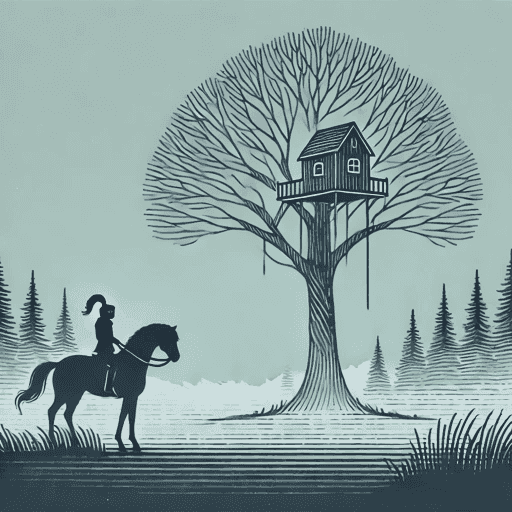
The Knight at Dawn
38 pages • 1-hour read
Mary Pope OsborneThe Knight at Dawn
A modern alternative to SparkNotes and CliffsNotes, SuperSummary offers high-quality Study Guides with detailed chapter summaries and analysis of major themes, characters, and more.
Symbols & Motifs
The Knight
The knight symbolizes the values of the Middle Ages, particularly the idealized version of the era popular in fiction. The story doesn’t delve into historical details about knights’ roles as warriors, instead portraying the titular character as a majestic and self-contained figure who evokes the grandeur and chivalry often associated with tales set in the medieval era: “The knight sat on the black horse. His armor shone in the moonlight” (47). The knight has no name or dialogue in the story, and the children never see his face. These authorial decisions reinforce his role as a symbolic embodiment of the Age of Chivalry, rather than a distinct individual. Many popular tales about knights promote ideals like courage and kindness toward those in need. Accordingly, the knight in this story rides to the children’s rescue on his black steed after they become lost in the fog. The novel closes with Jack dreaming that he and Annie are “with the knight again” (56), reinforcing that the encounter with the knight inspires Jack to move forward on his journey toward overcoming fear.
Later in the Magic Tree House series, Jack and Annie learn that the knight is Morgan Le Fay, who uses her shapeshifting powers to come to the children’s aid in the first three books before introducing herself to them in the fourth. This revelation explains the knight’s anonymity and connects to the knight’s function as a symbol of an idealized, romanticized idea of the Middle Ages. In Osborne’s books, Morgan Le Fay is a kindly enchantress who hails from Camelot, a magical land inhabited by King Arthur, Queen Guinevere, Merlin, and the Knights of the Round Table. Arthurian legends focus on daring deeds and chivalric ideals rather than the historical realities of medieval life, much like the knight’s characterization in this story. As a symbol of the Age of Chivalry, the knight contributes to the story’s intersection of history and fantasy and advances the plot, Jack’s characterization, and the theme of overcoming fear.
The Magic Tree House
The magic tree house functions as a motif connected to the theme of Learning Through the Excitement of Discovery. The wooden structure has a rope ladder that Jack and Annie use to reach its perch “high in the branches of the tallest tree in the woods” (7). Mirroring its lofty position in the oak tree, the tree house takes the siblings on an adventure to the Middle Ages that pushes their courage, teamwork, and imagination to new heights. Osborne uses the spinning and the rushing of the wind that herald the tree house’s journeys through time to add to the story’s suspense and accentuate the excitement of discovery: “The wind moaned louder. The leaves shook harder. Jack squeezed his eyes shut. The tree house started to spin. It spun faster and faster! Then everything was still. Absolutely still” (12). The magic tree house is integral to the theme of discovery because it transports Jack and Annie on exciting educational adventures throughout history. In addition, because it is a tree house, it is specifically in the children’s domain, rather than being a part of the adult world, and seems as if it were designed specifically for them.
Books
Like the time-traveling tree house that contains them, the books in the novel serve as a motif supporting the theme of Learning Through the Excitement of Discovery. Each volume in the magic tree house’s library represents a potential destination for Jack and Annie’s adventures. The children embark on their journeys by making wishes on pictures inside the books, an authorial decision that celebrates books’ powers to transport, inspire, and educate in the real world. Out of the two siblings, Jack has an especially deep appreciation for the excitement that books offer. An avid reader, the thought of “all the books in the tree house” persuades him to reenter the tree house even though the children’s last adventure brought him perilously close to a Tyrannosaurus Rex (14).
The book about knights and castles is an especially important example of the motif because it aids the children’s exploration during their time in the Middle Ages. For example, the text informs Jack of an escape route in Chapter 7: “In this castle, a trapdoor led from the storeroom through a secret passage to a precipice over the moat” (39). In addition to helping the children experience the thrill of exploring a medieval castle, the book advances their search for the identity of the magic tree house’s creator. The revelation prompted by “the fancy M” on the “blue leather bookmark” in the book about castles reinforces books’ importance to the theme of discovery (55). Osborne extols the joys and importance of reading by making books a central motif of the excitement of discovery.

Unlock the meaning behind every key symbol & motif
See how recurring imagery, objects, and ideas shape the narrative.
- Explore how the author builds meaning through symbolism
- Understand what symbols & motifs represent in the text
- Connect recurring ideas to themes, characters, and events