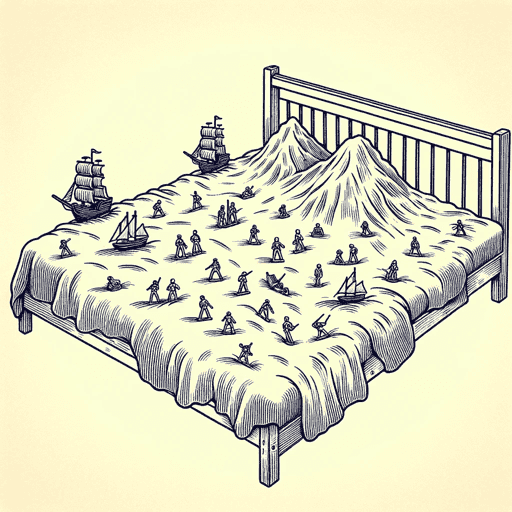
The Land of Counterpane
19 pages • 38-minute read
Robert Louis StevensonThe Land of Counterpane
A modern alternative to SparkNotes and CliffsNotes, SuperSummary offers high-quality Study Guides with detailed chapter summaries and analysis of major themes, characters, and more.
Literary Devices
Form and Meter
The structure of “The Land of Counterpane” consists of four quatrains, meaning four groupings of four lines each. Each stanza also features two rhymed couplets. A couplet is a pair of rhyming lines forming a single unit and also typically featuring the same meter. The first two lines of each stanza rhyme, and the third and fourth lines of each stanza rhyme. Each rhyming pair could also be categorized as masculine rhyme, meaning that the rhyme occurs on the final stressed syllable. For example, the first couplet ends with “a-bed” and “head,” rhyming on the short “e” sound. The second couplet ends with “lay” and “day,” rhyming the long “a” sound.
Besides rhyme and structure, each line also contains a specific meter. Each line is written in iambic tetrameter, meaning each line contains four units of an unstressed syllable followed by a stressed syllable. For example, the first two lines are broken down in the following pattern of unstressed and stressed components: “When I was sick and lay a bed / I had two pillows at my head” (Lines 1-2). This same pattern repeats throughout all 16 lines of the poem.
This structure, rhyme scheme, and meter fits with the fantastical storytelling of Stevenson’s poem. The sing-song rhythm and dependable rhyme scheme is reminiscent of nursery rhymes, ballads, or fairy tales. Stevenson’s use of this organizational method is in keeping with the narrative poem/storytelling genre and draws readers into the imaginative tale Stevenson relays.
Alliteration
Alliteration occurs when the same letter or sound is repeated at the beginning of subsequent words or closely located words. Stevenson employs alliteration throughout a number of his lines. Line 9 reads, “And sometimes sent my ships in fleets,” repeating the “s” consonant sound at the beginning of words. This usage of alliteration also appears in Line 13: “I was the giant great and still.” Alliteration in the first instance, with the repetition of the “s” sound, assists with the flow of the line. One word easily slips into the next, imitating the smooth movement of water, just as the ships flow down the river of sheets. In the second instance, alliteration is used for emphasis. The repetition of the “g” sound stresses the importance of the speaker as the creator of the “land of counterpane” (Line 16). The focus is placed on the power and authority of the speaker thanks to the use of this literary device.
Anaphora
Anaphora is the repetition of a word or a sequence of words at the beginning of a phrase or sentence. Two specific lines in the poem begin with “And sometimes” (Lines 5, 9). Various other sentences begin with just the word: “And” (Lines 3, 15). This repetition of “and” occurs as the world the speaker is building keeps getting bigger and bigger, progressing from soldiers to ships to entire cities. Every repetition of “and” coincides with the growing imagination of the speaker and signals to readers that more is to come thanks to the speaker’s creativity. There is also a repeated pattern with lines beginning with the first-person, singular pronoun “I,” followed by a past tense verb: “I had” (Line 2), “I watched” (Line 6), and “I was” (Line 13). This repeated pattern adds to the “sing-song” rhythm of the poem, fulfilling readers’ expectations of the narrative/storytelling genre with its predictability and repetition.

Unlock all 19 pages of this Study Guide
Get in-depth, chapter-by-chapter summaries and analysis from our literary experts.
- Grasp challenging concepts with clear, comprehensive explanations
- Revisit key plot points and ideas without rereading the book
- Share impressive insights in classes and book clubs