The Land of Counterpane
The Land of Counterpane
A modern alternative to SparkNotes and CliffsNotes, SuperSummary offers high-quality Study Guides with detailed chapter summaries and analysis of major themes, characters, and more.
Themes
Physical Limits Aren’t Limiting
Though the speaker in the poem is bed-ridden, “The Land of Counterpane” is not a sorrowful poem. While one might expect a lament or a cry for adventure, Stevenson delivers instead a joyous celebration of the imagination and an adventurous spirit—all from the “confines” of a bedroom. Stevenson’s poem underscores a childlike attitude of viewing the world with rose-colored glasses, an exercise in viewing the glass half full despite the obvious. This view, Stevenson contends, is one that can help more than just children make sense of the world.
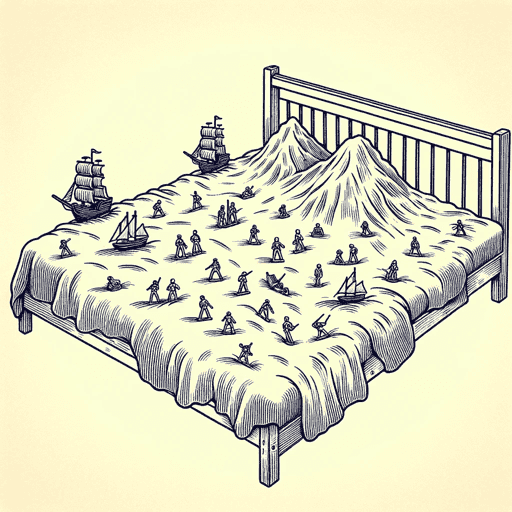
The poem begins with physical limitations: “Sick” (Line 1), the speaker “lay a-bed” (Line 1), confined to their bedroom as they convalesce. They are trapped amidst their “pillows” (Line 2) and “bed-clothes” (Line 11), while their body tries to heal itself. The introductory images are not only related to bedrooms and sickness, but they are also physical items. As the poem progresses, these physical items are joined by imaginative scenarios to create a fantasy that transcends physical and mental limits. While the speaker’s physical body is confined to bed, their experiences and interactions with the world are shaped by their mind and therefore unlimited. In a way, being stuck in their bedroom does not stop the speaker from “living” out in the world. The speaker might bemoan their stay indoors, but while lying amongst the sheets, the speaker can still watch soldiers go “through the hills” (Line 8). They can still witness ships traveling through waterways “up and down among the sheets” (Line 10). The speaker can see “trees,” “houses” (Line 11), and “cities” (Line 12). They can observe the entire “land” (Line 16), including “dale and plain” (Line 15). The speaker successfully builds a world in which travel is only limited by the imagination.
Every nook and cranny of this imaginary world is visible to the poem’s speaker. So while the speaker is limited to one specific place—their bed—they are really not confined there at all. Conversely, if the speaker gives in to despair and bemoans their sickness, they might lose their grasp on their imaginative freedom. Because the speaker eagerly traverses the land, they are able to explore their own world, both land and sea, unbounded in their adventures. They can really go wherever they wish. The poem’s underlying message is that physical limitations don’t—and shouldn’t—always affect wanderlust. If anything, the speaker is given more control over where they wish to go and what they want to see. The message Stevenson conveys to readers is that while there are always two ways to approach a situation—either positively or negatively—having a positive approach is always more productive and enjoyable no matter how bad the outlook may initially be.
Imagination is a Powerful Tool
It is creativity that enables the speaker to overcome their physical limitations of being sick and not feeling confined to their sick bed. However, this worldbuilding on the part of the speaker is only possible thanks to their imagination. Without the imagination, the speaker would not have been able to entertain themself while healing. It is with the power of the imagination that the speaker is able to make what is inanimate animate; they can “give life” to the situation surrounding them. Through their creativity, the speaker makes their “leaden soldiers go” (Line 6) and march in “uniforms and drills” (Line 7). Through the power of the imagination, the speaker makes their “ships in fleets” (Line 9) sail “up and down” (Line 10) the river of their sheets. They are able to construct “trees” and “houses” (Line 11) to form “cities all about” (Line 12). None of this—the soldiers, the ships, the cities—would exist without the speaker’s creative capabilities. Without such a powerful imagination, the speaker would not be able to make his soldiers or ships “move” in such a way. The speaker would be relegated to a boring, tiresome convalescence (and the toys would be relegated to a boring, tiresome existence) rather than fantastical entertainment. For the speaker, the imagination acts as a tool which conveys a powerful sense of agency.
The theme of imagination as a powerful tool reveals an adverse effect as well. As mentioned previously in this guide, Stevenson lived during a time of imperialism and colonialism, with upheavals throughout the “new” world taking shape due to those who fought back against the unjust oppression from colonialism’s reach. At the heart of many notions of destiny and new enterprise (whether the US’ 19th-century doctrine of manifest destiny/imperialism or Europe’s own brand of imperialism/empire expansion) lies an (un)imaginative belief in the nature of change and progress. Unspeakable acts (like so-called “inventive” ways to steal land) were done and are still done in the name of change and so-called progress. Individuals, groups, corporations, and governments alike held visionary ideas about growth and prosperity that both exceeded imagination and gave in to the darker recesses of imagination. This type of imagination, though not mentioned specifically in the poem, is also a powerful yet dangerous tool. The soldiers and ships that the speaker plays with, for instance, are toy stand-ins for the very soldiers and ships sent to “new” lands in the name of visionary progress. For the speaker, these excursions into the “the pleasant land of counterpane” (Line 16) help pass the time and help overcome boredom. In the real-world examples of colonization and imperialism, excursions such as these are powerful and unpleasant tools used for empire and conquering lands, powerful tools fueled by imagination, creativity, and inventiveness that were used as tools of the powerful.

Unlock every key theme and why it matters
Get in-depth breakdowns of the book’s main ideas and how they connect and evolve.
- Explore how themes develop throughout the text
- Connect themes to characters, events, and symbols
- Support essays and discussions with thematic evidence