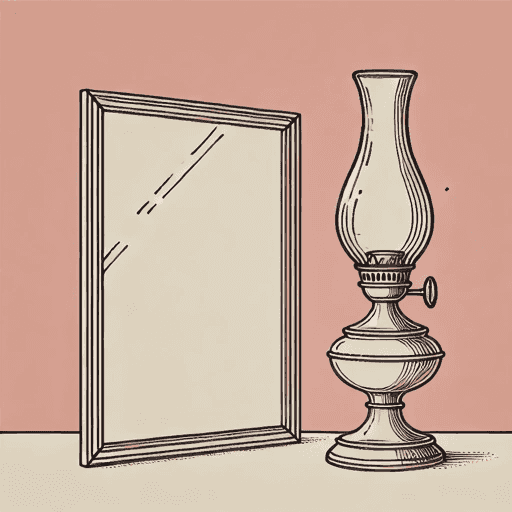
The Mirror and the Lamp: Romantic Theory and the Critical Tradition
The Mirror and the Lamp: Romantic Theory and the Critical Tradition
A modern alternative to SparkNotes and CliffsNotes, SuperSummary offers high-quality Study Guides with detailed chapter summaries and analysis of major themes, characters, and more.
Summaries & Analyses
Quizzes
NEWReading Tools
Chapters 7-9Chapter Summaries & Analyses
Chapter 7 Summary: “The Psychology of Literary Invention: Mechanical and Organic Theories”
Abrams shifts to another element of Romantic philosophy and literary criticism: Psychology. Philosophers like Alexander Gerard (1728-1795), Locke, Hume, and Thomas Hobbes (1588-1679) all incorporated the creative act into their philosophy of mind, which is the philosophic precursor to modern psychological science. This philosophy generally centered around a tension between imagination (sometimes referred to as “fancy”) and judgment.
In focusing on “descriptive psychology” (158), Abrams examines the Romantic view of the mental creative process. Abrams establishes Coleridge as marking a movement away from the earlier mechanical analogies of creative thought to analogies of living plants in the Romantic period and beyond.
The 18th century in England was defined by the Enlightenment and British Empiricism, both philosophical and scientific movements that significantly advanced science and an understanding of the physical world. Philosophers like Hume sought to apply empirical scientific principles to understanding the human mind, thereby establishing an initial psychological science.
Hume and Hobbes posited that the mind worked similarly to the physical world as understood through Newton’s laws of motion. Therefore, as the world is made of particles, the mind is made of ideas and sensations. Those ideas and sensations are compilations of the sense experience, especially the sight, of the individual. In this view, the imagination is the mechanism by which the mind analyzes and synthesizes sense experience. This process can result in the mental creation of impossible creatures. Homer’s Chimera is a prime example that merely takes apart known animals and assembles a different animal from their pieces.
Hume saw ideas more as solid particles than impressions, and he believed that while impressions could be mixed together, ideas connected to form a sequence rather than amalgamations. This mechanical model of the mind becomes complicated when trying to define the poetic or artistic creative process, however. In the natural universe, atoms are randomly attracted and repelled, but in the creation of a work of art, like a poem, there is a sequence of judgments made by the author to either include or exclude words, ideas, and images. Hume, among others, turned to the theological solution of a designer or creator as genius, which establishes a new analogy for mind—the designing artisan.
In the continued attempt to establish a coherent narrative for the workings of the mind, scholars like Hume and Gerard moved further into the artisan analogy. However, the explanation that invention comes from attraction and association continued to fall flat. Gerard, at the same time as some German thinkers, began to describe the phenomena of poetic invention as a natural process akin to a plant taking in nourishment and growing.
To fully explore the plant analogy of imagination and poetic invention, Abrams turns to Coleridge. He argues that perhaps one of Coleridge’s most profound contributions to philosophy and literary theory is the distinction he makes between fancy and imagination. Until the 19th century, the two terms were largely used interchangeably and referred to the images in the mind assimilated from sensory input. Coleridge, however, made a specific distinction between fancy as an associative accident and imagination as a deliberate function of growth. This distinction was revolutionary; however, many of Coleridge’s contemporaries—including Wordsworth—largely rejected the profound departure from associationism this split requires.
Abrams demonstrates multiple instances of Coleridge using an analogy of a plant to describe and define the function of the mind. Part of this analogy requires that thought be alive as a plant is alive, evolving and growing, instead of inert and dead, as in a mechanical analogy. Similarly, rather than separate parts mechanically associating, Coleridge describes learning, imagination, and poetic invention as the growth of a plant, with the parts absorbed entirely into the whole. The plant analogy then yields a theory of literary creation that is focused on the unity of thought rather than the individual elements and their possibly accidental association.
Chapter 8 Summary: “The Psychology of Literary Invention: Unconscious Genius and Organic Growth”
Abrams advances his discussion of “organic aesthetics” (187) with a short survey of the development of organism-based philosophy of nature. From Aristotle through German theorists in the 18th and early 19th centuries there was a conflict between a more mechanistic and intentional model of the universe and an organic living model of the universe. Abrams focuses on three elements of art—natural genius, inspiration, and grace—to explore the living model as it applies to poetry, especially in the early 19th century.
Throughout the history of aesthetics and literary criticism, there was a belief that continued through the Romantic period that the greatest works of art were the product of natural genius. In other words, Shakespeare and Homer, for example, were born endowed with a gift for art and creation. This idea comes into conflict with a model of the world based on an analogy of mechanics or physics, which relies on deductive reasoning and observation—logical thinking—rather than sparks of divine brilliance. As a result, various theorists still committed to the concept of a born genius used organic metaphors to describe the creative process, breaking from the Enlightenment commitment to mechanical creation.
Similarly, inspiration was part of the general theory of creative thought and production of art and literature. In the Classical period through the 18th century, the inspiration described by essentially all artists was treated as a divine intervention into the mind of the artist. Even in the Enlightenment, the concept of the Watchmaker and intelligent design figured into the act of creation. Romantic thinkers, however, especially Shelley, departed from the supernatural/divine model of creative imagination to a natural or organic model that described the poetic inspiration as growing from the artist’s own soul.
For Romantics like Shelley, the poem was grown and born, like a plant or a child, and was therefore alive rather than made and mechanical. Moreover, they believed that great poetry has a sense of something undefinable and indescribable that is felt by poet and reader rather than codified by philosophers and critics—grace. In trying to describe or hint at this element of beauty, the only metaphorical model that functioned was that of the natural world and the experience of being struck by inherent beauty.
Abrams ties the 18th century discussions of grace, nature, natural genius and inspiration to late-18th and 19th-century German thinkers who formed the other half of Romantic philosophy and literature. He begins with Gottfried Wilhelm Leibniz (1646-1716), who believed that all matter in the universe were elements of the supreme divinity of existence, with the soul and mind of the human being forming elements of that divinity. This connects to the theories of Johann Georg Sulzer (1720-1779), who explored mystery and je ne sais quoi in literature and human thought. The mystery of how a plant moves and adjusts is akin, then, to the mystery of beauty and profundity in a poem.
Moving to Johann Wolfgang von Goethe (1749-1832) and Immanuel Kant (1724-1804), Abrams demonstrates how each applied biology to aesthetic theory, just as the empiricists applied physical science to the same topic. Though Goethe was more committed to the connection, Kant uncharacteristically allowed for uncertainty via the organic analogy of creative thought in art. After Kant, Friedrich Schelling (1775-1854) argued that creative imagination in the service of making art combined all the natural functions of mind to resolve conflict, and acted as the origin of philosophical thinking.
From Schelling and those like him came the foundation of the psychological concept of the unconscious mind that Abrams connects to the organic analogies he’s traced through early theories of psychology. He connects the unconscious to the natural, showing how later British writers like Coleridge and Carlyle used that concept to argue that true poetry grows naturally from the unconscious mind in opposition to the idea that poetry is carefully crafted according to set rules from the conscious mind. Therefore, poetry is inherently natural rather than artificial.
Coleridge’s discussion of the imagination, Abrams argues, advanced the German psychologies of creation based on a natural analogy, as Coleridge combined elements of organic history, organic evaluation, and organic law into the broader philosophy. According to this view, organic history is the historical context of the work of art, and just as soil influences the type of plant, so too does the socio-historical context of the artist affect the art. Organic evaluation determines the beauty and excellence of a poem based on how well it represents the parts of the poem as a unified whole. Organic law replaced the earlier rules-based literary criticism of the neoclassicists, arguing that the natural and spontaneous genius of the artist’s mind grows and deliberately nurtures the work of art.
Chapter 9 Summary: “Literature as a Revelation of Personality”
Abrams turns to the fundamental shift in the Romantic period to the artist/poet as the primary focus of analysis in criticism. He outlines three approaches to poet-centered scholarship: “One looks to an author for the explanation of his work; another reads an author out of his work; and the third reads a work in order to find its author in it” (227). Abrams argues that the third of these, discovering the individual within the poem, is the most philosophical and potentially profound approach.
Historically, though critical focus was either on the universe or the audience, there is some foundation for the turn to the artist in the Romantic period. A major concern from the Classical era to the 18th century was the moral value of poetry, and for a poem to be morally instructive, the poet had to be morally sound. The author was generally considered to be important only insofar as the poet’s unique style affected the body of work as a whole. Until the very late 18th century, the only real concern beyond the demonstrated morality of the poet was how the poet’s biography could impact an understanding of the poetry.
This movement to focus on the artist involved the emerging dichotomy of the objective/subjective split in philosophy, especially German philosophy. Abrams identifies August Wilhelm von Schlegel (1767-1845) and Friedrich Schiller (1759-1805) as the primary philosophers who connected objectivity, subjectivity, and the artist as a focus of literary criticism. He explains how Schlegel’s theories led to a creator-focused discussion of literature that connected the poet to God, which in turn led to viewing literature both as a representation of reality and reflection of the artist’s inner will. In English criticism, the objective was often tied to epic poetry and the subjective to lyric poetry. However, in the early 19th century, critics like Keble argued that all poetry is inherently subjective because it expresses the poet’s inner truths rather than any objective truths.
Abrams then turns to the literary criticism surrounding the works of William Shakespeare (1564-1616), the ancient Greek poet Homer (c. 8th century BCE), and John Milton (1608-1674) to discuss the 19th-century connection between literary criticism and philosophical theory. Criticism on Shakespeare from the 18th and early 19th centuries—especially criticism by Coleridge, Keats, and Hazlitt—concluded that Shakespeare’s identity was obscured in his plays. Rather than revealing Shakespeare’s identity, they argued, his plays reveal essential truths about humanity. However, the sonnets were treated differently in criticism, as there are several critics Abrams cites who constructed a biography of Shakespeare via his sonnets. That line of thought extends into the mid-19th and 20th centuries with theories that all of Shakespeare’s characters, especially Hamlet, reflect the inner man as well as the universal artist.
In contrast to Shakespeare, most criticism of Milton involved connecting his biography to his work. Abrams shows how William Blake, Shelley, and Coleridge, as well as earlier and later scholars, connected Milton to his characters, primarily in Paradise Lost (1667). Each scholar Abrams cites argued for different aspects of Milton’s spiritual, political, and personal beliefs, but all agreed that Milton shows himself in his poetry. Abrams additionally ties the contrasting interpretations to the critics/poets themselves to argue that, in considering the poet, the interpreter views the poet and poem through their own lens of experience.
In contrast to most of his contemporaries, John Keble’s quest to interpret Homer biographically led to a largely subjective interpretation of The Iliad. Abrams shows how Keble broke down the poem into “canons” (259), which lay the foundation for 20th-century biographical criticism. Keble’s conclusions were that Homer writes from a sense of nostalgia, and though born humbly was pious and politically conservative. This, Abrams argues, is remarkably similar to Keble’s own personality, which further supports Abrams’s earlier argument that biographical criticism can easily become as—or even more—reflective of the critic than of the poet or poem.
Chapters 7-9 Analysis
Abrams’s descriptions of Coleridge’s thought are markedly different in tone than his earlier explanations and surveys of aesthetic thought. At the start of the book Abrams maintained an objective tone, reporting the history and ideas of philosophers, poets, and critics. In this section, when he describes Coleridge’s approach to defining imagination and advancing the organicism theory, his descriptions are poetic and complimentary, with Abrams moving more explicitly to genuine argument rather than suggestion. In his discussion of organicism, Abrams focuses on creating streams of connections to show the emergence of new approaches and ideas in the Romantic period regarding The Nature of Poetry, with the Romantics advocating for their own views of the role of the poet and the way the mind and creativity function.
Abrams uses critical discussions of Shakespeare to compare and contrast the schools of thought surrounding the relationship of the poet to his or her work, which brings more attention to the focus on the poet in Expressive Theory. He contrasts the criticism that argued that it was impossible to determine anything of Shakespeare’s biography through the close reading of the sonnets or plays—i.e., “the majority concurred with Schiller that in Shakespeare ‘the poet could nowhere be seized’” (244, emphasis added)—with alternative criticism that embraced the possibility of teasing out personal details from the work: “[D]o not the sonnets speak out in the first person, and with the most convincing passion, about explicit people and events?” (246).
These contrasting views on potential biographical elements in Shakespeare illuminate how central the figure of the poet had become in Romantic thought and criticism, something that still endured in Abrams’s own time. Since Romanticism tended to celebrate individual genius and advocated strongly for poetry as the expression of the poet’s personal feelings, a stronger interest in possible autobiographical elements in a poet’s work also appeared. Such strands of Expressive Theory turned the critical evaluation of poetry into something that could provide a key to understanding the poet, instead of merely regarding the poet as the vehicle for imitation or creation, as other strands of literary theory had done. In other words, this emphasis shifted the critical reading of poetry from centering the poem itself in isolation to using the poem as a lens for better understanding the artist.
Abrams’s discussion of Goethe also contains a subtle argument for the overarching value of literary art and The Poet as Critic. He argues that Goethe’s background in biology, in concert with his own artistic work, creates a smooth transition from theory to art and back to criticism: “[Goethe] say[s] that he has also found a principle for explaining a work of art which is ‘really also an egg of Columbus,’ and a kind of master-key to critical theory” (206). Goethe’s interest in examining and crafting theories about art and aesthetics echoes the interest of Wordworth and Shelley elsewhere in the text, with both Wordsworth’s Preface and Shelley’s Defence of Poetry reflecting how, like Goethe, they seek to develop aesthetic theories that can explain both their own approach to poetry and illuminate the functions and purposes of art more generally.

Get in-depth, chapter-by-chapter summaries and analysis from our literary experts.
- Grasp challenging concepts with clear, comprehensive explanations
- Revisit key plot points and ideas without rereading the book
- Share impressive insights in classes and book clubs