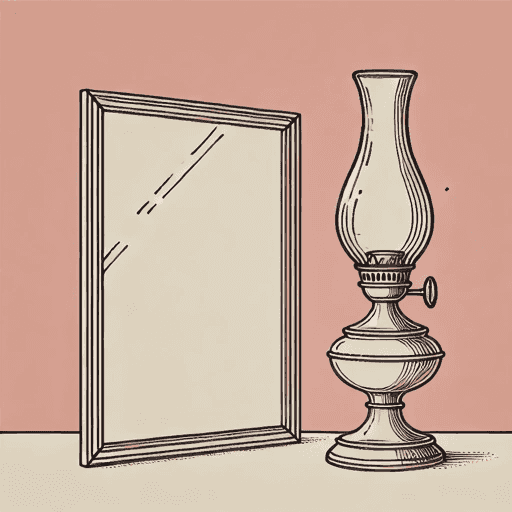
The Mirror and the Lamp: Romantic Theory and the Critical Tradition
58 pages • 1-hour read
M. H. AbramsThe Mirror and the Lamp: Romantic Theory and the Critical Tradition
A modern alternative to SparkNotes and CliffsNotes, SuperSummary offers high-quality Study Guides with detailed chapter summaries and analysis of major themes, characters, and more.
Key Figures
M. H. Abrams
Meyer Howard (M. H.) Abrams was a foundationally important academic who helped shape critical appreciation and understanding of Romantic era poetry and literary criticism as a whole. He studied English Literature at Harvard in the 1930s and taught English Literature and Literary Theory at Cornell University.
In addition to The Mirror and the Lamp, Abrams is also well-known for Natural Supernaturalism: Tradition and Revolution in Romantic Literature published in 1971, and is best known as the managing editor and creator of the Norton Anthology of English Literature. The anthology served as a primary introductory text to English literature as a collection of important texts considered in context of history and culture for decades in American academia, and is still widely in use today. He served as the managing editor of the collection for 38 years before ceding leadership to Stephen Greenblatt.
In his career teaching and writing, he taught prominent author Thomas Pynchon and renowned critic Harold Bloom. In 2014, Abrams was awarded The National Humanities Medal by President Barack Obama, just a year before his death. Later in his life, he continued teaching as a professor emeritus and worked on theory surrounding the effect of reading poetry out loud, which he titled The Fourth Dimension of a Poem.
Samuel Coleridge
Samuel Taylor Coleridge lived in England from his birth in 1772 to his death in 1834. He was one of the most influential Romantic poets, and a significant critic and philosopher. Coleridge was the son of a vicar and theology figured prominently in his writing and his sermons
He and William Wordsworth were good friends for most of their careers and their collaboration on Lyrical Ballads contributed to their common reference as the Lake Poets. Coleridge was a fervent admirer of Wordsworth’s work; however, they differed somewhat on their definitions of poetry, and when Coleridge stopped writing poetry in his middle age, his criticism often diverged from Wordsworth’s primary focus on poetry as “the spontaneous overflow of powerful feelings” (47). Among Coleridge’s most famous and important poems are The Rime of the Ancient Mariner, “Kubla Khan,” and “The Eolian Harp.”
Although all of the Romantic poets engaged in some public literary criticism, Coleridge was more focused and therefore more prominent, and his critical and philosophical work, like Biographia Literaria remains influential in poetic philosophy and literary criticism today. Abrams discusses Coleridge’s ideas at length, with particular focus on his massive work on the imagination and its import in poetic creation. Abrams also highlights the areas where Coleridge departs from Wordsworth in poetic theory, in particular Coleridge’s focus on the deliberate nature of crafting poetry rather than Wordsworth’s reverence for natural poetry.
William Wordsworth
William Wordsworth is largely considered the first and most influential of the British Romantic poets, and his name is synonymous with Romanticism for many critics and readers. He was born in 1770, and published his major work, Lyrical Ballads, as a collaborative project with friend Samuel Taylor Coleridge in 1798. He continued writing poetry and philosophy of poetry throughout most of his life, until his death in 1850. In addition to Lyrical Ballads, Wordsworth published The Prelude in 1850, which explores his development as a writer.
Wordsworth considered the innocent and pure expressions of emotion the most prized elements of poetic excellence and often referenced common speech as the ideal language of genuine poetry. Though he was highly influenced by 18th-century thought, his reverence for nature in its unmodified form and his definition of poetry as a spontaneous expression of emotion places him solidly as the English foundation of Expressive Theory and poetics. Abrams references Wordsworth extensively in The Mirror and the Lamp and credits his ideas as the foundation of Romantic criticism.
Plato
Plato is perhaps the most important philosopher in Western culture. His work compiling the thought of Socrates in The Trials of Socrates forms all modern understanding of Socrates’ ideas. However, Plato’s contribution to Western thought goes well beyond repeating the lessons and approaches of his teacher and mentor. His concept of an ideal world beyond the perceivable world that is referred to as the Theory of Forms influenced philosophy for centuries, and remains an important metaphysical theory today. Plato further provided significant ideas for forming a more perfect society based on contemplating the good.
Abrams references Platonic Forms as well as Plato’s largely negative view of poetry as a mere reflection of the real world to establish the foundation of Mimetic Theory.
Aristotle
Like Plato, Aristotle is responsible for much of the foundation of Western philosophical thought. Aristotle was Plato’s most famous student, and had a much more positive view of the value of poetry. Although he shared Plato’s view that poetry reflected reality, Aristotle’s work on the structure, purpose, and use of poetry in his Poetics is arguably the beginning of serious literary criticism.
In the English renaissance, the re-emergence of Aristotle’s work created a schism in Mimetic Theory. Though Aristotle agrees with Plato that art is a reflection of life, he believed that poetry could reveal elements of human experience via imitation and call specific attention to them. In the Enlightenment period through the 18th century, the focus on the importance of catharsis and the impact of the poet on the audience comes in large part from Aristotle. Abrams treats both Aristotle and Plato seriously, but as past figures who had significant influence and whose thought formed the foundation of the theories that Romanticism and Expressive Theory rebel against.
Longinus
Cassius Longinus was a Roman philosopher and rhetorician who is one of three possible authors of the pivotal aesthetic work On the Sublime, which established the concept of an overwhelming quality of experience that defines transformative moments and the best works of art. This work was used during the Romantic period as a counterpoint to the mechanistic and fact oriented view of the universe popular in 18th-century thought. Abrams cites Longinus’s impact on Wordsworth, Coleridge, and other important Romantic writers and thinkers. Perhaps most definitive is the concept of innate genius which guides the Expressive Theory’s focus on the sincerity of the poet’s emotion in a poem.
Percy Bysshe Shelley
Percy Shelley was a Romantic poet who began at 17 years old, and died when he was 29 from drowning in Italy. Shelley was a controversial figure in the Romantic movement because of his active political activism. Shelley was an avowed atheist, a vegetarian, and his love life was often scandalous. His poetry was as passionate as his personal life, and he personified the sincerity so prized by many Romantic writers and theorists.
Abrams cites Shelley’s “A Defence of Poetry” in several places in the book to provide a Romantic interpretation of Plato’s Forms to show how the two are not mutually exclusive, regardless of Plato’s general distaste related to poetry. Shelley vigorously defends the value of poetry in his prose work, and his poems like “Ozymandias” and “Queen Mab” demonstrate Shelley’s devotion to Romantic principles of poetic emotion and nature.
John Keats
John Keats is the other heavily referenced and influential poet of the Romantic period. Like Shelley, he began writing and publishing as a young man, and died young. Even though he only wrote for about four years, Keats produced over 150 poems including two epics. His odes are his best known and most critically praised work.
However, Keats was also a serious thinker and his letters reveal discussions of the poetic imagination that rival those of Coleridge. Keats’s most famous poems include “Ode on a Grecian Urn,” which Abrams references but refuses to name even though it contains the ubiquitous line, spoken by the urn, “Beauty is truth, truth beauty,—that is all/ ye know on earth, and all ye need to know” (49-50, Poetry Foundation), which connects directly to the conflict regarding truth in poetry to which Abrams devotes an entire chapter. Keats’s work is one of only a few poems that are directly quoted in the book, specifically in Lamia when Abrams argues with Keats’s reaction to Newton and science.
John Stuart Mill
Largely considered to be the most influential philosopher of the Romantic period, John Stuart Mill was an important ethical and political philosopher in the early to mid-19th century in England. His political views came from his inherited philosophy of radical utilitarianism. He was raised and educated by his father, James Mill, who was a devoted follower of philosopher and father of utilitarianism Jeremy Bentham. The radical politics that James Mill believed in, including politics foundationally concerned with human happiness and general utility rather than economic gain or natural rights, was a major contributor to J.S. Mill’s political beliefs in women’s suffrage, freedom of speech, and a foundational idea that power can only be ethically wielded to prevent harm to others.
His father educated Mill at home, and various writings suggest James Mill’s harshness and insistence on near perfection in intellectual work resulted in J.S. Mill’s mental health crisis in his early twenties (Internet Encyclopedia of Philosophy). At that point, J.S. Mill turned to poetry, specifically Wordsworth, whom he always credited with curing the depression Mill experienced. As a result, Mill became fascinated with Romantic thought and poetry as a whole.
Though the bulk of Mill’s work is political, ethical, and epistemological, Abrams focuses on Mill’s work on poetry, which is far less well-known. Although Abrams cites many philosophers throughout the book, J.S. Mill is arguably the most Romantic of the 19th-century English philosophers, and Abrams returns to his writing repeatedly throughout the book.

Unlock analysis of every key figure
Get a detailed breakdown of each key figure’s role and motivations.
- Explore in-depth profiles for every key figure
- Trace key figures’ turning points and relationships
- Connect important figures to a book’s themes and key ideas