The Persians
The Persians
A modern alternative to SparkNotes and CliffsNotes, SuperSummary offers high-quality Study Guides with detailed chapter summaries and analysis of major themes, characters, and more. For select classroom titles, we also provide Teaching Guides with discussion and quiz questions to prompt student engagement.
Summaries & Analyses
Quizzes
NEWReading Tools
Important Quotes
“Of the Persians who have departed
for the land of Greece, we are called the Trusted,
the guardians of the wealthy palace rich in gold,
whom our lord himself, King Xerxes,
son of Darius, chose by seniority
to supervise the country.
But by now the spirit within me,
all too ready to foresee evil, is troubled
about the return of the king. And of his vast army of men;
for all the strength of the Asiatic race
has departed, and in every house
the woman left behind howls for her young husband;
and no messenger, no horseman
has come to the Persian capital.”
(Lines 1-14)
At the beginning of the play, the chorus of wise old men describes the state of anxiety that pervades the capital city of Susa. The size of Xerxes’ invading force has depopulated the city of its men, leaving those left behind vulnerable to attack and thus uneasy; adding to the tense atmosphere is the lack of news, which bodes ill for the fate of the Persian king and his men.
“The city-sacking army of the King
has now passed over to the neighbor land on the other
side of the water,
crossing the strait of Helle, daughter of Athamas,
by means of a boat-bridge tied together with flaxen cables
placing a roadway, fastened with many bolts, as a yoke
on the neck of the sea.”
(Lines 65-70)
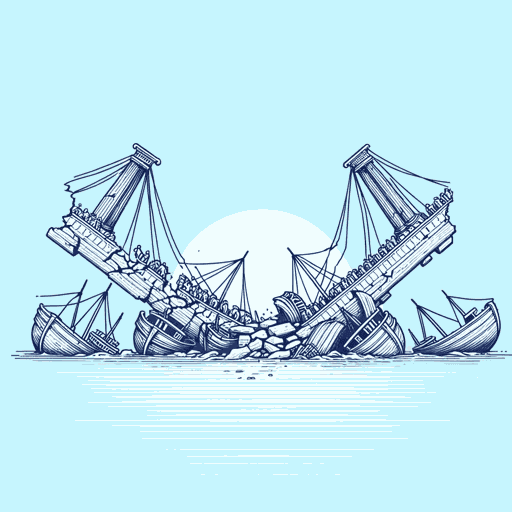
The chorus describes the boat bridge built by Xerxes to cross into Greece. This bridge spanned the Hellespont, the modern day Dardanelles or Strait of Gallipoli. In the play, it is both a symbol of the might of the Persian fleet and an act of hubris that causes their defeat at Salamis.
“But what man can escape
the guileful deception of a god?”
(Line 114)
Ancient Greek tragedies are typically set in the world of myth and epic, where mortals must navigate the whims of a pantheon of gods, each with differing motivations and interests. Here, although Aeschylus writes about events that took place in recent history rather a legendary past, he does not deviate from the trope of hubris punished. While Xerxes thought himself a clever military leader, the gods remained on the side of the Greeks—an insurmountable obstacle.
“All hail, my Queen, most exalted among the slim-waisted
women of Persia, venerable mother of Xerxes and wife of
Darius! You were the spouse of one who was a god to the
Persians, and you are the mother of their god too, unless our
old protecting power has now changed sides against our
army.”
(Lines 155-159)
The chorus addresses Atossa, Queen Mother and consort of former king Darius. This passage indicates that Persian rulers were treated as gods by their people—at least according to Aeschylus, who juxtaposes the authoritarian model of Persian governance with Athenian democracy.
“I will tell you
a saying which is not my own creation but has come down
from our ancestors, and which causes me to be very fearful,
my friends: that great wealth may make the dust rise from the ground by tripping up the prosperity that Darius, not
without the aid of some god, had built up.”
(Lines 160-165)
Atossa is anxious that Xerxes has squandered the wealth and success of the Persian Empire in his campaign against Greece. The spirit of Darius confirms her fears, echoing her words.
“There seemed to come into my sight
two finely dressed women—one arrayed in Persian, the other
in Doric robes, outstandingly superior in stature to the
women of real life, of flawless beauty and sisters of the same
stock: one, by fall of the lot, was a native and inhabitant of the land of Greece, the other of the Orient.”
(Lines 183-187)
Atossa’s dream depicts her son, Xerxes, attempting to yoke two women of mythic stature to his chariot. This dream proves prophetic; the woman representing Greece breaks her yoke and throws Xerxes from his chariot, foreshadowing his defeat at the Battle of Salamis.
“Then I saw an eagle fleeing for
refuge to the altar of Phoebus—and I was rooted speechless
to the spot with terror, my friends. Next I saw a hawk
swooping on him at full speed with beating wings and tearing
at his head with its talons—and he simply cowered and submitted.”
(Lines 205-210)
The omen of the hawk attacking an eagle that Atossa sees upon waking from her prophetic dream compounds her anxieties for her son. As the augury is interpreted, the larger eagle—a bird often symbolizing monarchical power—represents Persia, while the smaller hawk stands for Greece. Like the queen’s dream, this foreshadows the news of Xerxes’ defeat.
“The shores of Salamis, and all the regions near
them, are full of corpses wretchedly slain.”
(Lines 272-273)
Xerxes’ invasion of Greece turns into a total rout when a double agent tricks him into believing the Greeks plan to flee. The overly confident Xerxes is an easy mark: The false spy simply tells him what he wants to hear, and there are none to speak truth to power. In the battle, the Greek ships decimate the Persian fleet and the shipwrecked survivors are slaughtered in the open sea. Proper burial of the dead was highly important in Greek society; the image of unburied dead strewn on the sea and shore serves as a rare, horrific imprecation to Greek brutality.
“Chorus: Ah, how I groan when I remember Athens!
Messenger: She is indeed hateful to her foes:
we can remember well
how many Persian women they caused
to be bereaved and widowed, all for nothing.”
(Lines 286-288)
Xerxes’ defeat at Salamis is a painful reminder of his father Darius’s earlier defeat at Marathon, a battle in which Aeschylus himself fought. This quote is an example of Aeschylus’s nationalism, playing up the military might of his nation-state.
“Come on, sons of the Greeks, for the freedom of your homeland,
for the freedom of your children, your wives, the
temples of your fathers’ gods, and the tombs of your ancestors!
Now all is at stake!”
(Lines 402-404)
At Salamis, the Persians fought for colonial conquest, while the Greeks fought to protect their homeland—a motivation that gave a morale boost to the Greek defenders, who used the terrain and geography of their archipelago to repel an invading force more than triple their number. Whereas the Greek forces were mostly comprised of well-equipped free men, many of the Persian forces were conscripts, with less motivation for victory.
“O cruel divinity, how I see you have beguiled the minds
of the Persians! My son has found his vengeance upon famous
Athens to be a bitter one; the Eastern lives that Marathon
had already destroyed were not enough for him.”
(Lines 474-475)
One of Xerxes’ many faults is his inability to learn from the past. His father’s loss at Marathon should have dissuaded Xerxes from invading Greece. Instead, he hubristically sought revenge and paid dearly for it.
“He thought he could stop the flow of the Hellespont,
the divine streams of the Bosporus, by putting chains
on it, as if it were a slave; he altered the nature of its passage,
put hammered fetters upon it and created a great pathway
for a great army. He thought, ill-counselled as he was, that
he, a mortal, could lord it over all the gods and over Poseidon.”
(Lines 746-751)
Building a bridge over Hellespont is interpreted as an affront to the sea god, Poseidon. This is an act of hubris, a common tragic flaw of many characters in Greek tragedy. Although slavery was a fact of Athenian society as well as that of Persia, with this passage—along with Atossa’s dream of Xerxes attempting to use giant women as beasts of burden—Aeschylus points to the Persians’ mistreatment of even this low caste of society.
“I tell you this plainly, my old contemporaries: take all of us together who have held this kingship, and we will not be found to have caused this much suffering.”
(Lines 785-787)
Though Darius also lost a battle against the Greeks, it is implied that his defeat was nowhere near the scale of Xerxes’ defeat at Salamis. Darius describes the virtues of his lineage, indicating that Xerxes has endangered the future of the Persian empire through his misstep.
“Look on at the price that is being paid for
these actions, and remember Athens and Greece: let no one despise the fortune he possesses and, through lust for more, let his prosperity go to waste.”
(Lines 824-826)
Aeschylus implies that Persia was so thoroughly defeated at Salamis that they will never attempt to invade Greece again. However, he wrote this knowing that history had already proved him wrong—Persia invaded Greece a third time only a year after this battle. Possibly, Aeschylus meant this forecast to be taken in the abstract rather than the concrete—eventually Persia’s might and reputation would crumble, while those of Greece would remain for all time.
“You do stir up in me
a longing for my brave comrades,
speaking of unforgettable, unforgettable things, hateful
beyond hatefulness.
My heart cries out, cries out within my body!”
(Lines 887-890)
Xerxes and the chorus engage in a ritualistic exchange of lamentations, punctuated by moans. Xerxes does not attempt to hide from the pathos of his situation, but rather embraces it, allowing the chorus to chastise him for his costly mistake. Aeschylus thus presents the Persian king in a sympathetic, if deeply humiliating, light.

Unlock every key quote and its meaning
Get 15 quotes with page numbers and clear analysis to help you reference, write, and discuss with confidence.
- Cite quotes accurately with exact page numbers
- Understand what each quote really means
- Strengthen your analysis in essays or discussions