The Persians
The Persians
A modern alternative to SparkNotes and CliffsNotes, SuperSummary offers high-quality Study Guides with detailed chapter summaries and analysis of major themes, characters, and more. For select classroom titles, we also provide Teaching Guides with discussion and quiz questions to prompt student engagement.
Summaries & Analyses
Quizzes
NEWReading Tools
Themes
Contrasting Modes of Leadership
Athens, now commonly regarded as the birthplace of Western democracy, was the host of the Dionysia festival where The Persians won first prize. It’s not surprising then, that Aeschylus’ play questions the governing structure of the Persian Empire—Athens prided itself on the fact that its citizens were free from the rule of a king. Aeschylus really plays up the absolute power of monarchs: The chorus describes Darius as “one who was a god to the / Persians” (Lines 157-58), and they declare that Xerxes may be “a god too, unless our / old protecting power has now changed sides against our army” (Lines 158-59). Atossa, before learning of her son’s defeat, notes that he is not accountable to the people; his defeat would be bad for Persia, but he would remain in power. The ancient world had other unaccountable, deified leaders, such as the Egyptian pharaohs; however, this kind of power dynamic ran contrary to the ethos of Aeschylus’s society. Even Pericles, the powerful Athenian leader who was the chief sponsor of the Dionysia festival during which The Persians was performed, was constrained by democratic limits. While the wars described in The Persians were fought by a coalition of Greek city-states led by Athens and Sparta (a famously totalitarian society), Aeschylus’s audience widely accepted that the ethos of freedom was instrumental in the Greeks’ success against superior Persian numbers.
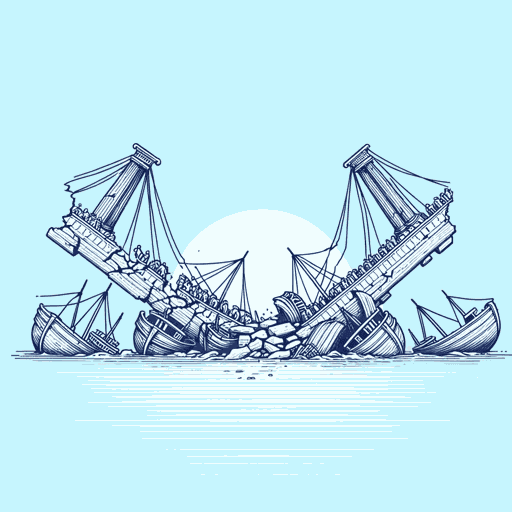
Within the play, Xerxes is portrayed as a particularly bad king. Unlike his ancestors, whose accomplishments and glories were a seemingly unbroken line of triumph, Xerxes makes foolish mistakes and overreaches. It is particularly significant that the character who most highlights Xerxes’ failures is the ghost of his father Darius. Although Darius was also a former foe of Greece, Aeschylus’s play respects him as a worthy and wise ruler—someone who does not abuse his power to doom his people to destruction and leave his cities vulnerable to attack. Xerxes, on the other hand, is impulsive. His attempt to bridge the ocean, the realm of the god Poseidon, is an act of hubris, or excessive pride; however, because of his role in Persian governance, no one can stop him or argue with his vision. The gods view Xerxes’ ship-bridge as an affront. Echoing their leader’s impiety, Xerxes’ armies “plunder the images of the gods and set fire to temples” (Line 810). In Greek literature and mythology, hubris does not go unpunished; Aeschylus’s audience would have recognized this as the cause of Persian defeat.
Athenian and Greek Nationalism
The Persians premiered in the Dionysia festival only eight years after the events it dramatizes. Xerxes’ failed invasion and defeat at the Battle of Salamis was a major victory for the allied Greek forces: Persia’s second invasion of Greece was thwarted, and the battle demonstrated that Greeks could win even when vastly outnumbered. In portraying this historical event, Aeschylus’s play participates in an important function of the Dionysia festival: promoting Athenian cultural nationalism. Throughout decades of war against the larger Persian Empire, and against other Greek city-states, Athens developed a robust ethos of national pride, which worked its way into the Dionysia tragedy competition. Many plays featured themes of xenophobia and Athenian superiority; a playwright whose work questioned this attitude was fined as punishment.
In The Persians, Aeschylus emphasizes the glory of Athens through a carefully curated version of the Battle of Salamis that excludes any mention of Greek deaths and foregrounds Persian foreignness. Aeschylus’s play depicts a thoroughly defeated Persia: The chorus, the ghost of Darius, and even Xerxes agree that the decisive defeat may even be a deathblow to the ancient empire. This, however, ignores history that Aeschylus knew: The Persian Empire sacked Athens the year after their defeat at Salamis; moreover, Greek victory was costly, most notably during the Battle of Thermopylae in 480 BC, when allied Greek forces, led by King Leonidas of Sparta, held off the Persian army by sacrificing their own lives. Additionally, in the play, the audience never loses sight of differences between Persians and Greeks. The Persian kings consider themselves gods—an attitude that reads as hubris to Greek sensibilities and is shown to be suitably punished when Xerxes angers Poseidon with his bridge of ships. Although the play treats Darius and Atossa respectfully, the play’s older characters are clearly relics of a now-gone past: neither the chorus of counselors, nor Darius, nor Atossa has any influence over Xerxes’ decisions—unlike the Athenian democratic system that prizes consensus.
Foreshadowing, Omens, and Prophesy
In The Persians, foreshadowing, prophesy, and omens—all of which foretell the catastrophic defeat of the Persian army and herald the decline of the Persian Empire—come from Xerxes’ parents, Atossa and Darius. Xerxes’ failure indicates how he has squandered the wisdom of past generations.
Queen Atossa’s dream of a woman representing Greece knocking Xerxes from his chariot reflects her fears about her son’s military campaign. Directly upon waking from the dream, Atossa sees a bird augury omen that reinforces the meaning of her earlier vision: An eagle, a bird representing royalty and empire, is forced to take shelter in the temple of the sun god after being attacked by a small hawk, foreshadowing the defeat of the massive Persian army by the smaller Greek coalition.
In classical mythology, Greek heroes often make pilgrimages to hear from the spirits of the dead, who offer oracular pronouncements and admonitions. The Persians includes this trope with the ghost of Darius the Great, who is summoned by Queen Atossa and her counselors. Although Darius is summoned to console his mourning courtiers and widow, he does the opposite, prophesying the downfall of the Persian Empire: “I am afraid the great wealth I gained by my labours / may be overturned and become the booty of the first comer” (Lines 752-53). Because of Xerxes’ folly, the hard-won accomplishments of his ancestors will come to nothing.

Unlock every key theme and why it matters
Get in-depth breakdowns of the book’s main ideas and how they connect and evolve.
- Explore how themes develop throughout the text
- Connect themes to characters, events, and symbols
- Support essays and discussions with thematic evidence