61 pages • 2-hour read
The Romance of the Forest
A modern alternative to SparkNotes and CliffsNotes, SuperSummary offers high-quality Study Guides with detailed chapter summaries and analysis of major themes, characters, and more.
Symbols & Motifs
The Abbey
Content Warning: This section of the guide includes discussion of death.
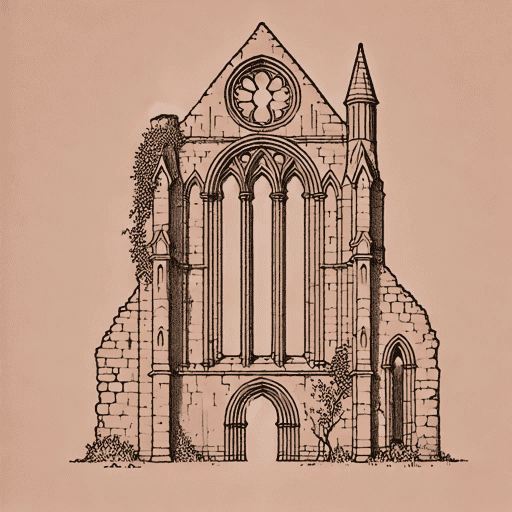
The Abbey of St. Clair, situated in the Forest of Fontanville, provides a setting that comes to represent not only the dangers of Adeline’s past but also the uncertainty of her present and future circumstances. Described as a ruin with a few habitable rooms and a plethora of hidden passageways and ancient chambers, the abbey initially supplies the story with the Gothic backdrop that is characteristic of the genre, complete with a sense of decayed grandeur and ruin. This is a suitable backdrop to illustrate the change in La Motte’s fortunes, as he flees the modern, sophisticated city of Paris for this crumbling relic of a bygone age, where regret for his actions haunts him as much as the possibility of ghosts. This trace of a past time considered more stern and brutal than their present age also lends an appropriate backdrop to the Marquis’s actions, which escalate from unwanted courtship to kidnapping to murder.
The hidden aspects of the abbey, however, put Adeline in contact with her past, though she initially isn’t able to claim it as such. The dream, the storm that leads her to discover the hidden chambers where her father died, and the manuscript he wrote during his captivity are connections that will legitimize her as his heir. The abbey, initially a place of uneasy refuge, comes to represent a prison for Adeline, one she tries to escape twice. The success of her second attempt signals Adeline’s growing maturity and autonomy as a character. Though still dependent, she has fallen in love and found an ally in Theodore, and seeing the true nature of the Marquis makes her all the more determined to escape his influence.
Eventually, all the characters leave the abbey behind as the imagined terrors of their situation give way to more immediate dangers of incarceration when the Marquis makes his various charges. The abbey setting, with its lingering atmosphere charged with rumors of past tragedies and the dread of the unknown, is no longer needed as the characters face a more contemporary and realistic threat in the villainous Marquis.
The Forest
Forests in literature have a long history of representing wild places that pose the antithesis to cultivated or civilized spaces. Forests are equally as often sites of danger or transformation. In medieval romances like The Romance of Tristan by Béroul (1150), Perceval, the Story of the Grail by Chrétien de Troyes (1181), or Le Morte d’Arthur by Thomas Malory (1485), forests are sites where the adventurous knight is challenged and must rely on his strength and wits to overcome an adversary. (The Romance of the Forest recalls this definition of the romance as, in its most general sense, a tale of adventure; the love story comes to characterize the romance only in its more modern usage.)
The Forest of Fontanville retains this sense of the forest as a place of threat or danger as much as it is a refuge for the wanderer. While the forest is intimidating in the dark of night and storms are frequent, the forest also offers a setting of tranquil peace and inspiring calm for Adeline. The deer are so tame that they let her pet them, representing Adeline’s powerful innocence. Her long walks in the forest are a soothing exercise, particularly when her mind is troubled. And her first meeting with Theodore takes place in the forest, when she thinks he is a simple huntsman, likewise lending that encounter a sense of innocence. Able to either intimidate or shelter, the forest in the novel provides a wild natural setting that provides a contrast to the other communal settings of town and village. Ultimately, it becomes a place where characters’ true selves emerge.
The Manuscript
The manuscript that Adeline finds in what serves as the dungeon of the abbey comes to supply tangible proof of the current Marquis’s crimes. It also serves to foreshadow and symbolize Adeline’s connection to her past. In a sense, the diary of the unidentified prisoner functions as a Gothic tale of its own, a narrative that spurs terror and pity in Adeline. Adeline is moved by his expressions of despair, outraged at the injustice of his being imprisoned for no crime and, at certain points, so overcome by suspense and dread that she cannot read further. In this way, the manuscript signals the power of fiction to move the imagination.
Later, when she realizes the man who wrote this manuscript is her father, Adeline recovers the manuscript from La Motte as she considers it a family heirloom and one of the few connections she has to a parent. The manuscript then symbolizes her heritage. The prisoner’s account of his woes demonstrates that he has the same keen sensibility that Adeline has, confirming the kinship and thus Adeline’s right to succeed as his heir.
The Seal
Like the manuscript, the seal that Adeline uses on her letters comes to symbolize the one connection she has to the mother who died at her birth. From ancient times, a seal was a unique symbol that could identify the author of a document. With the advent of paper and letter writing, drops of wax closed the letter or envelope so it could only be read by the recipient, and a seal in the wax could identify the sender. Noble or important families often passed on seals that symbolized their lineage, or a seal could be a personal artifact. Both senses are represented by the seal Adeline uses, which turns out to belong to her birth mother.
In the novel, the seal also functions as a plot device that leads the Marquis to guess at Adeline’s identity because he recognizes the symbol as belonging to her mother’s family. The seal’s journey to Adeline’s hands is as complicated as her journey. After the current Marquis murdered his brother, the seal came into his possession along with his brother’s title and all his other property. When he took away the infant Adeline on the Marquis’s orders, Jean d’Aunoy stole the seal and other assorted small items of value. His wife used the seal, but when she died, it became Adeline’s and was one of the few possessions she took to the convent with her. In this way, Adeline managed to retain a connection to her mother, even though she didn’t know who her birth mother was. It can be assumed that, when she inherits the marquessate, Adeline continues to use the seal, thus signifying her legitimate possession of her family’s property and titles and confirming her fully revealed identity.

Unlock the meaning behind every key symbol & motif
See how recurring imagery, objects, and ideas shape the narrative.
- Explore how the author builds meaning through symbolism
- Understand what symbols & motifs represent in the text
- Connect recurring ideas to themes, characters, and events