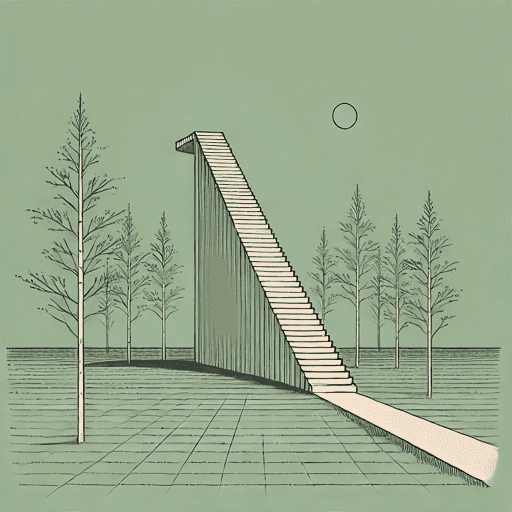
The Staircase in the Woods
62 pages • 2-hour read
Chuck WendigThe Staircase in the Woods
A modern alternative to SparkNotes and CliffsNotes, SuperSummary offers high-quality Study Guides with detailed chapter summaries and analysis of major themes, characters, and more.
Background
Content Warning: This section of the guide includes discussion of death and physical abuse.
Genre Context: Urban Fantasy
Urban fantasy might sound like a relatively new subgenre of fiction, but scholars identify Mary Shelley’s Frankenstein and Bram Stoker’s Dracula as early examples. Subverting the common convention of fantasy stories that are linked to sylvan settings, urban fantasies often take place in or near cityscapes or other human-made locales, while also tapping into archetypes of the eternal, paranormal, and deeply powerful that exist outside the scope of typical human understanding: “At its best, urban fantasy is not only enthralling. It offers a new way to understand our own urban existence” (March-Russell, Paul. “Urban Fantasy Novels: Why They Matter and Which Ones to Read First.” The Conversation, 18 May 2020). This is what happens in The Staircase in the Woods, the action of which begins in the forest of Bucks County, outside of Philadelphia, Pennsylvania, and resumes in a forest outside of Boston, Massachusetts.
In the novel, the combination of the post-World War II housing boom that led to rapid suburbanization and the deeply profound trauma caused by the war coalesced to create an environment in which despair and violence prosper. Veterans like Alfie Shawcatch came home and attempted to find a form of “peace” away from the horrors in concentration camps and on the battlefield. By moving out of city apartments and into single-family homes, they found a level of privacy that seemed to guarantee them the peace and quiet they craved. However, in the novel, this privacy allowed Shawcatch’s despair (and illness) to fester unchecked, and he enacted horrific violence on his family. This fictional crisis reflects the grim reality that increases in domestic violence after periods of conflict—like war—are common, as “[a]n end to violence in the public sphere is widely seen to precipitate the escalation of violence in the private sphere” (Bradley, Samantha. “Domestic and Family Violence in Post-Conflict Communities.” Health and Human Rights Journal, vol. 20, no. 2, pp. 123-36, 2020). Thus, although Shawcatch may be imaginary, his story is based on a very real phenomenon.
In the novel, this domestic violence creates a supernatural entity consisting of those homes that have witnessed the worst of humanity. This sentient being feeds on human brutality and craves more of it. By creating a physical manifestation of humanity’s deepest flaws and crimes, the author utilizes “[u]rban fantasy’s mix of past and present, natural and supernatural, seen and unseen” to examine “Freud’s description of the psyche, in which planes of human activity are layered one upon the other” (March-Russell). In the world of the novel, rooms that have witnessed intense human suffering are layered on top of one another in this supernatural “house,” building atop Shawcatch’s original house of horrors, which lives at its very heart.
Thus, the postwar suburban setting is intrinsically linked to the creation of the monstrous house, which gains agency as it witnesses humanity’s worst impulses. The house claims to have had such potential, to have been “a place of promise. Not merely a house, but a home. A place of love, a place of family” (371), but it becomes a nightmarish place where humans—like Shawcatch and Owen’s and Nick’s fathers—do their worst. In Wendig’s approach to urban fantasy, this specialized subgenre is blended with the conventions of horror to represent a new way of interpreting human experience and emotion.

Unlock all 62 pages of this Study Guide
Get in-depth, chapter-by-chapter summaries and analysis from our literary experts.
- Grasp challenging concepts with clear, comprehensive explanations
- Revisit key plot points and ideas without rereading the book
- Share impressive insights in classes and book clubs