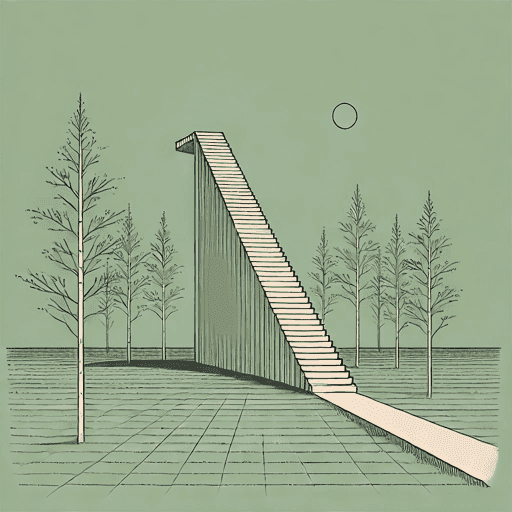
The Staircase in the Woods
A modern alternative to SparkNotes and CliffsNotes, SuperSummary offers high-quality Study Guides with detailed chapter summaries and analysis of major themes, characters, and more.
Summaries & Analyses
Quizzes
NEWReading Tools
Themes
Content Warning: This section of the guide includes discussion of child sexual abuse, child abuse, emotional abuse, suicidal ideation, self-harm, mental illness, substance use, and cursing.
The Importance of Found Family
Each of the five main characters, including Matty, has—at best—a problematic home life. At worst, they are subjected to emotional, physical, and sexual abuse that continues to haunt them well into adulthood. As children, these characters find one another and come together to create a loyal friend group, which they call the “Covenant.” This lofty name suggests the solemnity and intensity of their bond. In referring to themselves as the Covenant, they implicitly recognize that these relationships are more significant than their familial connections
For the five friends, the Covenant provides them with a sense of “home” that they lack in their own families’ houses. The group provides “[a] safe space, a found family, a real home, existing wherever they each [a]re at any time—they c[an] always shelter in place with one another” (70). Because Lauren is habitually abandoned by her uncaring mother, she harbors feelings of worthlessness that are only relieved by the presence of her friends. Prior to their camping weekend, she thinks, “Alone, alone, alone. Well, not this weekend. This weekend […] it was getting away from this home and going to her real home, which was wherever the crew was hanging out” (67). Thus, the friend group ends up providing more support and love than the teens’ families ever do. Even as adults, when they find themselves trapped in the house, they have the ability and desire to soothe and comfort one another. Even the adult Hamish, who has a terrible self-image, admits that he only managed to break free of his conviction that he was “some dumb, fat kid” when he spent time with the group (280). The love of his friends gives Hamish confidence in himself, something he lacks in their absence.
However, the word “covenant” indicates an agreement that can never be dissolved. Those who honor a covenant will benefit from its terms, but those who break it will suffer consequences; there is no way to break free of this bond entirely. The dynamics of the friend group reflect this reality when the adult friends find themselves haunted by their failure to search for Matty after his disappearance. It therefore follows that only by resurrecting the Covenant and working together can they save Nick and escape the dark influence of the house. As Owen says, “We’re all really fucked up and just trying to get through life, and it’s better when we do it together instead of alone. […] That’s how we’ll get out of this place” (333). After Nick tells the story of Dan Harrow and Alfie Shawcatch, the narrative suggests what Lore and Owen both already suspect: that the house wants them alone in order to prey on their fears and weaknesses. When they refuse to abandon Nick as they did Matty, this act of faith ultimately exorcises the demonic house.
The Long-Term Effects of Trauma
The friends’ experiences repeatedly demonstrate the lasting consequences of serious trauma, as they have survived emotional and sexual abuse and the grief of losing a dear friend, along with many other incidents in their adult lives. As the four remaining friends struggle to manage their intense feelings of worthlessness, emotional pain, debilitating guilt, and self-destructive coping mechanisms, they must come to terms with the aftermath of their trauma to escape the physical and psychological prison of the malevolent house at the top of the staircase.
The painful significance of lifelong trauma is felt most keenly by Owen, who broadcasts his ingrained anxiety from the very beginning of the novel by chewing his fingernails to the point of injury. This behavior is linked to his traumatic childhood, and when the dynamics of the friends’ reunion convince him that Lore has left him behind, this perception retraumatizes him. When the group first encounters Marshie, Owen suddenly understands her preoccupation with “[t]he worries, the anxieties. The unreturned love. That feeling deep down in you that you’re not good enough, not anything, that you’re just […] a hole that sucks the light out of the room, out of the world” (137). This feeling prompts Owen to self-harm and, later, to self-isolate. Because he felt worthless and expendable as a young man, this experience paves the way for his sense of hopelessness in middle age. Because he has been so deeply wounded by his father’s years of emotional abuse, he sees words as “[a] razor sliding across the meat of your heart” (181). In short, he is so traumatized that he anticipates being wounded again and again, and he interprets every such injury as further evidence of his own insignificance.
In addition to Owen, Nick and Lore experience their own traumas that result in intense loneliness. The trauma of losing Matty provokes painful consequences for Nick because he feels that he, too, has been let down by his friends. They never noticed that his father was abusing him, and their blithe perception of his father as the “Cool Dad” further isolated him. Likewise, when his friends disregard his attempts to search for Matty, he pursues this goal alone, and his vulnerability and unresolved trauma render him easy prey for the house. In Lore’s case, her mother’s neglect led her to interpret Matty’s rejection of her LSD as a similar form of emotional abandonment, and because she felt “judged” and “hurt,” she began “pretending that she didn’t need him, didn’t need any of them,” and in her mind, “that was when it all started” (370). Even as an adult, Lore convinces herself that she is better off alone, and this harmful coping strategy hurts both her and her friends until her experiences in the house help her realize the importance of remaining true to her bonds of friendship.
The Pervasive Nature of Guilt
Certain kinds of trauma can lead to tremendous guilt, especially when the traumatized individuals blame themselves—accurately or not—for those experiences. Guilt also has the power to make people believe things about themselves that are untrue, distorting reality and warping identity. This guilt can wear away at people until they grow even more susceptible to self-blame in the future. This dynamic is especially evident in the wake of Matty’s disappearance and his friends’ refusal to accompany him up the staircase. When teenage Owen talks to the police, he “scream[s] at himself inside his head,” saying “This is your fault […] You stupid baby. You could’ve gone after him. But you didn’t. This is your fault, you weak, scared, stupid piece of shit” (61). Rather than simply chastising himself for being disloyal in a particular moment, Owen condemns his entire existence, labeling himself with harsh, demeaning terms that warp his sense of identity and go on to poison his self-regard even in adulthood. Lore similarly labels herself with cruel epithets when she finds herself in the house’s thrall. By blaming herself for every misfortune that has befallen her friends in the wake of Matty’s disappearance (for which she feels responsible), she focuses on one mistake and makes it a central feature of her character. She doesn’t realize that she was merely a scared child at the time; instead, she thinks of herself as a “stupid bitch”(187), internalizing a punishing degree of worthlessness and blame. Owen’s and Lore’s guilt causes them to reframe their understanding of themselves, and they realize that they were forced to make an impossible choice when they were young.
Likewise, Hamish’s guilt compels him to believe that he “deserves” to be in hell and that he is “a fucking epic piece of shit” (235). His drug use reflects his maladaptive attempt to deal with the trauma of losing Matty. This addiction caused a near-death experience that resulted in additional trauma, but rather than giving himself the latitude to realize that he simply needed support to overcome his fears and addiction, he began to punish his body instead. Even as an adult with an established family, he has kept his loved ones at a distance and did not tell his wife about Matty or the overdose. In the house, all the reasons for his shame crowd into his mind, overwhelming him with the misguided conviction that he is an awful person who deserves blame rather than love, forgiveness, or understanding. His struggles illustrate the myriad ways in which guilt can warp a person’s thinking.
The Duality of “Home”
The friends’ experiences show that although a family home is conventionally seen as a sanctuary, it can just as easily become a place of intense pain when a family’s circumstances and dynamics do not live up to this promise. Just as parents are supposed to protect and support their children, homes should be safe spaces, but parents who are corrupted by their own pain create disastrous spaces that stand as silent witnesses to abuse and trauma. Thus, the novel personifies homes, especially those that host human suffering, and this unique storytelling premise draws attention to the double-edged nature of a home as a place that can both offer peace and inflict pain.
Although the Covenant is formed to help the friends to survive the challenges of school, it also provides them with a sense of belonging and support that they each lack at home. In fact, the friends come together in order to avoid being home. As the narrative states, “Lore was always alone at her house […] Owen knew the people at his house didn’t want him there […] Hamish’s parents fought like you wouldn’t believe […] and Nick needed people other than his dad to hang out with, even though everyone loved his dad” (69). Matty is the only one who does not hate his home, but his friends are well aware that even his relationship with his narcissistic parents is not healthy. Because the friends’ homes are not physically or emotionally safe, they find a new haven in each other, reclaiming a sense of “home” that their families fail to provide them.
However, because the friends are keenly aware that physical houses can harbor more pain than comfort, the adult Owen soon realizes that the people inside the supernatural house “are just the house’s memories. What it saw. What it felt. People being monsters to one another inside the walls of their home. A place that was supposed to be safe but wasn’t” (315). Notably, although a home can be a “retreat from the world” (339), this phrase can take on a sinister connotation when a home’s inhabitants (like Nick’s and Owen’s fathers) behave in ways that would never be tolerated in the open. Both men could be their abusive selves in relative safety within the confines of their houses, but this safety for them rendered their sons inherently unsafe. Nick refers to this dynamic in the Interlude when he says that a home can provide a place “away from prying eyes where you can finally drop the mask, lose the pretense, and be who you need to be. It is necessary and it is good. Until, of course, it’s not” (338). Thus, a “home” has the potential to be good or bad, safe or threatening, in large part due to the privacy that its four walls afford its inhabitants.

Unlock every key theme and why it matters
Get in-depth breakdowns of the book’s main ideas and how they connect and evolve.
- Explore how themes develop throughout the text
- Connect themes to characters, events, and symbols
- Support essays and discussions with thematic evidence