62 pages • 2-hour read
The Staircase in the Woods
A modern alternative to SparkNotes and CliffsNotes, SuperSummary offers high-quality Study Guides with detailed chapter summaries and analysis of major themes, characters, and more.
Chapters 0-17Chapter Summaries & Analyses
Content Warning: This section of the guide includes discussion of illness, child death, child abuse, mental illness, substance use, and cursing.
Chapter 0 Summary: “The Heart of It”
Lauren “Lore” Banks cradles Owen Zuikas’s head in her lap, though neither character is named yet. She explains that friendship is like a house. Each friend has their own room, so to speak, but there are many shared spaces. The house is a place of fun and laughter, but it also contains frustration and pain. The air can go bad, mold can grow, and friends can move out, leaving the house empty.
Chapter 1 Summary: “Owen: May 30, Pittsburgh, PA”
Owen is sleeping, but his buzzing cell phone wakes him. He declines a call from his childhood friend Lore. As he looks around his bland apartment, he feels that he doesn’t “deserve” anything better than these mediocre surroundings. Lore calls again and tells him to check his email. He sees a message from their mutual friend Nick Lobell and is shocked by the contents. As the call ends, Owen stares at the email for the next hour.
Chapter 2 Summary: “The Email”
In the email, Nick tells his three childhood friends—Lore, Owen, and Hamish Moore—that he has pancreatic cancer and will soon die. He is invoking the “Covenant” (a solemn agreement that the friends made years ago to support and protect one another). Now, Nick is summoning them all to his home in New Hampshire before he dies. Nick has attached a plane ticket for each of them.
Chapter 3 Summary: “Invocation”
Lore calls Owen again. She is persistent, and this trait makes her successful in life. By contrast, Owen reflects that Nick is a “human cigarette.” Lore urges Owen and Hamish to go to New Hampshire, saying that they all owe this to Nick. She also stresses the fact that he has invoked the Covenant. Owen points out that they broke the Covenant long ago, but Lore convinces him to get on the flight tomorrow. He reflects on his resentment of her success as a game developer, bitter about the fact that she achieved her success by making use of the creative ideas that they developed together. Owen feels that she left him behind.
Chapter 4 Summary: “Lore: May 30, Seattle, WA”
Lore is supposed to be working, but she has been creatively stuck for six months. She takes a pill to get her brain moving. Usually, these “little microdose” mushroom capsules allow her to work efficiently, but not this time. She needs to make more capsules, so she goes to her bedroom to retrieve the mushrooms from the box that Owen bought for her, musing over how much she misses him. However, she feels that he is better off not using her as a crutch anymore. She looks in the mirror and sees a vision of the group’s fifth friend, Matthew “Matty” Shiffman, who has long been lost. The image winks at her, and she cries out. Lore knows that she is seeing Matty because she has been affected both by the mushrooms and by Nick’s email.
Chapter 5 Summary: “Nailbiter: May 31”
Owen tells his boss that he can’t work for the next several days because he must attend a funeral. On the plane, Owen bites off his thumbnail, causing his thumb to bleed. He has obsessive-compulsive disorder and is particularly susceptible to obsessive and intrusive thoughts. However, he was forced to stop seeing his therapist because he couldn’t afford it. Now, he fears the prospect of seeing his old friends and dreads their judgment on how little he has accomplished.
Chapter 6 Summary: “What They Each Wanted”
Lore just wants to have fun with her friends, just like old times, but with Matty gone, Nick dying, Hamish being a “douchebag,” and Owen being Owen, she just hopes to survive the experience. Owen hopes that it will feel like they’ve never been apart and that Nick will be his funny self. He envisions them toasting Matty, who was the best of them, but he knows that this fantasy is unlikely.
Chapter 7 Summary: “You Are Three, You Come With Me”
Lore, Hamish, and Owen meet outside the baggage-claim area. Owen is immediately annoyed by Lore, who is trying too hard to be “cool.” Hamish looks completely different; he is muscular now, and his former bulk is gone. Lore’s hug feels “ill-fitting,” and Hamish’s feels like hugging a rock. They discuss Nick, and Owen suggests that they do whatever Nick wants and give him whatever he needs during this weekend. They all agree, and soon, a chauffeur drives them to Nick’s home.
Chapter 8 Summary: “Vehicular Combat”
In the car, Hamish talks about his three children, and Lore confronts him about voting for Creel, a politician that she dislikes. He admits that he did vote for Creel once, but not again. When Lore accuses him of taking “red hat selfies” and going to “Nazi rallies” (35), Owen tries to defuse the situation, but Lore is determined to pick a fight.
Chapter 9 Summary: “This Is Not the Hotel”
Lore falls asleep and wakes when Owen asks the driver where they are. They are in the woods, and Nick is waiting. Hamish gets out and gives Nick a bear hug, and Nick shouts, “The Covenant!” Owen and Nick hug too, though they were never close. Nick grins in the same way he always did. The car pulls away, and Lore realizes that she has no phone signal. Nick urges them to trust him and tells them that they will be going camping. Hamish says that they ought to do what Nick wants. As a cold wind blows, they go into the woods.
Chapter 10 Summary: “A Walk in the Woods, Part Two”
Owen’s personal rule is to never go into the woods, and he hasn’t done so ever since Matty was lost. Thinking again of Lore’s career as a game developer, he cannot restrain his bitterness toward her for making “their” game without him. He believes that she sees him as dead weight, so he tells her to go ahead into the woods without him. She does.
Lore wants the group to purge the figurative poison that taints them; she compares it to bloodletting. Suddenly, she hears Matty’s voice in her ear, asking if she is all alone again. No one else hears the voice, but she feels as though she is being “summoned.”
Chapter 11 Summary: “Sour Times”
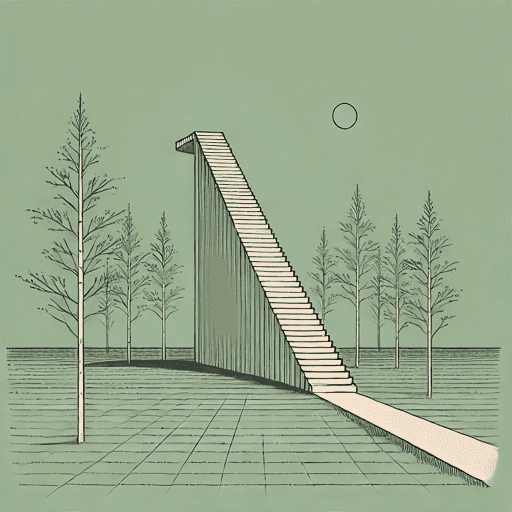
Owen can’t chew his fingernails, so he chews his lip instead. Hamish asks if Owen is angry at him too, but Owen claims not to be. Hamish admits that Nick is angry at him because he never responded to any of Nick’s emails over the years; he says that he has been trying to move forward, while Nick has remained stuck in the past. Owen grows more anxious as they walk. He reflects that his childhood home wasn’t a home at all, and he begins to feel sick. Suddenly, Lore, Hamish, and Owen see a staircase to nowhere standing alone in the woods.
Chapter 12 Summary: “The Second Staircase”
The trees seem to bend away from the staircase, as if they are frightened of it. Nick admits that there is no campsite, and Owen vomits. Nick declares that they must fix a mistake that they made years ago.
Chapter 13 Summary: “Where Is Matty Shiffman? June 13, 1998”
The narrative shifts decades into the past, focusing on the days following Matty’s disappearance. Detective Doore questions a young Owen about the incident. She says that Owen’s, Nick’s, Hamish’s, and Lauren’s stories all match; the friends reported that when they went camping, Matty disappeared in the middle of the night, and although they looked for him, they couldn’t find him. The friends said that they then returned home; when they realized that Matty wasn’t at his house, they called the police.
Owen can tell that she thinks they’re lying. Doore knows that the group uses drugs, and she wants to know if Matty took any that night. She points out that Matty was a promising boy and asserts that someone must take the blame for this. Owen finally tells the truth: that none of them knows where Matty is.
Chapter 14 Summary: “Home Is the Place You Escape. June 5, 1998”
The narrative shifts back in time to just before the fateful camping trip. Owen is excited to go camping with his friends, but he needs to escape his house first. He is shocked when his father gives him permission for the trip. When Owen begins to explain when he’ll be back, his father says that he doesn’t care if Owen ever comes back. Owen reflects that a father who doesn’t care about his child is worse than one who hates his child.
Lauren is primping in the mirror, thinking about Matty. She knows that Owen is romantically interested in her, and they have made out a few times, but she is more attracted to Matty’s drive and ambition. She reflects that when Nick saw her and Matty kissing, he told her that Owen liked her and that she needed to choose between Owen and Matty; she chose Matty. She is excited to go camping and escape her empty house because her friends feel like home.
Chapter 15 Summary: “A Walk in the Woods, Part One”
The five kids hike up Highchair Rocks. The group’s bond of friendship arose as a way to survive school and their terrible home lives. Lauren is always alone, and Owen’s parents don’t want him. Hamish’s folks are always fighting, Nick needs someone besides his father, and Matty’s parents’ love is conditional at best. Owen is grateful for his friends because they keep him from being alone with himself. When he has difficulty with the hike, Lauren checks to make sure that he is well because she doesn’t want anything to happen to her “writing partner.” They go on talking, but when Matty calls to her, she abandons Owen. Soon afterward, Lauren beckons to the group, telling them to come and see something that she has found.
Chapter 16 Summary: “The First Staircase”
The friends behold a mysterious staircase in the middle of the woods. Matty cautions everyone against climbing it because they might get hurt. Nick says that when he was in the woods a month ago, the staircase wasn’t here. Owen thinks that if it had been here for more than a few days, it would be covered in leaves; he therefore concludes that it is not of “this world.” They leave the staircase to set up camp, but Owen looks back and thinks he sees it “shudder,” like a predator waking up.
Chapter 17 Summary: “Teen Shit”
Nick, Owen, and Hamish play a game while Matty and Lauren go off into the woods together. When Nick starts talking about Matty and Lauren having sex, Hamish invokes the “Covenant” to get him to stop, for Owen’s sake. (The five friends have made a pact, called the Covenant, to always protect each other.) Owen keeps thinking about the staircase and feels as though it is beckoning him.
Chapters 0-17 Analysis
In these early chapters, Wendig employs dual timelines to emphasize the interwoven quality of past and present. In addition to employing suggestive chapter headers, he also differentiates between the two timelines through additional signifiers, such as shifting character names. Specifically, the teenage Lauren goes by the nickname of “Lore” when she is an adult, and the use of these two names helps to identify which era Wendig is describing from one passage to the next. As the novel unfolds, details from the past will manifest in the friends’ deeply troubled adult lives, illustrating The Long-Term Effects of Trauma.
However, until the full picture is revealed, the author relies on vivid imagery to establish the novel’s ominous and foreboding mood, hinting at the hidden reality of a darker presence in the surrounding woods. Long before the novel provides its first hint of the fantastic, a prime example of the author’s use of foreshadowing occurs with Lauren, Hamish, Owen, and Nick’s initial foray into the woods for their “camping” weekend. Notably, when Owen looks back at the road and Lauren follows his gaze, they see a “pair of ink-black crows picking bits of mashed squirrel off the road” and behold the gory “[r]ed threads like wet yarn plucked by a plundering beak” (46). This graphic image of predation in progress uses a simile to suggest that the five friends are entering a realm in which similar forms of carnage—whether literal or metaphorical—will soon ensue.
Wendig also personifies the very air around the adult Owen and the preternatural staircase to create a sense of malevolent sentience in the landscape itself. Owen feels as though the air “want[s] to push him down into the scrub, into the dead leaves, until the underbrush grew over him and swallowed him up” (47). At first, Owen perceives the forest as a singular living organism that exudes an aura of danger, as though the very plants surrounding him pose a deadly threat. However, when he sees the staircase, he notes that the trees are bending away from the structure, “as if in fear,” and “none of [the greenery] dare[s] to climb the staircase” (55). The personified trees and brush, which seemed threatening to Owen just moments before, now demonstrate a visceral, cell-deep fear of the staircase itself, establishing this incongruous structure as something completely unnatural.
To further enhance the ominous mood, Wendig peppers the narrative with allusions that implicitly place the novel among the annals of the English literary canon, drawing upon the ready-made connotations inherent in such phrases that originated in William Shakespeare’s Hamlet. While the comparisons to be made here are more abstract than specific, Wendig does invoke Hamlet’s references to mortality when Owen identifies the “scent of cigarette smoke clinging to [Nick’s] car like a ghost refusing to leave this mortal coil” (34). In Hamlet, the titular character refers to death as “shuffl[ing] off this mortal coil” (III.1.75), and his psychological distress and preoccupation with death are echoed in Nick’s claim to be dying of cancer. In this context, his decision to invoke the enigmatic “Covenant” acts as a haunting of sorts, as he has called his friends back to the dangerous realm of memory. Even though Nick’s claim of illness will soon be revealed to be false, the imagery of haunting will prove central to the novel, as the five friends remain haunted by Matty’s disappearance years ago. Just as Hamlet feels that his family has moved on much too quickly from the tragic loss of his father, Nick believes that his friends have inappropriately moved on from Matty’s disappearance without doing enough to find him. As Nick asserts, “It’s time to repair an error […] We broke the Covenant. And now we have the chance to fix it” (56). However, Nick’s erratic behavior suggests that he, like Hamlet, might also be experiencing an unhealthy mental state that clouds his judgment.
Wendig also makes allusions to ancient Greek mythology when the narrative states, “Lore and Owen had been friends for a long, long time, and now they weren’t. None of them were. She knew why. There were a lot of reasons, but those reasons had one origin point, like the hydra—many heads, one body, one heart” (50). In Greek mythology, the Hydra is a nine-headed serpent. If a warrior were to chop off one of the Hydra’s heads, two more would grow in its place. In modern parlance, references to the Hydra have come to signify complex problems whose solutions merely give rise to more problems. Thus, the simile suggests that the origin of the Covenant’s destruction—Matty’s disappearance—is monstrous and complex. In this context, the as-yet-hidden demons and metaphorical monsters that plague the troubled friend group will clearly not be easy to slay.
As the remaining four friends uneasily reunite years later, their interactions, however fraught, nonetheless demonstrate The Importance of Found Family and The Dual Nature of “Home.” In their earlier years as teenagers, they forged what they call the “Covenant”—their solemn promise to support and protect one another—and they saw this sacred abstraction as a safe haven, something that none of them could find in their homes with their relatives. In the suggestively titled chapter “Home Is the Place You Escape,” a young Lauren anticipates the upcoming weekend camping trip with her friends because their presence feels more like home to her than her own house and family ever could. Lauren sees her house as no more than a place where she is always alone. Owen’s home life with an emotionally abusive father is no better, and Hamish’s home is always disrupted by his parents’ shouting. None of the teens ever experienced a supportive or loving home until they found one another and became “each other’s respite” from the world (70).

Unlock all 62 pages of this Study Guide
Get in-depth, chapter-by-chapter summaries and analysis from our literary experts.
- Grasp challenging concepts with clear, comprehensive explanations
- Revisit key plot points and ideas without rereading the book
- Share impressive insights in classes and book clubs