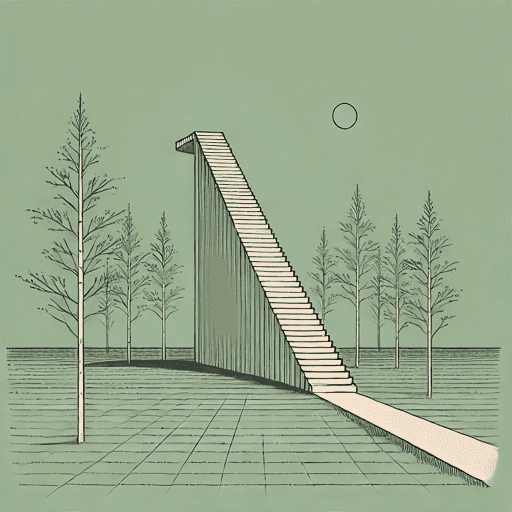
The Staircase in the Woods
62 pages • 2-hour read
Chuck WendigThe Staircase in the Woods
A modern alternative to SparkNotes and CliffsNotes, SuperSummary offers high-quality Study Guides with detailed chapter summaries and analysis of major themes, characters, and more.
Chapters 35-52Chapter Summaries & Analyses
Content Warning: This section of the guide includes discussion of graphic violence, illness, death, child abuse, suicidal ideation, mental illness, substance use, and cursing.
Chapter 35 Summary: “How to Sell a Murder House”
Lore, Nick, Owen, and Hamish enter a room labeled the “Greige Space,” which features remnants of dead fish floating in the large aquarium, as well as a sour vanilla candle and new carpet smells that feel like a sensory assault. Hamish recognizes this room from a well-known “murder house” in which a family of three once lived. As the story goes, the parents hated one another, and one day, the father beat the mother to death with a blown-glass heart that she had made. He then strangled his son.
The four friends look toward a shelf and see that very glass heart, covered in blood and matted hair. Hamish points out that none of the rooms they’ve seen have any windows, and he suggests that there may be no way out. He thinks they deserve this fate. Suddenly, Nick lashes out verbally at the group, causing Hamish and Owen to grow defensive. Seeing this, Lore realizes that the house wants them to fight, so she urges everyone to band together. Nick wants to keep moving, but Lore insists that they stay in one place and think for a moment.
Chapter 36 Summary: “Examinations”
Owen is so anxious that he wants to bite off his fingertips. As Lore examines the books on the shelves, she realizes how much more purposeful and intentional Nick now seems. Nick opens a door to find a darkened bedroom, and a different door leads to a bathroom with a shattered mirror. Meanwhile, Lore finds the book she once wrote (The Crazy Bitch’s Guide to Game Design) sitting on the shelf, but this copy is filled with many of the sexist and violent things that the men in her industry said to her and about her. She realizes that this house functions very much like a game.
Chapter 37 Summary: “Ludonarrative Dissonance”
Lore gathers the group together and explains her revelation that the house is like a game; she notes that they came through the staircase, which served as a portal. Owen picks up her point, comparing the house to a game in which the player moves through a space, opening doors and finding objects; in such games, if the player makes a wrong turn, they die. Lore insists that the group must be intentional about their next move. They eat some protein bars that she has in her backpack and try to rest. She hopes that in time, the other rooms might shift and give them more information.
Chapter 38 Summary: “The Voices”
Owen and Hamish hear voices that remind them of when their respective parents used to fight. Owen reflects that someone’s words can hurt more than their fists and recalls visiting his father, who was dying of cancer, but before he can complete the thought, he “flinch[es] at the coming memory, and cut[s] it off at the knees” (182).
When Lore hears the voices, she thinks that other people must be present in the house. Nick sleeps through the disruption until the voices get louder, and Hamish eventually realizes that the voices belong to the couple who owned the house. Lore suggests that they keep moving, but Owen resists. He realizes that he has been playing it safe all his life. They use the bathroom, one at a time, leaving the door open.
Chapter 39 Summary: “The Loneliest Number”
Lore goes into the bathroom and sees shards of the broken mirror everywhere. She gets angry at herself for pushing Matty years ago and for failing to follow him up the stairs; she then gets angry at the others for following her and reflects that she should do this alone because they are holding her back.
Suddenly, Owen bursts in, yelling at her for closing the door, but she had never touched it. Lore realizes that Owen’s entrance has chased away the angry, intrusive thoughts, and she understands that the house wants to get each of them alone.
Chapter 40 Summary: “You’re Not Scared of the Dark, You’re Scared of What’s in It”
Lore insists that they need to build a strategy, but Nick just wants to keep moving. They turn on their phone flashlights. Lore asks if Nick has his Zippo, but he claims to have lost it. Lore opens the door to the bedroom, and the group smells the antiseptic sourness of a sick room. Lore and Hamish enter first, but Owen slams the door behind them when he recognizes the man in the bed as his father. Nick opens the door again, but now the space is a playroom containing a dead Christmas tree, and Lore and Hamish aren’t there.
Chapter 41 Summary: “New Room, Who This”
Lore and Hamish see the sick man in the bed. Then, they hear the door click shut behind them. When Lore opens the door again, she finds a country kitchen. Once again, Lore thinks that she’s a step closer to going it alone, as always.
Chapter 42 Summary: “The Tear-Drowned Playroom”
Owen rips his pinky nail with his teeth, making his finger bleed. He and Nick open the door to the Greige Room, but now it’s an attic filled with boxes. On a soiled mattress, a figure that looks like a body suddenly sits up, so Owen slams the door shut. He and Nick don’t know what to do now.
Chapter 43 Summary: “The Sick Boy’s Kitchen”
Lore and Hamish enter the kitchen, and when they reopen the door, the dying man’s bedroom has become a different bedroom. Lore wonders if this liminal space is a house, given that every room is a bedroom, bathroom, or kitchen. Lore identifies this kitchen as the infamous Billy Dink’s. (His mother poisoned him to make it appear as though he had several diseases, and she then reaped the world’s sympathy and money. When he was 13, Billy caught on to her ruse and stabbed her in the kitchen.) Now, Lore can see the bloodstains on the floor. Hamish opens cupboards, finding stale food and a message in Matty’s handwriting, which reads, “THE HEART IS WHERE THE HOME IS” (203).
Chapter 44 Summary: “The Tale of Tank Thunderforge. 1998”
In the earlier timeline, the four remaining friends sit in Nick’s basement, one week after Matty’s disappearance. Owen, Lauren, and Hamish talk about how poorly their parents are handling the matter. Nick says that his parents know he didn’t do anything wrong, but Nick talked to a lawyer because Doore will not stop investigating Matty’s disappearance. Nick declares that he is going to go “full-on Tank Thunderforge” (205), referencing his old Dungeons & Dragons character, a self-hating dwarf who often protected others. He has already made a statement, in which he claimed that he brought drugs and Matty took them. Because of this statement, Nick goes to juvenile detention for six months, but everyone in the town still blames the entire friend group.
Chapter 45 Summary: “Shelter in Place”
In the present-day timeline, Nick wants to keep moving, but Owen wants to stay in one place. Owen suggests that the rooms move in a pattern, cycling through a finite number before restarting the cycle. Nick accuses Owen of always being too afraid to do anything. Nick says that he has been looking for supernatural staircases for years and emailing the group with sightings, trying to figure out what happened to Matty and convince the others to join him. Owen apologizes for not seeing matters from Nick’s perspective and asks how much Nick knows about the staircases in general. Nick “hesitates” before answering, but he says that a staircase tends to show up until someone goes missing, after which it disappears again—almost as if it leaves once it gets what it wants. Nick compares the staircase to a hunter setting a trap. Hearing this, Owen realizes that hate is an active thing, and he considers the idea that the house itself could be alive. Despite their fears, Owen and Nick try to sleep for a while.
Chapter 46 Summary: “Messages From Matty”
Lore and Hamish find other messages of Matty’s inside the cabinets. He writes about feeling the house inside his head and declares that it wants to live inside him. Other messages state that Matty will become the house, as he wants to find “THE CENTER.” Lore suspects that the house forced Matty to experience an utter break from reality. She can already feel the house’s malevolence inside her, and Hamish feels it too.
Chapter 47 Summary: “The Funeral”
In the earlier timeline, Lauren, Hamish, and Owen know that they are not welcome at Matty’s funeral, which takes place one year after he disappeared, but they attend anyway. When people are invited to speak, Lauren rises, but Matty’s mother screams at her and chases her away. Hamish and Owen follow her and find her sharing a cigarette with Nick, who has just returned from juvenile detention. He says that it is time to find Matty and that he heard about another staircase near Pittsburgh. They all refuse, wanting to move on with their lives. Nick screams at them, saying horrible things, and in this moment, the Covenant dies.
Chapter 48 Summary: “In the Mansion of Sleep”
In the present, Owen dreams of a house with one window, and that window is an eye. The house tells him to come inside, and he wanders the rooms, hearing hundreds of voices. Jolting awake, he sees Nick standing over him, looking as though he is made of parts of a house: He has windows for eyes and teeth like a fence. Suddenly, Nick looks normal again, and Owen hopes that his impression was just the remnants of the dream lingering in his mind. As Nick speaks, Owen sees something flash in his eyes, which look like windows again. Owen starts to feel that he deserves to be there with Nick and that they are both “washed up,” like Nick said. The room on the other side of the door is still the attic, so Owen suggests that they step into that room, then return to this one, and then close the door; he believes that this sequence of actions will make the rooms shift. It works.
Chapter 49 Summary: “What Hell Is”
For Lore and Hamish, the rooms never repeat. They are horrified by the contents of each new space, and sleeping is a challenge because the noises get louder whenever they try to sleep. As time goes on, Hamish finds himself overwhelmed with feelings of guilt and worthlessness when he tries to rest. He is certain that this is hell. Hamish is a Christian because he is convinced that God gave him a second chance at life—with a wife and kids and his health. However, he has been serially unfaithful to his wife, and to make matters worse, his kids are selfish, and he doesn’t understand them. He loves them, but he has treated them badly and now feels wretched. Hamish has been sober for years, but when he and Lore find a room full of empty liquor bottles, he longs for death, thinking that death could be a way to escape this place. When he sees himself in the mirror, he beholds a distorted image that is decayed and bloated. He punches the mirror, and when Lore pulls him back, he rams her in the nose. He feels guilty, as though he deserves to be there, so he grabs a shard of mirror and moves it toward his throat.
Chapter 50 Summary: “Intervention”
Lore had not previously realized how much Hamish is struggling. When she sees him preparing to stab himself with the shard, she knees him in the crotch, and the fight leaves him. Later, she suggests that the house finds their bad thoughts and amplifies them. Lore realizes that she shouldn’t push Hamish too hard, even though the house is goading her to break him. Hamish admits that he once died of an overdose, but the hospital revived him. It has occurred to him that he is still dead and was never revived; if so, he reasons that this must be his afterlife. Lore remembers Matty’s written message not to let the house win. She thinks that maybe they have been playing this unknowable game by the house’s rules, so she decides that they should start breaking things, reasoning that if the house hates them, they should hate it back.
Chapter 51 Summary: “Agita”
Owen and Nick cycle through various rooms but soon grow fatigued. Owen chews his nails in secret. Exhausted, they bicker with each other. Nick accuses Owen of being jealous of Matty, and Owen blames Nick for trapping them there. When Owen wants to punch Nick, he suddenly realizes how much the house is interfering with their thoughts and emotions. He tells Nick that he loves him, and Nick is stunned. Owen decides to cycle the room behind the door again, and when he opens it, the sight that meets his eyes astonishes him.
Chapter 52 Summary: “Reiteration”
It is Marshie’s room. Owen is thrilled to learn that the house is finite because that means it might be possible to find Hamish and Lore again. Owen wants to try an experiment in this room.
Chapters 35-52 Analysis
The house’s ever-shifting, labyrinthine structure forces the protagonists to confront their worst fears and deepest imaginings, and as they desperately struggle to free themselves from this liminal space, Owen undergoes key shifts in his character development and self-awareness. When Lore and Nick want to leave the greige room and he wants to stay, he realizes that “[h]e d[oes]n’t want to leave because—well, this room [i]s safe” (184). However, he soon realizes that the room’s illusion of safety is really just “[t]he comfort of doing nothing,” “[t]he peace of waiting,” and “[t]he easy contentment of slow death,” and he finally thinks to himself, “That’s what you’ve been doing your whole life […] Just watching and waiting and—And dying” (184). The intensity of this revelation galvanizes Owen into new action that transcends his habitual descents into nail-biting anxiety. Usually, he is prone to blaming others (especially Lore) for leaving him behind, but he now realizes that he is responsible for his own choices and that his fear of moving forward has kept him stuck. In this way, he finally takes the first steps toward addressing The Long-Term Effects of Trauma on his own psyche and his adult choices.
While Owen’s transformation takes place internally, the narrative’s descriptions of Nick’s external attributes continue to suggest that he harbors hidden motives and may have been taken over by the malice of the preternatural house. He has already proven himself to be devious and deceitful, and as his friends struggle to find a way to escape their surroundings, his manner begins to show “predatory, fox-like” leanings, and he is anything but helpful. He routinely starts fights among the others, and at one point, he ominously “turn[s] his hand into a gun and point[s] it at Owen” before cruelly accusing his friend of always following Lore’s lead (163). This is not the only scene that associates Nick with gun-related imagery, as in a different moment, Lore notices that “Nick seem[s] now like a bullet fired from a gun—it w[ill] not be turned away from its trajectory, not until it hit[s] what it [i]s aiming at” (169). Because this mindset is so unlike Nick, Lore feels her hackles rising in apprehension, and it is clear that Nick has come to embody an insidiously threatening and destructive force that is otherwise invisible to the trapped friends.
Although the full extent of Nick’s compromised state will not be revealed until later in the narrative, Wendig inserts key moments that foreshadow the conflicts to come, especially when Nick shows uneasy hesitation under questioning. For example, when Owen asks if Nick has “any idea” about what will happen if they ascend the staircase, Nick hesitates, but once everyone is trapped in the supernatural dimensions of the ever-shifting house, Nick never hesitates or shies away from anything; instead, his instinct is always “to keep moving,” charging ahead through the house without strategy or forethought. Even more tellingly, once Nick and Owen are alone, Wendig strategically alters the descriptions around the character’s physical appearance, blending architecture-related imagery into the depictions of Nick’s facial features. When Owen wakes up to find Nick standing directly over him, he notes that Nick’s “[e]yes [look] like windows. Teeth like the flat bright boards of a freshly painted picket fence. Skin like popcorn ceiling” (222). To this ominous overview, Wendig adds a hint of sentient malevolence as Nick's eyes “flash […] like window glass. And like something moving behind that glass” (223). Combined with Lore and Hamish’s discovery of Matty’s messages that the house wants to possess their minds, Owen’s observations of Nick suggest that the house may already have taken control of Nick.
Even in the midst of these incipient threats and divisions, the characters continue to demonstrate The Importance of Found Family. For example, Lore struggles against her conviction that she would be better off alone—a belief that she first developed with the trauma of her childhood. Now trapped in this alternate dimension, she recognizes that they will all be safer if they stay together. Her sense of camaraderie with her long-time friends is also apparent when she treats Hamish gently as he struggles with morbid thoughts of hell. Like her, he hasn’t known the safety of a true “home,” and his connection with his friends represents the only “safe” place he has ever found.
Because the nightmare staircase house is triggering for all the friends, these chapters also highlight the long-term effects of trauma and The Pervasive Nature of Guilt. Owen, in particular, frequently remembers the vicious things that his father said to him and dwells on the insidious sense of worthlessness that these experiences inspired. Similarly, Lore continues to believe that she deserves to be alone, and Hamish experiences deep guilt over his marital infidelity and past drug use. Everyone but Nick—whose private thoughts and feelings are never revealed by the third-person omniscient narrator—is plagued by guilt, believing that they deserve to be trapped in this nightmare because they abandoned the search for Matty years ago.

Unlock all 62 pages of this Study Guide
Get in-depth, chapter-by-chapter summaries and analysis from our literary experts.
- Grasp challenging concepts with clear, comprehensive explanations
- Revisit key plot points and ideas without rereading the book
- Share impressive insights in classes and book clubs