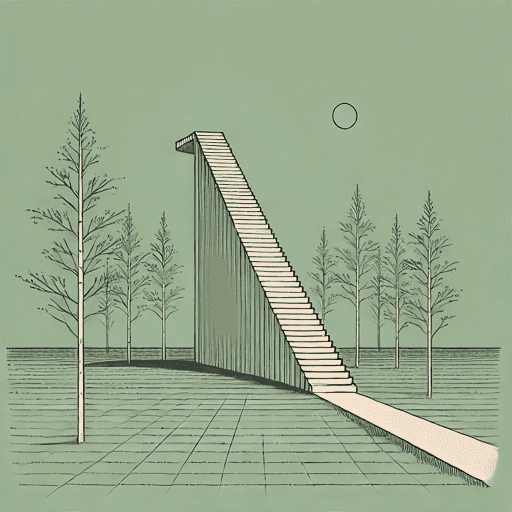
The Staircase in the Woods
62 pages • 2-hour read
Chuck WendigThe Staircase in the Woods
A modern alternative to SparkNotes and CliffsNotes, SuperSummary offers high-quality Study Guides with detailed chapter summaries and analysis of major themes, characters, and more.
Chapters 71-85Chapter Summaries & Analyses
Content Warning: This section of the guide includes discussion of graphic violence, death, child death, child sexual abuse, suicidal ideation, self-harm, mental illness, and substance use.
Chapter 71 Summary: “Not Dead Yet”
Lore, Hamish, and Owen drag the unconscious Nick into the crawlspace. Immediately, their anger melts away. Lore asks Owen about Matty, and Owen explains that when the house got inside him, he suddenly understood its nature. It showed Nick Matty’s death just to break him, but Owen believes that Matty escaped. However, Owen fears that Matty might now be like the house himself, just as the compromised Nick has been trying to inflict more pain on the world in order to make the house bigger.
Chapter 72 Summary: “The Possession of Nicholas Lobell”
Nick screams and thrashes, and when the others attempt to hold him, he bites Owen and head-butts Hamish before Lore can wrap some electrical tape over his mouth. They don’t know if it is possible to wrench Nick free of the house’s apparent possession of him. They can see bits of the house in Nick’s eyes, and his skin “rippl[es] like living wallpaper” in Lore’s peripheral vision (328). They all tell Nick that they love him, and they beg him to resist the house’s power. Owen feels the pain of memory radiating from him, so he confronts Nick with his knowledge of Nick’s father’s sexual abuse. Owen says that the abuse was never Nick’s fault, and he apologizes for never realizing the truth of what was happening. All the fight leaves Nick, and he collapses into a catatonic state.
Chapter 73 Summary: “Midnight Interruption”
Owen tells Lore and Hamish what Nick’s father did. They are appalled that they never realized this. Nick wakes up and says that the worst part of the matter was that he still loved his father. He didn’t like himself enough to hate his father. Now, Nick blames himself for bringing them all there and says that he doesn’t deserve to be with them. He is holding a long, splintered piece of wood, and they realize that he is about to attempt suicide. Owen confesses that he used to cut himself with his penknife because he hated himself too. Now, he asserts that the only way the friends will get through life—and this house—is by staying together.
Chapter 74 Summary: “Of Fantasies and Fingerprints”
They rest. Nick says that he can still feel the house inside him, waiting. Lore returns to thinking about strategy. She realizes that Owen and Nick know things about the house that might help them escape. Lore says that Nick, especially, needs to dig deep.
Interlude Summary: “The House Wakes Up”
Nick tells a story, saying that a house becomes a home when it becomes part of its inhabitants’ identity. It also affords them privacy, away from the world. At home, people can be who they really are, and this is good. However, this can also be bad because a person’s home hides their pain, rage, and despair. When that happens, something new awakens.
Nick says that after World War II, a man named Dan Harrow designed postwar housing communities in several states. He thought of single-family homes as private oases in the world, and he felt that soldiers who fought in the war deserved these retreats. He built the first community in Pennsylvania, and a man named Alfie Shawcatch (an Army veteran who helped liberate Wöbbelin) bought one of the homes, seeking peace from the nightmares of the war. He and his wife moved in and had three kids.
However, Shawcatch couldn’t sleep, and he was haunted by memories of the war. One night, he killed his wife and his sons. His daughter hid in a crawlspace, so Shawcatch tried to smoke her out. He burned the entire house down, and he was still inside it. The house watched and remembered everything. Nick says that whatever the house is filled with—love, pain, hate—can spill out. Shawcatch filled his house with blood, screams, and nightmares, and although it burned to the ground, it was reborn into “a cursed thing” (344). It hated Shawcatch for what he did, but it was lonely and craved company.
As time went on, other homes that had seen the worst of humanity joined Shawcatch’s reborn house, room by room, and the malevolent entity’s power grew. Full of hatred, it needed people to hurt, so it erected staircases in places where the portals would be safe. Once people climbed the staircases, they belonged to the house. It could torture them by emptying them out and filling them up with more hate before releasing them back into the world to create yet more horror.
Chapter 75 Summary: “Matty’s Clue”
The friends realize that the house has not been able to conquer them because they are stronger together than individually. Lore, Hamish, and Owen brainstorm further, and Lore thinks about Matty’s message that the heart is wherever the home is. She theorizes that the original house is somewhere inside this one, so they decide to dig deeper into the house so that they can hopefully find Shawcatch’s original home.
Chapter 76 Summary: “As Above, So Below”
Lore and Hamish rip up the floor. Nick apologizes to Owen for leaving him alone and for tricking them. Owen apologizes to Nick for not listening. He promises to free Nick from this place. Lore and Hamish unearth what looks like a bottomless pit, and Nick says that the house doesn’t want them to go down there. They begin to climb down, using the pipes and wires. The deeper they go, the hotter the pipes get. Soon, they can no longer touch the pipes with bare hands. Nick lets go and falls to the bottom; he shouts up that he’s okay, so the others follow.
Chapter 77 Summary: “The Third Staircase”
They all land on another staircase, a very long one. Nick looks bad, and Lore knows that they need to move quickly.
Chapter 78 Summary: “House in a House”
They descend for a long time and step onto a patch of grass. They see a 1950s-era house ahead. The staircase disappears into the darkness. They see the name “Shawcatch” painted on the mailbox, and as they approach the house, the door opens.
Chapter 79 Summary: “The Host”
A man in his mid-thirties snaps to attention. He welcomes them, but he isn’t really a person. He is only partially made of things like skin and hair, but his other parts are made of the house. He says that he has been watching them. Lore and Owen realize that he looks like Shawcatch but is really a personification of the house itself. Just then, his eyes snap shut, and he goes quiet. The group hears another voice, and they turn to see a little boy—half human, half automaton—speaking to them. He is accompanied by his brother, and then his mother enters the room too. They welcome Nick back, and Nick grins.
Chapter 80 Summary: “The Trap”
In a voice that is not Nick’s, Nick thanks Lore, Hamish, and Owen for returning him. He says that they can leave, but he will stay. Lore, Owen, and Hamish trade looks and nod. Lore says that they’re there for Nick. Suddenly, Nick laughs and claps his hands, and the lights go out.
Chapter 81 Summary: “The Floor Show”
When the lights come back on, Shawcatch and his family are gone. Nick is there, but he is accompanied by three more automatons—one that is Lore, one that is Owen, and one that is Hamish. Hamish’s doppelgänger vomits in the corner, shoving pills down his throat. Owen’s doppelgänger cuts his skin with the penknife. Lore’s calls out, asking if anyone is home. They all demand their friend back, and Not-Nick promises to show them one more thing that is guaranteed to break them.
Chapter 82 Summary: “Matty Shiffman”
The lights go out again, and when they come back on, Matty is kneeling in front of Not-Nick. Matty made it here, to the house’s heart, but he couldn’t be broken because he was too good and invested in the world being fair. He fought because he wanted to return to his friends, Not-Nick says. The house showed Matty how his friends left him alone here and refused to fight for him; this is what finally broke him. Lore realizes that when she pretended that she didn’t need Matty, she initiated all of this; that was when Matty went up the steps to prove that he didn’t need her either. Now, Not-Nick wraps his hands around Hamish’s throat and slashes Owen’s face. Not-Nick screams that he is the house and that he was full of promise: of safety, family, and love. Instead, the house became a place of pain, and they will grow to love the pain, as the house has.
Chapter 83 Summary: “Exorcism and Eviction”
Not-Nick says that the friends broke the Covenant, so now the Covenant will break them. Lore scrambles for a way to exorcise the house from Nick, so she begins recounting a hilarious high school memory. Owen adds details, and Not-Nick hisses. Hamish joins in, and Not-Nick’s head rocks back. They tell more stories, the funniest ones from their childhood. Nick, they realize, was the carrier of the Covenant all along. His eyes are bloodshot, but now, they look like his own eyes again. The Shawcatch automaton reappears behind him as the house shakes. Suddenly, Nick sets Shawcatch on fire, and they all run as the house goes up in flames. They push through the door.
Chapter 84 Summary: “The Great Egress”
Lore, Owen, Hamish, and Nick emerge in a forest. The door closes and disappears, and their luggage sits around them. They are sitting precisely where the staircase was before.
Chapter 85 Summary: “The Covenant”
Six months later, the four convene at a coffee shop in Madison, Wisconsin. Nick is on antidepressants, and Hamish has told his wife about his past infidelities. Lore and Owen now work together. The group takes Hamish’s rental car to Matty’s house. Their private investigator has told them that six women in this area have gone missing in the last 10 years. They see the front door open, and Matty steps out. They know that they might “find the house still in his eyes” (381), and they agree to do all they can to save him. They invoke the Covenant and exit the vehicle.
Chapters 71-85 Analysis
In the novel’s climactic scenes, Wendig delivers the culmination of his examination of The Duality of “Home.” When the friends realize that their own pain adds new rooms to the nightmare house that has entrapped them, this dynamic serves as a vivid, ever-shifting metaphor for the enduring legacy of human cruelty and suffering, which can take on a life of its own, warping and twisting the survivors’ perceptions and threatening to taint their entire world with The Long-Term Effects of Trauma. In this context, the house itself becomes the reliquary of the friends’ darkest experiences—just as their original homes bore witness to the various types of pain that they endured at their abusive parents’ hands. Thus, in the world of the novel, the very concept of “home” is a double-edged sword; this abstract place that ought to be synonymous with safety becomes all too often associated with pain and horror.
As the friends relive their traumatic childhood experiences, they realize that The Pervasive Nature of Guilt has splintered the group, driving them apart; this was especially true after Matty’s disappearance. Now, as they fight the house for control of Nick, it is Nick’s guilt over failing to stop his father’s abuse that comes to the fore, just as the other three feel guilty for never having realized what was happening to him. Nick’s and Owen’s fathers did tremendous harm in their sons’ lives, and the breakdown of the Covenant in the years after Matty’s disappearance only made matters worse. Owen killed his father, and Nick suffered alone throughout his fruitless years of searching for Matty, ignored by the rest of the Covenant. Now, only when the friends regain their faith in The Importance of Found Family will they manage to overcome the house’s influence.
As they fight to counteract the house’s corrosive effects, the friends must join forces. In the climactic moment of their triumph over the supernatural space, the author invokes the cleansing imagery of fire, which scours clean the house’s darkest, dankest corners, obliterating the remnants of the horrors that the four have been enduring. As Nick sets fire to the Shawcatch automaton, “great heaving flowers of [flame] [sear] the air, catching the carpet on fire, the drapes, the walls, everything” (376). By employing a metaphor that equates flames with flowers, the author injects the suggestion of life and hope into this scene of destruction, invoking fire’s status as a cleansing, purifying force. Likewise, when the four friends convene to rescue Matty in Wisconsin, they stolidly invoke the Covenant and resolve “to stand together” (381), and their stance and determination demonstrate their renewed dedication to the importance of found family.

Unlock all 62 pages of this Study Guide
Get in-depth, chapter-by-chapter summaries and analysis from our literary experts.
- Grasp challenging concepts with clear, comprehensive explanations
- Revisit key plot points and ideas without rereading the book
- Share impressive insights in classes and book clubs