The Staircase in the Woods
62 pages • 2-hour read
Chuck WendigThe Staircase in the Woods
A modern alternative to SparkNotes and CliffsNotes, SuperSummary offers high-quality Study Guides with detailed chapter summaries and analysis of major themes, characters, and more.
Important Quotes
Content Warning: This section of the guide includes discussion of child abuse, suicidal ideation, mental illness, substance use, and cursing.
“‘Friendship is like a house,’ she said to him, his head cradled in her lap. ‘You move into this place together. You find your own room there, and they find theirs, but there’s all this common space, all these shared places. And you each put into it all the things you love […] And this friendship, this house, it’s a place of laughter and fun and togetherness too. But there’s frustration sometimes. Agitation. Sometimes that gets big, too big, all the awful feelings, all that resentment, building up like carbon monoxide. Friendship, like a house, can go bad, too.’”
(Chapter 0, Page 5)
The first chapter begins in medias res, showing a brief glimpse of a pivotal scene that will not arrive until much later in the narrative. In this moment, as an adult Lore watches over Owen, she introduces the idea that houses can witness trauma and become just as warped by cruelty as the humans who perpetuate it and those who endure it. By likening friendship to a house, the author establishes the fact that the entire novel is essentially an allegory for the universal battle that people must wage against traumatic experiences in order to regain control of their own traumatized psyches. The concept of friendship is also bound tightly into this dynamic, foreshadowing the fact that the friends will have to confront all that has “gone bad” in their lives and their bond before they can properly move on. This passage also highlights The Duality of “Home” as a place of comfort and pain.
“Owen gonna Owen. Always tonguing that broken tooth.”
(Chapter 3, Page 12)
This line, spoken by Lore, indirectly characterizes both her and Owen. She suggests that he is someone who can never let anything go, as he returns to the same troubling thought again and again. To illustrate this idea, she uses a metaphor, comparing his mental behavior to the physical act of feeling for a broken tooth. She also indirectly characterizes herself as being dismissive and insensitive to his struggles.
“Now: the bedroom. Again, red. Red as a Ruby Slipper apple, so red it was almost black.”
(Chapter 4, Page 18)
As Lore contemplates her colorful house, the passage includes an allusion to Dorothy’s ruby slippers in the fantasy novel The Wonderful Wizard of Oz. In Frank Baum’s original tale, these magical shoes return Dorothy to her home once she knows how to use them. In the context of Wendig’s novel, this idea might reflect Lore’s desire to return “home”—a concept that she identifies with the Covenant rather than the physical house where she grew up.
“But she said his thing was obsessive thinking. Intrusive thoughts. Catastrophe lived inside his skull, sharks circling in that dark water.”
(Chapter 5, Page 25)
Owen reflects on his former counselor’s observations about his obsessive and intrusive thoughts, using a metaphor to describe the way his mind constantly imagines potential catastrophes. He compares these catastrophic thoughts to sharks—apex predators that inspire fear in human beings because their attacks are destructive and unpredictable. This anxiety-ridden description characterizes Owen as someone who tends to live in fear.
“Felt genuine. Robust. Like one of his old hugs—the difference being there was so much less of him to hug now—a body hewn of rock, not soft happy marshmallow.”
(Chapter 7, Page 31)
In this passage, Hamish hugs Owen, who notes that that the embrace feels physically different than it used to and produces a different emotional effect. The hug isn’t warm and comforting, as Hamish’s hugs once were. Instead, Owen is disconcerted by the rock-like body of his friend, and his reaction drives home the idea that all the friends have changed dramatically over the years and pulled away from one another.
“Nick Lobell. Still rangy and lean, […] long like a fox. Older now, though […] Still the fox, but one that had gone through too many rough fencerows, that had survived too many scrapes but had lost some fur along the way. But he still had that same chaotic spark.”
(Chapter 9, Page 41)
The narrator uses a simile to compare Nick to a fox. Foxes bear the connotation of being sly and even cunning, so this comparison aptly foreshadows Nick’s deception. The description also presents him as being unpredictable and capable of hiding crucial truths from even his closest friends.
“Thing is, though [bloodletting] was a terrible practice for physicians, it served Lore as a very good metaphor for the problems among people. These people, in particular. They had a lot of bad blood between them. And it was building up inside them. The only way to get it out was to cut it out. And that meant Lore showing up with her knives out […] It was time to open up and let the blood flow.”
(Chapter 10, Pages 50-51)
The practice of venesection serves as a metaphor for the purgative effect that Lore hopes the weekend will have on the Covenant. Doctors once believed that bloodletting would rebalance the patient’s bodily fluids. She knows that bitterness and judgment have “infected” the group, so she hopes to metaphorically “open a vein” by picking fights that will purge the collective “body” of friends of all its festering ailments.
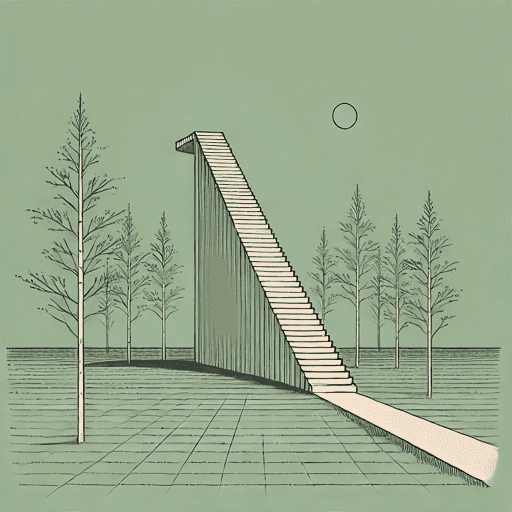
“He looked once more over his shoulder at the staircase. And for a moment, he thought he saw it shudder—not like in a hard wind or as if the ground shook. But shuddering like a wolf waking up—a stretch and a flex, as if ready for the hunt.”
(Chapter 16, Page 79)
A teenage Owen glances back at the preternatural staircase that he and his four friends see for the first time during their fateful camping trip. By comparing the structure to a waking wolf, the author makes it clear that the group’s presence has roused it from slumber and tempted it to stalk them. Because wolves are highly effective apex predators, this comparison foreshadows the horrors that will soon be associated with the staircase and the house.
“It scoured you. Burned you clean of a lot of bullshit, like scrubbing the barnacles off the boat hull that was your mind […] It was what it did to your programming, though, that Lauren loved the most when it came to dropping acid.”
(Chapter 22, Page 106)
The teenage Lauren thinks of LSD as a substance that cleans up her brain. The simile in the passage also foreshadows her adult career in coding and emphasizes the idea that each human mind functions according to specific “programming.” This concept is carried forward into the novel’s main conflict, as the friends’ traumas and the house’s cruel influence will serve as examples of faulty “programming” that must be “scoured” clean before they can escape from their predicament.
“But what none of them ever understood was the feeling of that house. Of being alone, when you weren’t supposed to be. The silence always felt loud. The air always felt empty and cold, like you were stranded on another world, with no one coming to get you.”
(Chapter 26, Page 118)
The young Lauren’s friends never realize that being alone all the time is not a benefit, as she has no one to care for her, make rules, or set limits. Caught in this alienating and isolating existence, Lauren intimately understands the duality of “home,” as the physically and spiritually empty house that she lives in cannot offer her the support and love that she needs. Because her mother is perpetually absent, Lauren internalizes the idea that she deserves to be alone.
“As a kid, Hamish had always been a leaf in a stream—just happy to float wherever the water was taking him. He was the easiest going, a wad of human Silly Putty eager to be molded. Life and time had changed him.”
(Chapter 30, Pages 133-134)
This passage characterizes the adult Hamish as uptight, a sharp contrast to his youthful, easygoing persona. The young Hamish enjoys the spiritual freedom of a floating leaf, happy to drift along with no desire to control his progress. Likewise, his comparison to a wad of Silly Putty, a pliant and malleable substance, also contrasts with his rock-hard, muscular adult physique. This shift indicates that he is no longer so adaptable or easy-going; in fact, he now panics often, fears divine retribution, and even turns to the ever-anxious Owen for reassurance.
“She struggled and tried to push Owen away […] He said it would be over soon. Lauren wasn’t sure what that meant, not exactly, but somehow in those words she found the deepest lake of darkest comfort and she stopped struggling, instead choosing to sink into the waters of his words.”
(Chapter 34, Page 155)
After Matty disappears, when Lauren is high on two doses of LSD, she nearly runs off a cliff, and only Owen’s voice comforts her and allows her to relax so that she doesn’t hurt herself. His words are compared to a deep, dark lake that buffers her against harm until she regains her sobriety. This metaphor also suggests The Importance of Found Family.
“And at that moment and in all the moments for years to come she would always think, I made him do it, I pushed him away, and if I hadn’t acted like such a dick that night, he would not have gone up that staircase like a cocky angry show-off. He is dead and gone, and I should be dead and gone too.”
(Chapter 34, Page 155)
Lore’s regret over her failure to follow Matty up the staircase highlights The Pervasive Nature of Guilt. She blames herself for his choice because she tried to make him feel that she didn’t need him, after which he retaliated by going up the staircase despite his friends’ refusal to accompany him. Even decades years later, she feels responsible and believes that she should be punished with death. This corrosive conviction also illustrates The Long-Term Effects of Trauma.
“Lore could feel something working its way through her, like a rabid animal looking to take a bite out of someone.”
(Chapter 35, Page 164)
This simile compares the way the house feels while invading Lore’s head to an infected and violent animal that is willing to sink its teeth into the nearest victim. The house makes her mean and makes her feel like she should break Hamish, berate Owen, or yell at Nick. This isn’t how she wants to act—she loves them—but the house changes her against her will.
“All he knew was that right now, he wanted to be alone. Somewhere in a dark corner, chewing his fingers down to the literal bone.”
(Chapter 36, Page 167)
Being trapped in the house heightens Owen’s anxieties so intensely that he thinks in hyperbole. He does not truly want to chew his fingers “down to the literal bone,” but the overstatement emphasizes the full extent of his anxiety and simultaneously invokes a viscerally graphic description that injects an element of horror into the narrative.
“It struck her then—them coming into the room seemed to chase away those dark thoughts. Like cockroaches when you turn on the light. Skitter, skitter.”
(Chapter 39, Page 188)
By comparing intrusive thoughts to cockroaches, Lore creates a vivid image of the unpredictability of the human mind, suggesting that it is “infested” with parasitic ideas that lurk in the shadows, hiding from the bright light of rational thought. Her musings also label the thoughts that come from the house as intrusive, abhorrent pests that deserve to be eradicated.
“His father had told him once, while drinking schnapps: I didn’t want you. You’re your mother’s child. I take responsibility for you, because you’re mine and I know it—but I don’t love you, Owen. I regret having you. And some days, honestly, I hate you. I hate that you’re here. I hate that you happened. You’re like a boat anchor, dragging us all down.”
(Chapter 44, Page 204)
This passage provides a vivid example of the emotional abuse that Owen’s father habitually subjects him to. This glimpse serves as a powerful explanation of Owen’s lifelong insecurities, as the very person who was supposed to support and protect him systematically tore down any sense of trust or self-esteem that his younger self might otherwise have had. Owen’s ability to recall these devastating words with such clarity demonstrates the long-term effects of trauma.
“They show up. Until someone goes missing. Then they go away again. Like…like they got what they wanted. Like it’s a fuckin’ jaw trap laid out in the woods, and once it snaps shut on the leg of a deer, the hunter doesn’t really need the trap anymore, so he takes it back.”
(Chapter 45, Page 210)
When Owen asks Nick what he knows about the staircases, Nick uses a metaphor to explain how these preternatural structures work. He compares a staircase to a trap that a hunter sets out; once it catches its victim (whoever is unlucky enough to find it and curious enough to climb it), the staircase disappears, like the hunter pulling a trap back in. Nick’s thorough understanding of how the staircases work also foreshadows the revelation that the house is already in possession of him.
“The heart is where the home is.”
(Chapter 46, Page 212)
By reversing (and subverting) the common expression “home is where the heart is,” Matty’s message delivers a warning and a path forward through the labyrinthine layers of the house. The original saying highlights the lighter, happier side of the duality of “home,” which focuses on a house’s tremendous potential to be a haven of love and acceptance. However, Matty’s version highlights the darker reality that a home can hide its inhabitants’ harmful actions as well.
“[Hamish thought about] how he was a piece of shit, how his family was better without him […] how this was a Hell he deserved, how he was dead and all of this was just part of his afterlife torment.”
(Chapter 50, Page 238)
This passage reflects Hamish’s internal spiral as he grows tormented by the suspicion that he is worthless and irrelevant. He sees his negative qualities magnified but disregards his positive qualities and his potential to change for the better. His harmful mindset demonstrates the pervasive nature of guilt, which can distort a person’s sense of self.
“It was dangerous to go alone. If Hamish were alone in here, he would’ve killed himself. If she were alone, who knows what would happen. The house would have its way, she feared.”
(Chapter 59, Page 280)
This line highlights the duality of “home,” focusing on the house’s nefarious intentions to torment and possess anyone it can capture. The house itself therefore becomes emblematic of the main characters’ childhood homes, which were full of malice and pain. The line also emphasizes the importance of found family, as Lore realizes that being alone is dangerous and renders people vulnerable.
“In the deepest dark of a house, of a home, hate and pain and suffering can fester […] It’s where home stops being where the heart is. Home is where the hurt is. Where the horror lives. Home becomes another name for that place where monsters go to hide and do their terrible work.”
(Interlude, Page 339)
The story that Nick tells in the Interlude explains how houses acquire their two-fold nature: the safe and loving versus the painful and tortuous. The duality of “home” stems from the privacy that it affords its inhabitants. In this protected space, people can let their guard down and relax more fully, but they can also act without regard for the limitations of morality and ethics.
“It may seem strange to think of a house watching anything, but when a house becomes a home, it becomes imbued with life. Alive in an almost literal way—and certainly aware […] Houses, in this way, are like vessels. Waiting to be filled up. And what fills them can spill out—be it love, be it pain, be it hate.”
(Chapter 74, Page 343)
The personification of houses calls further attention to the duality of “home,” explaining that houses have two sides because people have two sides. People can be loving and nurturing, or they can be cruel and neglectful. When the people inside a home behave in caring ways, the home can be where the heart is; however, when the people inside a home act viciously, the home itself takes on that quality.
“She felt judged, she felt hurt, so she hurt him in turn, and then he ran up that fucking staircase to show her how he didn’t need her—even as she was wolfing down the acid, pretending that she didn’t need him, didn’t need any of them, and that was when it all started.”
(Chapter 82, Page 370)
Lore blames herself for Matty’s choice, and her anguished mindset illustrates the pervasive nature of guilt. Though Matty chose to climb the staircase alone, she believes that her behavior drove him to it, and her continued self-blame emphasizes the long-term effects of trauma. Although it is now decades later, she still has a warped understanding of her culpability in Matty’s disappearance, and this misguided belief continues to impact her sense of self.
“They told increasingly funny, insane stories about Nick, because that was Nick. A wild card, an agent of chaos, a trickster spirit. But it was also about how he was always there for them. […] Nick was really the carrier of the Covenant. Each and every time.”
(Chapter 83, Page 375)
As the friends recount their fond memories of one another, their stories and their faith in Nick diminish the power of the house to maintain control of him. Hearing these memories also provides him with the strength to regain control of himself and burn the place to the ground. The novel’s climactic scene therefore demonstrates the importance of found family.

Unlock every key quote and its meaning
Get 25 quotes with page numbers and clear analysis to help you reference, write, and discuss with confidence.
- Cite quotes accurately with exact page numbers
- Understand what each quote really means
- Strengthen your analysis in essays or discussions