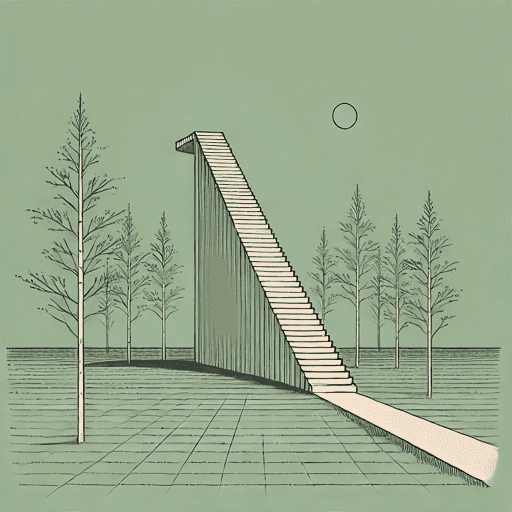
The Staircase in the Woods
62 pages • 2-hour read
Chuck WendigThe Staircase in the Woods
A modern alternative to SparkNotes and CliffsNotes, SuperSummary offers high-quality Study Guides with detailed chapter summaries and analysis of major themes, characters, and more.
Symbols & Motifs
Content Warning: This section of the guide includes discussion of child abuse and mental illness.
Houses
In the novel, houses serve as a motif that emphasizes The Duality of “Home.” Houses often mirror the people who live inside them. Just as a relationship between two humans can bring either pleasure or pain, houses have the same potential. As the avatar of the sentient house states, “I was a place of promise. Not merely a house, but a home. A place of love, a place of family […] but that man brought back all the pain of war […] The pain in us was electric and alive, it flowed through us like a boiling river” (371). In the world of the novel, single-family houses thus become uniquely private spaces in which mental illness and trauma sometimes grow unchecked. In this way, houses either are synonymous with safety and love or become linked to feelings of hurt and fear. The main characters’ homes are places that harbor more pain than happiness, and as Nick asserts, such fear-tainted homes can become “part of your very identity—your house, your home, is part of the tapestry that is you. You carry it with you, in your heart, to the end of things” (337). Because the link between one’s house and oneself is emotional, this connection can be either joyful or devastating.
Eyes
The old saying that the eyes are the windows to the soul is on full display in this novel, as the characters’ eyes reflect the level to which they have been possessed by the malevolent house. Hamish finds messages from Matty to this effect, reading, “IT WANTS TO LIVE INSIDE YOU YOU CAN TELL BY THE EYES” (212). Though Hamish and Lore do not immediately understand this reference to the “eyes,” the scenes with Owen and Nick aptly illustrate the house’s insidious influence. When Owen confronts Marshie and realizes that she is like an NPC in a computer game, she shuts down, but when he asserts that everything in the house is just an illusion, “[h]er eyes [snap] [in]to focus,” making him feel for the first time that she is “truly seeing him” (274). She then speaks in a voice that contains dozens of other voices, the voices of the house. Thus, the house’s possession of an individual is reflected by the appearance of their eyes, as evidenced by Owen’s experience when he looks into Nick’s eyes and sees that “[e]ach pupil [is] a hole, and in each hole [is] a set of steps. Staircases in the deep dark of his gaze. Starecases” (284). Nick’s gaze, like those of NPCs such as Marshie, shows that when the house controls him, the evidence is in his eyes.
Nail-Biting
Owen’s destructive nail-biting habit is a motif that highlights both The Long-Term Effects of Trauma and The Pervasive Nature of Guilt. He tends to bite his nails—or his tongue or cheek—whenever he is most anxious. Even when he is young, he recognizes that his brain tends to get stuck in anxiety “loops” in which he thinks the same things until his tension spirals to unbearable levels. The anxiety often results from his desire to escape his house and his father’s emotional abuse. Later, his distress stems from his guilt over failing to follow Matty up the staircase. In adulthood, the pain of these traumatic experiences follows him, causing the nail biting to continue unabated.
When Owen is overwhelmed with guilt and believes that he deserves to be stuck in the nightmare house, “[h]e so desperately want[s] to chew his nails” (223). However, once he begins to feel something stronger than his anxiety or guilt, the desire to bite his nails decreases. For example, after the revelation of Nick’s betrayal, Owen feels “[l]ike his brain [i]sn’t on an anxiety loop. He d[oes]n’t feel that crushing tightness in his chest, d[oes]n’t feel the need to chew his fingers down to the bone. He just want[s] to find Nick and beat him to death” (287). In this way, Owen’s mental state is frequently demonstrated by these external mannerisms.

Unlock the meaning behind every key symbol & motif
See how recurring imagery, objects, and ideas shape the narrative.
- Explore how the author builds meaning through symbolism
- Understand what symbols & motifs represent in the text
- Connect recurring ideas to themes, characters, and events