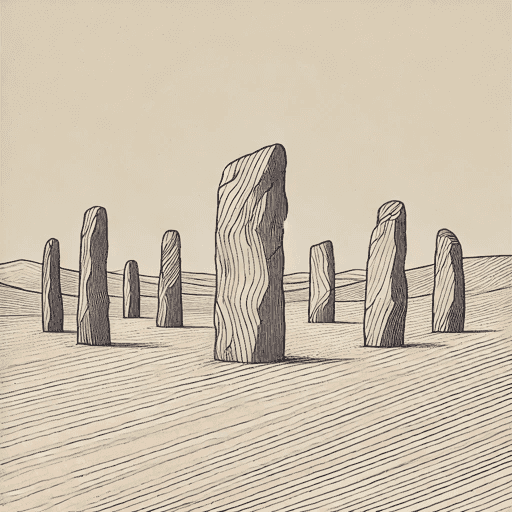
The Tombs of Atuan
50 pages • 1-hour read
Ursula K. Le GuinThe Tombs of Atuan
A modern alternative to SparkNotes and CliffsNotes, SuperSummary offers high-quality Study Guides with detailed chapter summaries and analysis of major themes, characters, and more.
Background
Authorial Context: Ursula K. Le Guin
Ursula K. Le Guin (1929-2018) was a respected American science fiction and fantasy author. She is best known for her fantasy series The Earthsea Cycle, science fiction series The Hainish Cycle, and short story “Those Who Walk Away From Omelas” (1973). She also wrote many other novels, novellas, and short stories, as well as poetry, essays, and literary criticism.
Le Guin was born in California to author Theodora Kroeber and anthropologist Alfred Louis Kroeber. She earned a master’s degree in French and married historian Charles Le Guin in 1953. She began writing in the late 1950s, publishing her first short story in 1962 and her first novel, A Wizard of Earthsea in 1968. Many critics regard A Wizard of Earthsea and The Left Hand of Darkness (the fourth novel in her Hainish Cycle) as her masterpieces. The Left Hand of Darkness was adapted for the stage in 1995, and her novel The Lathe of Heaven has twice been adapted for film. The Earthsea Cycle has inspired two film adaptations.
Le Guin’s work is influenced by cultural anthropology, Taoism, Indigenous folklore, feminism, and the work of bestselling science fiction author Philip K. Dick. She once described her novel The Lathe of Heaven as a tribute to him, and the similarities are apparent, particularly Dick’s novels The Man in the High Castle (1961) and Ubik (1966) (Wray, John. “Ursula K. Le Guin, The Art of Fiction No. 221.” Paris Review, 2013). Le Guin received many awards and accolades including eight Hugo Awards, six Nebula Awards, and 25 Locus Awards. In 2003, she became the first woman named Grandmaster of the Science Fiction and Fantasy Writers of America. After her death, a trust in her name announced the first Ursula K. Le Guin Prize for Fiction in 2021. The prize is awarded yearly to a writer of speculative fiction “who can imagine real grounds for hope and see alternatives to how we live now” (“The Ursula K. Le Guin Prize for Fiction.” Ursula K. Le Guin).
Series Context: The Earthsea Cycle
The Earthsea Cycle includes six novels and nine short stories. Le Guin first introduced the world of Earthsea in two short stories, “The Word of Unbinding” and “The Rule of Names,” both published in 1964. The first novel, A Wizard of Earthsea, was published in 1968. The fictitious Earthsea is an enormous archipelago containing hundreds of islands surrounded by a vast ocean. Most of the people living on the archipelago are called Hardics and have varying shades of brown skin. Le Guin initially faced some criticism for creating a world that was primarily nonwhite, while others lauded her efforts to resist white hero stereotypes common in fantasy fiction of the time. Some islands in Earthsea’s northeast are populated by the white-skinned Kargish Empire, where The Tombs of Atuan is set. Magic is common among the Hardic people, though most possess only minuscule amounts. Those with true power usually attend a school on the island of Roke to become trained, staff-carrying wizards. Magic is forbidden among the Kargish, who consider the Hardic barbarians.
The first novel of the series, A Wizard of Earthsea, is a coming-of-age story following a young boy called Sparrowhawk, who displays powerful magical potential. Sparrowhawk trains on the island of Gont with his mentor Ogion, who gives him his “true name,” Ged. Eventually, Ged attends the magic school on Roke, where a moment of foolish ego causes him to make a grave magical mistake, releasing an evil shadow into the world. The shadow chases him for years across the islands, while he completes his training and becomes a powerful wizard. At last, he confronts the shadow. Realizing it is a part of him, he calls it by his true name and becomes whole again.
Though Ged is the protagonist of several novels in The Earthsea Cycle, the second novel focuses on Tenar, who is raised in a cult of woman priestesses in the Kargish Empire. Tenar reappears in Tehanu, the fourth novel of the series, published nearly 20 years after the first three.

Unlock all 50 pages of this Study Guide
Get in-depth, chapter-by-chapter summaries and analysis from our literary experts.
- Grasp challenging concepts with clear, comprehensive explanations
- Revisit key plot points and ideas without rereading the book
- Share impressive insights in classes and book clubs