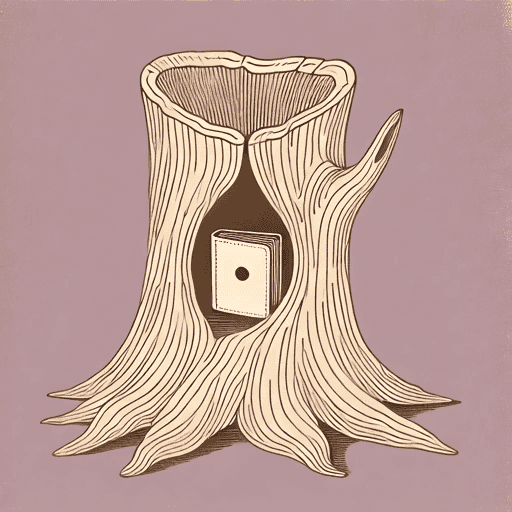
The Unworthy
63 pages • 2-hour read
Agustina Bazterrica, Transl. Sarah MosesThe Unworthy
A modern alternative to SparkNotes and CliffsNotes, SuperSummary offers high-quality Study Guides with detailed chapter summaries and analysis of major themes, characters, and more.
Pages 133-177Chapter Summaries & Analyses
Content Warning: This section contains bullying, rape, graphic violence, physical and emotional abuse, sexual content, and animal death.
Pages 133-177 Summary
One night in the hollow tree, the narrator tells Lucía what happened in the “metallic woods.” The narrator and Circe had left the town and wandered for days in search of food, water, and shelter. They finally came across a strange building that looked like an old school. The narrator found books full of formulas and words she didn’t understand and a box of “useless” cell phones. The narrator’s mother had told her “how people had done everything on those screens” (135) before the “final blackout.” Some believed that countries had turned off their electricity to protect against an artificial intelligence that was trying to take over, but “nature finished things off with a new degree of devastation” (135). The narrator also found a few cans of food in the building and a notebook filled with entries beginning with measured “concern” and ending with “pure rage”: Words like “CHAOS” and “CATASTROPHE” written in red ink. The narrator built a fire and was about to sample the canned food when she heard men’s voices. She put out the fire, grabbed Circe, and hid under the bed. Eventually, the men left, and Circe and the narrator fell asleep in their hiding place. The next morning, they walked until they reached the metallic woods. In that “useless” and “infertile” place, the men found them again. Circe was gone exploring, and the men attacked the narrator and raped her. Circe appeared and attacked them, but there were too many to fight. They hit the narrator until she fainted, and the last thing she remembers seeing was Circe’s eyes. When she woke, the men had left her for dead. She could barely move for the pain, but she dragged herself along until she found Circe’s body. The narrator did not cry, but she hugged the cat’s body for hours and sang to her. When she could move, she carried the little body until she came to the bank of a dry river. She buried Circe beneath a tree with a single green leaf, digging in the hard ground until her fingers bled. Then, she sobbed over the grave until she fainted. When she woke again, the narrator dragged herself away. She doesn’t know how long she wandered across the “ravaged earth” until she reached the House of the Sacred Sisterhood.
In the hollow tree, Lucía tells the narrator that she dreamed of a place where the world was green and thriving. The narrator doesn’t believe her; everything outside the Sisterhood is “endless desert,” but Lucía insists that she also dreamed of the narrator before they met in the woods.
Returning to their cells at dawn, the narrator and Lucía always wear their veils to avoid detection, and one morning, they see a dead Diaphanous Spirit in the garden. Her white tunic has blood stains, and there are rope marks on her wrists. Her tongueless mouth is open, and there are wounds on her neck. A butterfly perches on the woman, and the narrator notices that its legs don’t burn her. Lucía lifts the Diaphanous Spirit’s tunic and sees blood running down her legs. They hurry inside, but later, the narrator sneaks back out to take the Diaphanous Spirit’s sacred crystal.
In the Chapel of Ascension, the women learn that a Diaphanous Spirit has “left for the intangible dimension” (146). The women must mourn her through silence and fasting, each confined to her own room. The narrator has endless time to write, but she can think of nothing but Lucía. The narrator wonders who injured the Diaphanous Spirit’s body and who killed her and the Minor Saint. After three days without food or water, the women are let out of their cells. They eye one another suspiciously over breakfast, all except Lourdes, who is “radiant.” Despite her confinement, she has managed to spread a rumor that Lucía used “dark, ancestral magic” (149) against the Diaphanous Spirit. Lucía is “unperturbed,” but the narrator is “perturbed” and goes in search of amanitas.
That night, the narrator adds the amanita to cricket flour to make a bread and leaves it on Lourdes’s pillow. Lourdes removes her clothes and dances naked in the garden, looking surprisingly beautiful now that she isn’t “plotting.” She laughs and dances, then screams up at the moon. She hugs Lucía, calling her the “witch of the night” over and over until Lucía walks her to her cell as the narrator marvels at the woman’s “capacity for mercy” (151). Later, Lucía and the narrator sneak out to the woods. They are in their hollow tree when they see Lourdes and the “colossal” figure of the Superior Sister moving through the trees. The Superior Sister beats Lourdes with a branch, then begins to strangle her. With their veils drawn to conceal their identities, Lucía and the narrator attack the Sacred Sister with branches. They leave her on the ground and take Lourdes back to her cell, but in the morning, Lourdes’s body is hanging from a tree on the edge of the woods. The narrator is surprised at the depth of her emotion, given that she didn’t like Lourdes. Instead of breakfast, the unworthy are given instructions to gather in the Chapel of Ascension, and the narrator knows that the Superior Sister will “seek revenge.”
In the Chapel of Ascension, the assembled women wait in a silence so “total” that the narrator doesn’t even think of the scene with Lourdes in the woods. When the increasingly frail María de las Soledades coughs, she shuffles forward automatically to accept her punishment from the Superior Sister, who is armed with a whip. She orders María de las Soledades to go to the Tower of Silence, and María de las Soledades accepts her punishment with such “indifference” that the Superior Sister loses control and begins screaming at the unworthy. She marches up and down the rows of women and extracts two of them: Catalina, who lowers her gaze when the Superior Sister passes, and Élida, who has dirt stains on her tunic. When the remaining women are seated again, He speaks to them from behind the screen, claiming that Lourdes “conspired to trap a Diaphanous Spirit in the intangible dimension” (157). As he speaks, the narrator surreptitiously touches Lucía’s hand to “calm her.” However, when he announces that one of the unworthy will become Enlightened, she looks at Lucía and sees her terror reflected in the other woman’s eyes.
That night, the women hear Catalina and Élida screaming. Some servants whisper that the Superior Sister locked them in cages and forced them to live like dogs. Others say that they are dead.
For three days, the women don’t know who the new Enlightened is. Lucía and the narrator meet in the woods and take down Lourdes’s body, even though they know it is dangerous. They dig her a grave and bury her among the trees. As they work, the narrator is grateful that Lucía never mentions the narrator’s responsibility for Lourdes’s death. Once the burial is done, they bathe and clean their clothing in the Creek of Madness, kissing one another and telling each other their “real names.” At dawn, they return to their cells. Lucía tells the narrator that she wants to save María de las Soledades from the Tower of Silence, and she doesn’t want to become Enlightened and leave the narrator behind.
Instead of breakfast, the narrator and Lucía offer to tend the crops with a Diaphanous Spirit so that their tunics can dry. The narrator is surprised to see the plants looking so strong, and there is a bee among the crops, making her wonder “whether the world outside the House of the Sacred Sisterhood was beginning to recover” (162). Meanwhile, inside, the Superior Sister inspects the unworthy’s nails to see who buried Lourdes. Eventually, she accuses “one of Lourdes’s weaklings” (163) and imparts the “minor punishment” of lying on broken glass.
After three days, the narrator and Lucía finally have an opportunity to rescue María de las Soledades. They pick the lock to the Tower of Silence as a vulture circles overhead. They haven’t seen one in many years and “rejoice” at its presence, even though it is waiting for María de las Soledades to die. The chamber at the top of the tower reeks of “decay,” and they must walk over the bones of Chosen to reach María de las Soledades. They wet her lips with some water, but there is no recognition in the dying woman’s eyes, and she stops breathing in the narrator’s arms. She is filled with regret for not helping her sooner, and Lucía holds her hands as she cries. The vulture continues circling, but Lucía looks frightened and insists that it is one of the dead monks waiting for them to fall from the tower.
The unworthy gather in the Chapel of Ascension for the announcement of the new Enlightened, and Lucía and the narrator hold hands under their tunic. The Minor Saints sing the Hymn of the Enlightened while a “mutilated” Full Aura “trie[s] to imitate dancing” (168). When Lucía is announced as the new Enlightened, the narrator doesn’t cry, but she feels like “red sand is gathering in [her] blood, accumulating in [her] throat” (166). She is kept under guard, so they cannot sneak to the woods to say goodbye, and the narrator can do nothing but write “useless words […] that can’t open the carved black door” to the Refuge of the Enlightened” (166). For eight days, the narrator hears screams coming from behind the door and resolves to rescue Lucía.
The narrator sneaks out one night and waits in an empty cell beside the door to the Refuge of the Enlightened. There are two cages in the room covered with blankets, and the narrator thinks she can hear a crying sound coming from them. She thinks of Catalina and Élida, but she is determined to stay focused on Lucía. When she is sure the coast is clear, she picks the lock just enough to understand how the mechanism works. The next night, she returns, unlocks the door with ease, and discovers “the cogs of the lie” (172). The Enlightened’s wombs are “bursting with vice,” proof “that He was profaning them” (172). The narrator finds Lucía being raped by “Him” as the Superior Sister watches. She stifles a scream and stabs the Superior Sister, then hits her hard enough to knock her down. The naked man tries to attack her, and some of the Enlightened help the Superior Sister up. The Superior sister stabs the narrator in the stomach, but she and Lucía escape. Some of the Enlightened continue trying to help the Superior Sister, some are confused, and some rush to escape with Lucía and the narrator. As they leave, the narrator jams her quill into the lock, temporarily trapping their pursuers inside.
The narrator instructs Lucía to leave her in the hollow of their tree and escape with the others, showing her the wound in her stomach and insisting she won’t make it. Lucía hugs and kisses her, crying, and says “three words” that are “a vibration of fire” (174) before leaving. The narrator knows she has little time, and she writes furiously. She is unsure if it is the fabric staunching her blood or “the will to tell this story” (173) that is keeping her alive. There, in the “living cathedral” of the woods, the narrator plans to leave the pages she has protected so carefully. Maybe they will be found and read, or maybe they will return to the earth. When she hears the bells that announce the hunt for her, she will use a stone to widen the wound in her stomach, letting her blood spill so “the earth will receive it, absorb and transform it” (172).
Pages 133-177 Analysis
The closing pages of the novel track the narrator’s final dissolution of faith in the Sisterhood and her rediscovery of her humanity and sense of self through acts of love and compassion. This progression embodies the theme of The Redemptive Power of Love and Connection, as the narrator’s relationship with Lucía evolves into an ethical, spiritual, and political awakening. It is through this connection that she learns to act from empathy rather than survival.
Despite the growing hostility against her, Lucía refuses to participate in the Sisterhood’s culture of violence, backstabbing, and belittlement. She continues to treat Lourdes with compassion, even as Lourdes tries to destroy her by spreading evil rumors. The narrator, on the other hand, struggles to shed the vengeful, contentious nature she acquired at the Sisterhood and during her struggle to survive in the outside world. She admires but is also angered by Lucía’s mercy toward Lourdes, seeing it as weakness and complacency, and takes it upon herself to stand up for Lucía and “protect” her by drugging Lourdes with mushrooms. When this leads to Lourdes’s death at the hands of the Superior Sister, the narrator feels unexpected remorse. She mourns the woman she so despised and regrets her role in her death. She starts seeing how her actions have contributed to the culture of violence in the Sisterhood and put down weaker women like María de las Soledades. All along, the narrator has been taught to atone for her inherent “unworthiness” and rid herself of the “filth” in her blood, but the evil she has participated in at the Sisterhood is what she needs to make amends for. Lucía, with her insistence on burying Lourdes and rescuing María de las Soledades, helps the narrator rediscover empathy, mercy, and the true meaning of sisterhood. This moral clarity directly challenges the theme of Misogyny, Oppression, and Organized Religion. The Sisterhood frames pain as purification and rivalry as sacred duty, but Lucía models a different way of being, grounded in mutual care rather than competition. In choosing to protect and mourn even those who betrayed her, Lucía exposes the cruelty of a system that confuses suffering with sanctity.
As Lucía and the narrator begin to act in solidarity with the other women instead of against them, the power structure of the Sisterhood begins to weaken. The Superior Sister’s authority starts to slip, and the narrator sees her “out of control” for the first time (156), screaming at the women in a furious frenzy. This breakdown illustrates how female solidarity is the only effective means of fighting back against misogyny and patriarchal power structures. As the women begin to support one another, they become harder to control and take advantage of. Lucía and the narrator’s quiet acts of resistance—burying Lourdes, attempting to rescue María de las Soledades, and tending the crops—reclaim the idea of sacrifice as something chosen rather than coerced. These moments emphasize that collective action, however small, can unravel even the most rigid forms of spiritual authoritarianism.
The narrator’s doubts about the state of the outside world also continue to grow. She notices how crops look healthier, and animals that are supposedly extinct, like the vulture and the bees, appear. The narrator becomes convinced that she and Lucía could survive without the protection of the Enlightened and thinks of escaping. This shift signals the erosion of the Sisterhood’s central lie: that the world is uninhabitable and that obedience is the only form of salvation. The narrator’s growing trust in her own perceptions rather than in what He and the Superior Sister preach shows how authoritarian regimes depend on epistemic control. This reinforces the theme of Misogyny, Oppression, and Organized Religion, which critiques how religion can manipulate fear to enforce submission.
As the Sisterhood loses its hold on the narrator, she also regains control of her language; she no longer crosses words out or hesitates to write things down, taking back ownership of her narrative. The most significant example of this is the woods. For the majority of the text, the narrator refuses to call the forest surrounding the House of the Sacred Sisterhood the “woods” because of the associated trauma of being raped and watching Circe die in a manmade “metallic woods.” However, with Lucía’s help, the narrator can finally face these memories. Making love with Lucía in the trees surrounding the Sisterhood allows her to reclaim the “woods,” turning them into a site of love and wonder instead of a place of sadness and fear. Naming becomes an act of healing. The loss of Circe remains painful, but the woods offer a reminder that trauma and beauty can exist simultaneously. This moment reflects the theme of The Role of Language in Constructing Identity and Humanity.
The narrator reclaims words like “woods” and “mutilated,” but the word “love” is never spoken. When Lucía says goodbye to the narrator before escaping, she says “three words” that can be inferred are “I love you.” However, the narrator explains that “they weren’t words, they were a vibration of fire, fire that enveloped [her] like a river of light, a river of dazzling flowers” (174). In the narrator’s world, love is elevated to the level of the divine, and language becomes inadequate in the presence of something holy. This elevation of emotion beyond speech culminates the theme of The Role of Language in Constructing Identity and Humanity. Even when words fall short, the narrator’s act of writing sustains her spirit. She moves from writing as secret preservation to writing as sacrament—an offering to the earth, to Lucía, and to the future.
At the end of the novel, the narrator rescues Lucía from the Enlightened’s quarters, where she discovers “the cogs of the lie” (172); the mysterious man who leads the cult rapes and abuses the women who the unworthy believe are “mediators between [them] and the ancestral divinity” (12). In reality, the Sisterhood is a ruse for a single man to accumulate power and have access to women’s bodies. This reveal fully exposes the theme of Misogyny, Oppression, and Organized Religion. The elaborate theology, the mutilation rituals, and the hierarchy of worthiness all exist to conceal a simple and horrific truth: male violence in religious disguise. As the narrator describes the horror of the scene, she no longer capitalizes words like “enlightened” and “superior sister,” doing away with proper nouns and thereby stripping the Sisterhood of its legitimacy. This linguistic refusal becomes an act of rebellion. By denying the cult its capital letters, the narrator denies its sanctity. Language becomes a medium of justice.
In the end, the narrator is prepared to die in “[her] woods,” a place “that reverberates with the splendor of a living cathedral” (171). There is no heaven or hell, no god, “erroneous” or otherwise. However, there is love, compassion, and natural beauty, and the narrator feels the “aura” and “power” of the woods that surround her. She is “part of this pagan temple” (171) and knows she will be absorbed into the natural world as she dies. Her death is a rejoining—an ultimate act of freedom that transcends the binaries of punishment and reward, sacred and profane. In this final act, she chooses communion with nature and memory over obedience and fear.
Writing in the tree as Lucía flees, the narrator is critically wounded and plans to deepen her stomach wound and die when the search party from the Sisterhood approaches her. The Sisterhood used fear to demand atonement and self-flagellation, but now, love prompts the narrator to sacrifice herself willingly “to delay the progeny of filth, the mistakes of nature, the murderers that are the superior sister and that despicable man” (174). She puts others above herself for the first time and makes a sacrifice that actually means something, allowing Lucía and the other Enlightened to escape. Unlike the mutilations and rituals the Sisterhood demanded, this sacrifice is grounded in agency and love. The narrator’s death is a generative act. She offers herself to break a cycle of harm.
In the final pages of The Unworthy, all three major themes converge: The narrator exposes the violent truth of patriarchal religion (Misogyny, Oppression, and Organized Religion), reclaims the act of writing and naming as sacred (The Role of Language in Constructing Identity and Humanity), and chooses love as her final creed (The Redemptive Power of Love and Connection). Her death is an integration of grief and joy, fear and hope. And in the cathedral of trees, she leaves behind her body and her records and pages, hoping that both will return to the earth as an act of balance and restoration.

Unlock all 63 pages of this Study Guide
Get in-depth, chapter-by-chapter summaries and analysis from our literary experts.
- Grasp challenging concepts with clear, comprehensive explanations
- Revisit key plot points and ideas without rereading the book
- Share impressive insights in classes and book clubs