The Witch Collector
The Witch Collector
A modern alternative to SparkNotes and CliffsNotes, SuperSummary offers high-quality Study Guides with detailed chapter summaries and analysis of major themes, characters, and more.
Summaries & Analyses
Quizzes
NEWReading Tools
Games
Symbols & Motifs
Content Warning: This section of the guide references graphic violence and death.
The God Knife
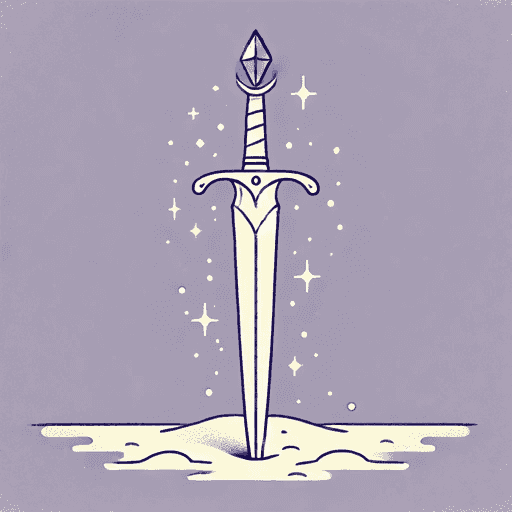
An instrument of immense power, the God Knife thematically symbolizes The Interplay Between Destiny and Choice. Forged from the god Thamaos’s rib by the sorcerer Un Drallag (now Alexus), the blade can kill gods themselves and represents divine legacy, inherited trauma, and the burden of history. Despite its divine origins and violent history, the knife’s meaning continually shifts based on the intentions of those who wield it.
The knife has its own will, subtly blurring the line between sentient relic and enchanted weapon. Though it has a Keeper (in this case, Raina), it seeks its true master. When Alexus and the God Knife reunite, the blade recognizes him, responding with a sense of sentient greeting. This recognition reinforces how fate weaves through the story yet allows for personal agency. Raina inherits the knife through her bloodline, but no one can take it from her unless she willingly gives it up or is killed. Her decision to return the blade to Alexus, not yet knowing he forged it, emphasizes the novel’s ongoing tension between inherited destiny and conscious choice.
Alexus’s role further deepens the symbolic complexity. He enchanted the knife so it can’t kill him, an act of clever foresight and control over his own fate. This enchantment becomes critical when General Vexx uses the blade to stab Alexus. The knife doesn’t kill him, but it can kill Neri, the god trapped inside him. Aware of this, Alexus consciously chooses to release Neri moments before the strike, transforming an act of violence into a redemptive decision.
Ultimately, the God Knife symbolizes the fine line between destruction and salvation. It’s a legacy of divine war and personal loss, but also a testament to how choice can reshape the trajectory of fate, even when destiny seems already carved in bone.
“There Is No Love Without Fear”
Early in the novel, Finn tells Raina, “There is no love without fear” (31), and she echoes these words at the end. This motif frames the story and shapes much of the emotional and thematic landscape. Though only spoken explicitly twice, the phrase resonates throughout the narrative. Nearly every major character acts out of a combination of love and fear, underscoring the idea that these emotions are inseparable and linking to the themes of The Wisdom of Forgiveness Versus Vengeance and The Nature of Good and Evil.
Ophelia, Raina’s mother, embodies this motif when she hides Raina’s witch marks: “Nephele […] always said to be thankful that I have no witch’s marks, because the power living inside me makes me valuable. And valuable things get locked away” (6). Ophelia’s deep love for her daughter is inseparable from her fear that Raina will be taken, either by the Witch Collector or by those who would use her power. This fear shapes Raina’s early identity, leaving her unaware of her true potential and cut off from her magical community.
Raina experiences the tension between love and fear most vividly in her relationship with Alexus. She struggles with the desire to open herself to him while dreading the cost of that vulnerability. When Alexus asks what she fears, Raina admits, “That I will never let myself know what it is to be yours. That I will deny myself this. Deny myself you. Out of fear” (330). Her fear of loss stems from trauma but also marks how deeply she loves. Even Alexus’s bond with Colden, sealed through shared immortality, reflects this theme. His loyalty is born not just of duty but of deep love and the fear of failing his closest friend again.
In The Witch Collector, fear doesn’t undermine love but proves it. The motif reveals that true romantic, familial, or platonic love carries risk and vulnerability. The choice to love despite fear defines the characters’ growth and, ultimately, their strength.
“No Victory Without Sacrifice”
The recurring motif of “No victory without sacrifice” (60), first spoken by Mena and repeated by multiple characters throughout The Witch Collector, encapsulates one of the novel’s core truths: Meaningful change comes only through loss. Repeated seven times, the phrase is a narrative refrain and a thematic bridge for The Interplay Between Destiny and Choice.
Though Raina’s fate appears sealed, given that she’s marked as the God Knife’s Keeper, bound to Alexus by a rune, and hunted by the Prince of the East, she consistently chooses to act, even when the cost is high. Early in the novel, she seeks vengeance for her sister’s abduction. However, as her understanding deepens, she chooses to risk her life for Colden, for Nephele, and ultimately for Tiressia itself. Her victories (rescuing her sister, wounding the prince, wielding magick that shouldn’t be possible) don’t come easily. They arrive only after immense personal sacrifice: losing her mother, confronting her trauma, and facing the possible loss of the man she loves.
Alexus also embodies this motif. He voluntarily binds his life to Colden’s to help preserve the Northlands, and he traps the god Neri within himself to prevent his return. When Vexx stabs him with the God Knife, Alexus must free Neri first, choosing to endure the blade to protect others. His actions illustrate that even immortals must make sacrifices to fulfill their purpose.
By linking sacrifice to both predetermined roles and chosen actions, the novel blurs the lines between fate and free will. While the characters may be fated to bear heavy burdens, they still choose how, and whether, to carry them. The refrain “No victory without sacrifice” becomes a mantra of empowered purpose rather than resignation, reminding readers that courage and conviction can reshape even the most daunting destinies.

Unlock the meaning behind every key symbol & motif
See how recurring imagery, objects, and ideas shape the narrative.
- Explore how the author builds meaning through symbolism
- Understand what symbols & motifs represent in the text
- Connect recurring ideas to themes, characters, and events