Train Dreams
Train Dreams
A modern alternative to SparkNotes and CliffsNotes, SuperSummary offers high-quality Study Guides with detailed chapter summaries and analysis of major themes, characters, and more.
Summaries & Analyses
Quizzes
NEWReading Tools
Games
Background
Content Warning: This section of the guide includes discussion of racism.
Historical and Social Context: 1900s Frontier Life in the US Northwest
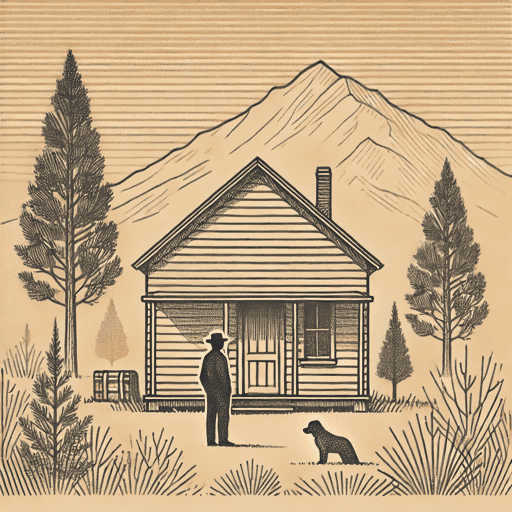
Frontier life in the Northwest United States in the early 1900s marked a collision between industrialization and wilderness. The Spokane International Railway, which operated from 1906-1958, figures prominently in Robert Grainier’s life in Train Dreams—not only is he a laborer who helps construct parts of the railroad, but he also frequently rides it, dreams of it, and hears it in the distance. Running for about 150 miles, the railway covered the expanse from British Columbia down through Spokane and into the Idaho Panhandle (Burns, Adam. “Spokane International Railroad: May, History, Photos.” American Rails, 13 Aug. 2024). The logging industry also encroached upon the landscape, becoming one of the predominant industries in the Pacific Northwest, one that Grainier contributes to in multiple ways. Despite his role in industrialization, Grainer also pushes back against it, resisting change by using horses and a wagon and by living remotely in the woods.
Socially, at that time, there was tension among different groups of people. When Idaho became a state in 1890, it was already home to several Indigenous peoples, including the Shoshoni, Kootenai, and Nez Perce. In Train Dreams, although the Kootenai interact with the residents of the frontier towns, the white settlers still harbor prejudice against them. This is evident in Johnson’s diction, in which he adopts the settlers’ voice, sometimes referring to the Kootenai as “mad” or “un-Christian.” Additionally, white settlers also distrusted the large population of Chinese laborers in the region. This anti-Chinese sentiment is reflected in the narrative’s opening scene, in which Grainier joins the effort to kill a Chinese laborer for supposed theft. Grainier’s actions reflect the nation’s attitude, at the US Chinese Exclusion Act of 1882 barred immigrants from China, and “in Idaho, white residents held an anti-Chinese convention in Boise in 1886, and throughout the next two decades, towns like Moscow and Clark Fork forcibly expelled their Chinese residents” (Cartan-Hansen, Joan, et. al. “Forgotten Neighbors: Idaho’s Chinese Immigrants: Idaho Experience.” PBS LearningMedia, 2018). In fact, Grainier recounts that his earliest memory was when he and his uncle “observ[ed] the mass deportation of a hundred or more Chinese families from the town” (27). As a result, Train Dreams depicts not only the harsh landscape of the American frontier, but its societal prejudice as well, grounding the narrative in real-world historical context.
Literary Context: American Modernism
Although Train Dreams was published in 2011, Johnson adopts the traditions of American Modernism, which originally spanned the late 1800s into the mid-1900s. This literary movement was marked by experimentation with form and style and often focused on an individual’s experience of adapting to changing times, a theme reflected in Johnson’s portrayal of Grainier’s life. The style of modernist writing was meant to reflect the increasing fragmentation of modern life, particularly post–World War I, through techniques like stream-of-consciousness narration and nonlinear narratives. Although Ernest Hemingway (The Sun Also Rises), F. Scott Fitzgerald (The Great Gatsby), William Faulkner (The Sound and the Fury), and John Steinbeck (The Grapes of Wrath) are frequently identified as seminal American modernists, equally important contributors to modernism include Katherine Anne Porter (Pale Horse, Pale Rider), Richard Wright (Native Son), and Zora Neale Hurston (Their Eyes Were Watching God).
Modernists played around with narrative structure, specifically the idea of nonlinear storytelling. This is evident in Train Dreams, as Robert Grainier’s story is told in a series of vignettes that include flashbacks that blur the lines between past and present, memory and reality. Consequently, the text feels like a photo album of Granier’s life, compiled out of chronological order. Like Ernest Hemingway’s Old Man and the Sea and John Steinbeck’s Of Mice and Men, Train Dreams employs an economy of words and a realism that portrays the struggles of the laboring man. Unlike Steinbeck, however, Johnson obscures the distinction between dreams and reality, adding to the harshness of frontier life. An example of this is the wolf-girl who terrorizes the landscape. Grainier’s sole interaction with her reveals that the wolf-girl is his daughter, Kate, but when he looks upon her, he notes, “Kate she was, but Kate no longer” (101). Grainier’s contradictory description of the girl as both Kate and not Kate is a paradox, and her appearance in the novella is presented as a real event, creating ambiguity around what is real and what is imagined. In this scene, and throughout the novella, Johnson blends experimentation with realism, creating a contemporary yet truly modernist take on the American frontier.

Unlock all 41 pages of this Study Guide
Get in-depth, chapter-by-chapter summaries and analysis from our literary experts.
- Grasp challenging concepts with clear, comprehensive explanations
- Revisit key plot points and ideas without rereading the book
- Share impressive insights in classes and book clubs