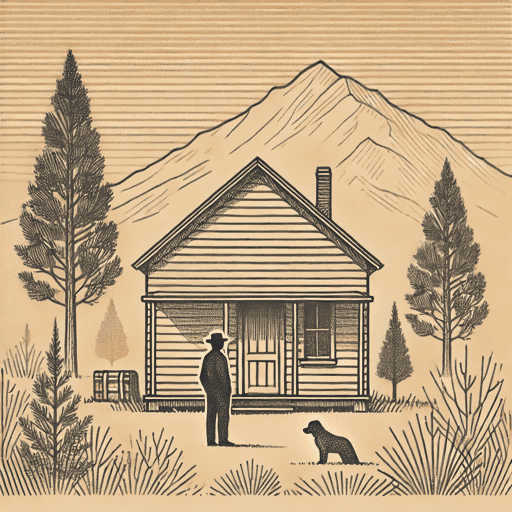
Train Dreams
Train Dreams
A modern alternative to SparkNotes and CliffsNotes, SuperSummary offers high-quality Study Guides with detailed chapter summaries and analysis of major themes, characters, and more.
Summaries & Analyses
Quizzes
NEWReading Tools
Games
Themes
Content Warning: This section of the guide includes discussion of racism and death.
Industrial Progress and the Erosion of Wilderness
Living on the Northwest frontier in the age of railroad expansion, Grainier experiences firsthand the collision between the vast expanse of wilderness and the promise of progress through technology. This ultimately results in the erosion of the natural world, and the novel explores this tension between industrial progress and the environment through the Spokane International Railway, Grainier’s clinging to the past, and the howl of the wolf-boy in the theater.
Working construction for the Spokane International Railway, Grainier experiences conflicting emotions that exemplify this tension. After they finish a job, “the first locomotive crossed the 112-foot interval of air over the 60-foot-deep gorge, traveling on the bridge they’d made […] The men cheered and whooped. Grainier felt sad. He couldn’t think why. He cheered and hollered too” (11-12). This industrial progress—a bridge strong enough to bear a train—has conquered the seemingly impossible, but at the expense of the gorge’s natural beauty. When Grainier inexplicably feels sad, he subconsciously mourns the loss that accompanies technological progress. However, he is also excited about the feat. The idea of industry “winning out” over nature is evident again when the machinery used in logging is described: “The engine was an old wood-burning steam colossus throbbing and booming and groaning while its vapors roared like a falls, the horses over on the skid road moving gigantically in a kind of silence, their noises erased by the commotion of steam and machinery” (13). The sound of the machines overpowering the horse noises represents how industry is conquering what was once wild. Only the engine can be heard, and the natural world is forgotten.
Additionally, Grainier clings to the past to avoid the push toward industrialization. The location of his home, so remote that when he dies it takes months for him to be discovered, indicates his desire to reside in a world untouched by humanity. Despite this longing, though, the world progresses around him while he holds on to vestiges of the past. When he helps Eddie Sauer move Claire Thompson, “Grainier took his mares and his wagon. Eddie had his sister’s husband’s Model T Ford […] Grainier preceding by half a mile because his horses disliked the automobile” (87). By choosing a now-outdated mode of transportation, Grainier demonstrates his reluctance to accept change; furthermore, the horses themselves, representative of nature, choose to keep their distance from the vehicle as well. Over time, Grainier only reluctantly accepts select technology that emerges, like “watch[ing] television whenever he was in town” (113). However, by the time of his death in 1968, he had not “spoken into a telephone” and only dared to ride “once on an aircraft” (113). Even though Grainier holds tight to the past, society trudges forward with new technology, leaving the wilderness and Grainier’s way of life in its wake.
Inevitable progress is also symbolized in the wolf-boy’s unsettling howl in the Bonners Ferry theater. At first, the audience laughs at the boy’s approach, deeming his wolfishness a mere costume. However, they stop when he laid his head back until his scalp contacted his spine, […] and opened his throat, and a sound rose in the auditorium like a wind coming from all four directions, low and terrifying, rumbling up […], the originating ideal of all such sounds ever made, of the foghorn and the ship’s horn, the locomotive’s lonesome whistle, of opera singing and the music of flutes and continuous moaning music of bagpipers. And suddenly it all went black. And that time was gone forever (116).
Starting as a wind, the “rumbling” that is both “low” and “terrifying” is animalistic. However, as the sound intensifies, it takes the shape of industry and culture, resembling the noises of ships and trains. This shift, which is depicted in one long sentence, represents the progression from untethered wildness to industrialized civilization. When the stage goes dark and “that time was gone forever” (116), the narrative closes its exploration of the topic, suggesting that progress is inevitable and highlighting what has been lost as a result.
The Symbiosis of Grief and Solitude
In Train Dreams, Grainier’s grief and solitude are the center of his life after his wife and daughter are lost in a wildfire. By living alone in his cabin and never remarrying, he clings to his family’s past and longs to be present in case they return. Granier’s cultivation of solitude illustrates how such isolation, adopted in the wake of loss and continued despite loneliness, can leave one mired in the past.
Grainier’s isolation is partly fueled by the hope that his wife and daughter survived the fire and will return to their home. His hopes are partially realized when he learns that Kate survived the fire and when he has a chance encounter with her. Up until his death, Grainier lives alone in his cabin, and “people wondered what drew him back to this hard-to-reach spot […] The truth was he’d vowed to stay, and he’d been shocked into making this vow by something that happened about ten years after the region had burned” (98). This event is the return of his daughter Kate, the infamous wolf-girl. Because this encounter prompts his vow to continue to live in isolation, his grief over losing her—not to death but to a life in the wild, one in which she does not recognize him—causes him to prolong his solitude by remaining in the wild where she might return.
Furthermore, Grainier’s sorrow over Gladys’s death drives him to remain isolated and to never remarry. In 1935, alone without his dog, “Grainer felt made of lead—thick and worthless. And lonely” (105). Feeling like lead, something heavy, suggests a melancholy that Grainier experiences in the years after losing his family. Totally alone, without even his dog anymore, Grainier considers himself to be worthless, but despite this loneliness, he repeatedly opts not to remarry. When Claire Thompson asks him about this choice, Grainier responds that he is “more than satisfied with all of everything’s been left to [him],” indicating that his love for Gladys is enough to sustain him. He adds that if Claire is looking for a husband, he “can’t think of a bigger mistake to make than to get around [him]” (95). These declarations make it clear that he has no interest in a new relationship or moving past his grief. However, when Claire calls him a hermit, Grainier realizes that his choice has resulted in isolation. Ultimately, he cuts himself off from others physically by retreating to his cabin and emotionally by rejecting any possibility of romantic relationships. Through this isolation, initially fueled by his grief, Grainier’s grief and loss are exacerbated, and a vicious cycle is enacted, whereby his grief and solitude fuel each other.
Memory as Hindrance and Help
In Train Dreams, Grainier’s recollections fuel the narrative structure in the form of flashbacks that seamlessly flow into and out of his present thoughts. His memories create a tangle of ruminations on his past mistakes and contemplations of his identity and existence, exploring the concept of memory, beyond nostalgia, to delve into more complex existential questions, highlighting how memory can both help and hinder.
Regret shapes Grainier’s memories of his involvement in the near-death of a Chinese laborer and the certain death of William Coswell Haley. The evening of the incident on the bridge, guilt haunts Grainier in his walk home, for he “almost met the Chinaman everywhere. Chinaman in the road. Chinaman in the woods. Chinaman walking softly, dangling his hands on arms like ropes. Chinaman dancing up out of the creek like a spider” (7). These imaginings indicate that Grainier cannot shake the idea of almost killing a man, and the memory of the man accompanies him wherever he goes. Years later, he admits that when he thinks of the man, “the thought paralyzed his heart” (62). In fact, he believes that his actions caused the man to curse Grainier’s family, resulting in the fire, an idea that links Grainier’s regret to tangible consequences. Grainier also grapples with memories of the itinerant man, William Coswell Haley, who was fatally wounded and left to die. Instead of going for help, Grainier gave him water and walked away, “the most cowardly and selfish of the many omissions that might have been counted against him in his early years” (35). This decision plagues him later in life when he admits that “rather than wearing away,” his guilt “had grown much keener as the years had passed” (62). In this way, memory is a constant reminder of the wrongs Grainier committed, his regret tainting his present.
However, his memories also aid his literal and figurative survival. When Grainier thinks of Gladys, long after her death, her memory inspires him to work harder, and he eventually builds a successful hauling business as a result. On a more abstract level, memory provides the link for Grainier to understand his identity. He notes that when he is young, he takes a train to Idaho to live with his aunt and uncle, whose family becomes his own. However, “the whole adventure made him forget things as soon as they happened, and he very soon misplaced this earliest part of his life entirely” (26). Grainier recognizes that by missing these memories, he loses a part of himself. Later in life, he wants to learn more from his aunt and uncle, but “by the time he thought to ask them, many years had passed and they’d long since died” (26). The memories cease to exist with their deaths, and as a result, Grainier lacks a fundamental understanding of his origins. These missing details could solidify his identity formation and give him a sense of belonging. By exploring Grainier’s relationship to his past and memories, the novella highlights how memory can be a source of regret and loss, as well as healing and growth.

Unlock every key theme and why it matters
Get in-depth breakdowns of the book’s main ideas and how they connect and evolve.
- Explore how themes develop throughout the text
- Connect themes to characters, events, and symbols
- Support essays and discussions with thematic evidence