41 pages • 1-hour read
Train Dreams
A modern alternative to SparkNotes and CliffsNotes, SuperSummary offers high-quality Study Guides with detailed chapter summaries and analysis of major themes, characters, and more.
Summaries & Analyses
Plot Summary
Background
Chapter Summaries & Analyses
Character Analysis
Themes
Symbols & Motifs
Important Quotes
Book Club Questions
Reading Tools
Chapters 4-6Chapter Summaries & Analyses
Content Warning: This section of the guide includes discussion of death, substance use, graphic violence, and animal cruelty and death.
Chapter 4 Summary
Grainier never shared William Coswell Haley’s story; he only brought the man water and then left. Despite this, Grainier stayed in the area into his twenties, working as a laborer. He was respected because he did not drink or get into trouble. At the age of 31, he fell in love with Gladys Olding. That summer, he took her to the land he purchased on a bluff overlooking the Moyea River. As they walked, he described where he planned to put a garden and a cabin. Eventually, they rested in a meadow, where they kissed, and Grainier asked her to marry him. Gladys said yes.
A few summers later, now in the present, he returns from the Robinson Gorge to a fire ravaging the area. Desperate, he searches for Gladys and their daughter, Kate, among the survivors. There is no news of them. Because the train is not running, he walks 20 miles toward his cabin through the smoky landscape. The ground is covered in ash, and there are no signs of life. He calls out for Gladys and Kate. Eventually, he sees flames only a half mile away. Dropping to his knees, Grainier weeps.
A week and a half later, when the train resumes, Grainier rides to British Columbia, learns nothing, and comes back the same day. Staying with his cousin, Grainier is wracked with grief but hopes that Gladys and Kate are alive. At night, he endures nightmares. A month after the fire, he plans to rebuild his home and wait for his family. Seeing the devastation, though, he returns to live in town.
In May, Grainier camps next to the river near his old home. Plants sprout from the ashes. However, there is nothing where the cabin once stood, except remnants of their woodstove. Hearing wolves in the distance, he senses Gladys’ presence and imagines that her favorite chocolates litter the ground. That night, Grainier sees Gladys’s white bonnet fly past.
Hoping for more visions, he survives the summer on mushrooms and trout. He rarely thinks of Kate. One day, a dog appears and follows him to Meadow Creek, where he purchases supplies and animals. When the weather changes, though, he is forced to slaughter and eat them. When he returns to town, the dog is gone.
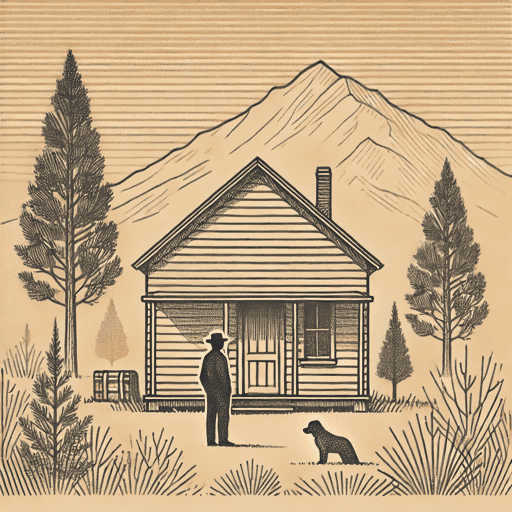
All winter, Grainier sells firewood until, in the spring, he returns to his campsite. The forest is sprouting again. He builds the walls of a small cabin. The dog reappears and gives birth to puppies that look like wolves.
When in Meadow Creek, he tells Kootenai Bob, an Indigenous man, about the pups. The man tells Grainier that it is unlikely for a dog to mate with wolves, who tend to be monogamous. However, he concedes that maybe the pups are part wolf. Only one pup stays, and Granier tries to teach it how to howl with the wolves, but the dog stays silent. Grainier, though, howls along, for it eases his grief. Eventually, the pup wanders off.
Later, in 1930, Grainier sees Kootenai Bob on the day Bob dies. Sitting outside a hotel in Meadow Creek, Bob is drunk for the first time in his life. So inebriated that he cannot speak, he wanders off and lies across the train tracks, unconscious. Several trains speed over his body before anyone realizes what happened. Over the next few days, his tribe searches for parts of his body.
Chapter 5 Summary
About four more years pass, and Grainier realizes that he cannot keep up with the physical demands of logging. In the spring of 1925, he stays in town to work for hire. One day, while helping the Pinkhams, Grainier witnesses their grandson fall over and die. Unsettled, Grainier takes the boy to the cemetery, where he gets additional jobs from a man named Helmer. Thus begins Grainier’s hauling career. For a while, he leases a horse and wagon from the Pinkhams, but eventually, he buys them outright.
In his travels, he often passes the Kootenai River, which reminds him of William Coswell Haley, and his regret intensifies. He also thinks of the Chinese laborer and believes that the man’s curses wrought misfortune on his family. Despite his brooding, Grainier enjoys the work and continues deep into the winter. Once, he helps a man who accidentally detonated dynamite in his house. If it were not for his dog, who ran to get help, the man would not have survived.
Grainier also transports a man named Peterson, who was shot by his own dog. During the ride, Grainer worries that Peterson will die and periodically talks to him. Eventually, Peterson reveals that Kootenai Bob shared information that made him want to kill his dog, but the animal shot him instead after slipping his leash and getting his gun. Comically, Grainier misunderstands and thinks that Kootenai Bob had been tied up.
After clarifying, Peterson explains that one day, the dog showed up barking, so he let it in. However, the next morning, it had clawed its way out and disappeared for 13 days. Kootenai Bob happened to stop by and see the wild dog after its return. He instructed Peterson to shoot the dog because it had been with wolves and the infamous wolf-girl. This wolf girl is rumored to have given birth to a wolf-child, and she is considered dangerous.
Suddenly, Grainier fears seeing the wolf-girl. Peterson admits that he cannot sleep thinking about her. He mentions that guys near him used to go out and “get on a stump and love a cow” (71), emphasizing that it is not unnatural to have sex with an animal. Grainier asks questions in disbelief, but Peterson returns to the idea of the wolf-girl. Grainier is so confused, all he can do is watch the darkness for signs of the wolf-girl. For a while, there are supposed sightings, but soon, something else captures the town’s attention.
Chapter 6 Summary
Over the years, Grainier struggles with nightmares and dreams. When he still lives by the river, he is haunted by Gladys and the image of his campfire. He struggles to distinguish between dream and reality. After some time in his new cabin, he sleeps more soundly, but dreams of riding a train, with images from his childhood passing by. Sometimes, when he wakes, the Spokane International is sounding in the distance. One morning, he rises feeling unnerved and cannot get back to sleep. As he looks around his cabin, he realizes that he has made a home for himself.
It is then that Grainier feels the presence of Glady’s spirit. She takes shape in front of him. The spirit does not speak; instead, she shows him her last moments on Earth. As the fire raged, Gladys gathered the baby and a few valuables, and she ran. However, by the time she reached the river, she only possessed her Bible, a box of chocolates, and Kate. Tying the baby into her apron, Gladys descended the rocks.
To free a hand, she tossed the Bible away. Moments later, she fell onto her back on the rocks, 20 feet below. Unable to move her legs, she untied Kate and let the baby crawl to safety. Eventually, the water swept Gladys away and drowned her. Meanwhile, Kate found the chocolates strewn about. Now dead, Gladys’s spirit watched from above as their home burned and Kate survived. Shocked and confused, Grainier marvels that he did not hear about anyone saving a baby. Gladys disappears, and the cabin goes dark.
Chapters 4-6 Analysis
Grainier develops in complexity in these chapters, and this shift is reflected structurally through lengthier chapters that outline the tragedy of the fire and emphasize his grief. These vignettes are situated in the middle of the narrative, and they are similarly the center of Grainier’s life story. The narrative also continues to emphasize the gap between how he sees himself—“cowardly and selfish” because he leaves William Coswell Haley to die (35)—and his true character, which proves to be compassionate, brave, and selfless in many other ways. He selflessly searches for his missing family, living a meager existence, and in the course of his errands, he transports people in need of medical attention. This harsh life has also worn Grainier down physically, and he feels the effects of his years of laboring in the logging and railroad industries. Along with his many physical ailments, “a general stiffness of his frame worked itself out by halves through most mornings, and he labored like an engine through the afternoons, but he was well past thirty-five years, closer now to forty” (58). Frontier life has rendered Grainier an old man at what is now considered a young age. His physical deterioration mirrors his emotional struggles with grief as both his mind and his body toil to survive a solitary existence.
Grainier’s isolation further highlights the theme of The Symbiosis of Grief and Solitude. Initially, although he knows that his wife and child must have perished in the fire, he still hopes for their return. Consequently, he endures a solitary existence, first by the river and then in a new cabin at the site of their old home. “Sickened by his natural grief” (43), he endures nightmares, senses Glady’s spirit, and imagines seeing her favorite chocolates and her bonnet. In his grief and desperation, his mind conjures up these images. Later, when the dog that befriends him gives birth to pups, Grainier tries to teach it how to howl like the wolves. When it stays silent, Grainier himself raises his voice: “He laid his head back and howled for all he was worth, because it did him good. It flushed out something heavy that tended to collect in his heart, and after […] he felt warm and buoyant” (53). Grainier needs an outlet for his grief and finds it in communal howling with wolves, highlighting his need to break out of his solitude in order to move beyond his grief. Grainier’s solitude is not just emotional, but physical, for when he helps to lift a lifeless Hank, the Pinkhams’ grandson, he realizes that “he hadn’t touched another person in several years” (61). This lack of physical contact is another manifestation of his grief—in his mourning, he has isolated himself both physically and emotionally.
Within this seclusion, Grainier experiences recollections that fuel the theme of Memory as Hindrance and Help. For Grainier, time does not lessen the pain of regret. A few years after the fire, he reflects while traveling for work. Thinking about William Coswell Haley, he notes that “rather than wearing away, Grainier’s regret at not having helped the man had grown much keener as the years had passed” (62). The more he thinks of the injured man, the worse Grainier feels. His memories only intensify his regret, reminding him of the possibility that, if he had helped Haley, the man might have lived. Memories also flood Grainier in his dreams as he catches glimpses of his childhood. Although there is nothing he explicitly regrets in these moments, he admits that “to be a child again in that other world had terrified him, and he couldn’t get back to sleep” (76). Moments later, Gladys’ spirit visits him and projects her memories of the fire, which are rife with grief and regret, for “she mourned for her daughter, whom she couldn’t find” (77). Although this is not Grainier’s recollection, he feels the burden of Gladys’s last moments when she falls to her death and lets Kate loose with the hopes that she will survive. Like his isolation, his continued return to memory fuels his grief instead of healing it.
Despite the weightiness of Grainier’s experiences, the narrative’s tone is occasionally light-hearted and humorous, as if to reinforce that there are positive aspects to life on the frontier. Sometimes, Grainier’s interactions are comical, like when he misunderstands Peterson and asks, “But why did you have Kootenai Bob tied up, and what has Kootenai Bob got to do with this, anyways?” (68). In a moment of confusion, for Peterson tells his tale over a series of starts and stops, Grainier mixes up the details. The result is an image of a man being tied to a dog’s leash, and humor momentarily lightens the tragedy that pervades the narrative.

Unlock all 41 pages of this Study Guide
Get in-depth, chapter-by-chapter summaries and analysis from our literary experts.
- Grasp challenging concepts with clear, comprehensive explanations
- Revisit key plot points and ideas without rereading the book
- Share impressive insights in classes and book clubs