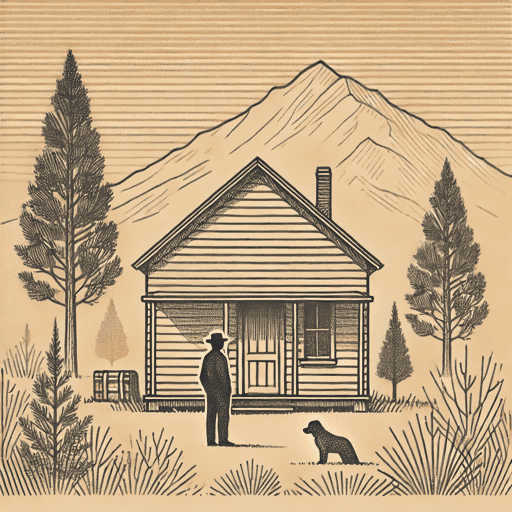
Train Dreams
41 pages • 1-hour read
Denis JohnsonTrain Dreams
A modern alternative to SparkNotes and CliffsNotes, SuperSummary offers high-quality Study Guides with detailed chapter summaries and analysis of major themes, characters, and more.
Important Quotes
Content Warning: This section of the guide includes discussion of racism, death, and sexual content.
“Hiking to his home after this incident, Grainier detoured two miles to the store at the railroad village of Meadow Creek to get a bottle of Hood’s Sarsaparilla for his wife, Gladys, and their infant daughter, Kate.”
(Chapter 1, Page 6)
After attempting to throw a man off a bridge for supposed theft, Grainier walks home. The two-mile detour and the use of the word “hike” suggest the isolated and rugged terrain of the Idaho frontier. Furthermore, this lengthy detour indicates his devotion to his wife and daughter. He cares so much for them that he wants to make sure they have medicine, a devotion that foreshadows his devastation after their loss.
“The Chinaman, he was sure, had cursed them powerfully while they dragged him along, and any bad thing might come of it. Though astonished now at the frenzy of the afternoon, baffled by the violence, at how it had carried him away like a seed in a wind, young Grainier still wished they’d gone ahead and killed that Chinaman before he’d cursed them.”
(Chapter 1, Page 8)
Reflecting on the day’s events, Grainier is shocked that he participated in the attempted murder of a possibly innocent man and admits that he got swept up in the moment, emphasizing how he was carried along with a simile comparing himself to a “seed in the wind. Despite this regret, Grainier worries that the supposed thief had cursed him. This concern reflects the anti-Chinese biases that pervaded the Idaho frontier. Because Grainier could not understand the man, he assumes that the words were a curse, a bias that allows him to justify his role in the man’s death.
“At the landing crouched a giant engine the captain called a donkey, an affair with two tremendous iron drums, one paying out cable and the other winding it in, dragging logs to the landing and sending out the hook simultaneously to the choker, who noosed the next log.”
(Chapter 2, Page 13)
This is a description of the engine used to move 18-foot logs from the railroad landing onto flatcars for transport. The diction and imagery are animalistic and ironic, as the engine and its sound are compared to a donkey, an animal reference furthered by its depiction as “crouched.” This word choice is ironic because the engine is representative of industrial progress stifling the natural world, contributing to the narrative’s exploration of the theme of Industrial Progress and the Erosion of Wilderness.
“It was only when you left it alone that a tree might treat you as a friend. After the blade bit in, you had yourself a war.”
(Chapter 2, Pages 14-14)
Arn Peeples explains that when left alone, nature is man’s friend. However, when man decides to cut down trees or harm the natural world, the battle begins, noted by the use of war. Peeples, Grainier, and the other men in their camp labor in the logging industry, so they engage in this dangerous work. Peeples’ statement develops the theme of industrial progress and the erosion of wilderness by exposing the adversarial relationship between humans and nature, instigated by humans in the name of progress.
“Arn Peeples had said a standing tree might be a friend, but it was from just such a tree that his death had descended.”
(Chapter 2, Pages 18-19)
Arn Peeples dies a few days after a dead limb from a tree falls and hits the back of his head. Grainier notes the irony of his death, in light of the fact that his statement that when you leave a tree alone, it is your friend, proves to be false. The irony contributes to a humorous tone despite the serious content.
“Down at the street’s end, at the Bonner Lumber Company’s railroad yard, men with axes, pistols, and shotguns in their hands stood by saying very little while the strange people clambered onto three flatcars, jabbering like birds and herding their children into the midst of themselves, away from the edges of the open cars.”
(Chapter 3, Page 27)
One of Grainier’s first memories is standing with his uncle watching the Chinese residents of the town be deported. The imagery reveals the prejudice and racism of the times, for “men,” who are likely white, stood guard with weapons until the Chinese families left. The word choice also reflects how the prejudices of society influence children: By calling the Chinese families “strange” and comparing them to birds and herding animals, Grainier depicts them as inferior and animalistic, reflecting the prejudices of the time through the eyes of a child.
“Young Robert wound in his line and laid the pole aside. He climbed the bank and stopped ten feet from where the man sat up against a tree with his legs out straight, barefoot, the left leg resting over a pallet of evergreen limbs.”
(Chapter 3, Page 30)
Grainier comes upon William Coswell Haley while fishing one day. The description of the protagonist as “young” refers to his inexperience and naiveté. He approaches the man when beckoned and is blindsided by the horrific story the man tells him. However, Grainier has an instinct that something is off, for he does not go near the man; instead, he “stopped ten feet” away, making it clear that he does not like nor trust the situation.
“Grainier considered the pasture a beautiful place. Somebody should paint it, he said to Gladys. The buttercups nodded in the breeze and the petals of the daisies trembled. Yet farther off, across the field, they seemed stationary.”
(Chapter 4, Page 38)
When Grainier takes Gladys to the land he purchased and tells her of the home and garden he plans to build, they sit in this meadow. The personification of the buttercups and daisies highlights the life and friendliness of the field, and it also foreshadows the life the couple will build together in this place.
“All his life, Robert Grainier would remember vividly the burned valley at sundown, the most dream-like business he’d ever witnessed waking—the brilliant pastels of the last light overhead, some clouds high and white, catching daylight from beyond the valley, others ribbed and gray and pink, the lowest of them rubbing the peaks of the Bussard and Queen mountains; and beneath this wondrous sky the black valley, utterly still, the train moving through it making a great noise but unable to wake this dead world.”
(Chapter 4, Pages 42-43)
After the fire, Grainier rides the train to and from British Columbia in search of Gladys and Kate. The imagery presents a stark contrast between the beautiful pastels of the sky in the last light of the day and the black scorched earth beneath it. This contrast represents the paradox of frontier life in the West: There is beauty in the landscape, but life itself can be harsh. Furthermore, the train, which symbolizes how life goes on, continues to run despite the tragedy.
“He climbed to their cabin site and saw no hint, no sign at all of his former life, only a patch of dark ground surrounded by the black spikes of spruce. The cabin was cinders, burned so completely that its ashes had mixed in with a common layer all about and then been tamped down by the snows and washed and dissolved by the thaw.”
(Chapter 4, Page 45)
In the spring after the fire, Grainier returns to the site of his home, and nothing remains. His cabin was so thoroughly destroyed that all signs of his life before are completely gone, a physical representation of his inner devastation. However, the fire and its destruction symbolize rebirth, not only for the environment but for Grainier too. He must start over, for there is “no sign at all of his former life.”
“Sometimes he thought about Kate, the pretty little tyke, but not frequently. Hers was not such a sad story. She’d hardly been awake, much less alive.”
(Chapter 4, Page 47)
In his grief, Grainier thinks of his daughter, Kate, infrequently. This seemingly heartless description of his child—that there is less to mourn because she barely lived—contrasts with Grainier’s typically kind and compassionate nature. Ultimately, it reflects how little he knew the girl, for he was frequently off working and gone for months at a time. Also, when he considers her “less alive,” it proves to be ironic, for she survived the fire.
“Mr. Pinkham asked Grainier a favor, standing in the shadow of the house while his wife waited in the yard under a wild mixture of clouds and sunshine, looking amazed and, from this distance, as young as a child, and also very beautiful, it seemed to Grainier.”
(Chapter 5, Page 60)
After the Pinkhams’ grandson suddenly dies, Mr. Pinkham asks for Grainier’s help. The imagery of the sky and the description of Mrs. Pinkham are paradoxical. The sky is a “wild mixture” of clouds, suggesting storm and sunshine, but also implying calmness. These contradictions provide a metaphorical backdrop for Mrs. Pinkham, who, although quite old, looks young and beautiful. These contradictions emphasize both the harshness and the beauty of life on the frontier.
“Grainier thought Peterson had gone to sleep. Or worse. But in a minute the victim answered: ‘Nope. I’m perfect.’”
(Chapter 5, Page 64)
When Grainier transports Peterson, the man whose dog shot him, to receive medical attention, Grainier asks the man if he needs anything, and this is the reply he receives. Peterson’s response is ironic, for he is suffering from a gunshot wound and is considered a “victim,” yet he tells Grainier he is “perfect” and in need of nothing. The irony and this situation—a dog shooting its owner—creates a humorous tone while highlighting Peterson’s understanding of the futility of helping him.
“Kootenai Bob stopped by the place one day a while after that. Do you know him? His name is Bobcat such and such, Bobcat Ate a Mountain or one of those rooty-tooty Indian names.”
(Chapter 5, Page 69)
When Peterson shares the story of the wolf-girl he learned from Kootenai Bob, he says this about the Indigenous man’s name. His word choice, calling him “rooty-tooty” and making up a name for him, indicates the prejudice that existed toward Indigenous people in Idaho at this time. He does not bother to know Bob’s real name, and he insults how the tribe names people.
“And then it was Gladys—nobody else—flickering and false, like a figure in a motion picture.”
(Chapter 6, Page 77)
Alone in his cabin after waking from a dream, Grainier senses Gladys’s spirit, which eventually materializes. Calling her “flickering and false” and comparing her to someone in a film, Grainier refers to the fact that she is a ghost, not a real person. However, this description is also linked to the memory Gladys provides, for Grainier is uncertain as to the truth of it. He questions whether Kate survived the fire and why he has not heard about it. This raises questions about the veracity of memory, especially those that are not our own.
“Needing a hand to steady her along the rocky bluff as they descended, she tossed away the Bible rather than the chocolates. This uncovering of her indifference to God, the Father of All—this was her undoing.”
(Chapter 6, Page 78)
Descending the cliff face during the fire, Gladys needed to hold on to the rocks, so she chose to discard the Bible rather than food. This is a practical choice as food will aid in her survival; however, the narrative indicates that the decision led to her death, as if God were punishing her. The Bible is symbolic of faith, and the commentary on Gladys’s action highlights the belief that faith was a necessity as much as food and water on the frontier.
“This sudden attention to terrain so long neglected constituted a disruption in the natural world, about as much as if the Almighty himself had been hit in the head.”
(Chapter 7, Page 89)
When Grainier helps Eddie Sauer move Claire Thompson from Montana to Idaho, Eddie cleans himself up on the morning they depart. Eddie is compared to a landscape, or “terrain,” that was unkempt but is now tended to. This metaphor highlights how the landscape of the frontier influences so much of their lives. Also, describing Eddie’s cleanliness as “a disruption in the natural world” highlights how his ragged appearance was the norm. Furthermore, this description adds to the humorous tone, for someone so “untended,” Eddie is comically clean and shaven.
“The widow herself sat up front next to Eddie with her arm hooked in his, wearing a white scarf over her head and a black dress she must have bought nearly a year ago for mourning; laughing and conversing while her escort tried to steer by one hand.”
(Chapter 7, Page 91)
In this description of Claire Thompson as she rides with Eddie on the move to Idaho, the words “mourning” and “laughing” situated next to each other provide a stark contrast that highlights the contradictions of the world these characters live in. Despite the harsh circumstances of frontier life—in this case, Claire being widowed after only a few years of marriage—they can find joy, illustrated by the juxtaposition of her white scarf with her black mourning dress.
“Grainier gave them a good start, but he caught up with them frequently at the top of the long rises, when the auto labored hard and boiled over.”
(Chapter 7, Page 91)
While moving Claire Thompson, Eddie drives first in the Model T car while Grainier follows with his horses and wagon. Despite the industrialization happening nationwide with the expansion of railroads and the rise of the automobile, Grainier’s horses outperform the vehicle, an ironic twist to the narrative’s theme of industrial progress and the erosion of wilderness, for in this moment, the less mechanized mode of transportation is more effective.
“She must have been easy to get along with, because she never spoke. But whenever Eddie engaged in talk she muttered to herself continually, sighed and grunted, even whistled very softly and tunelessly. Grainier would have figure her for mad if she’d been white.”
(Chapter 7, Page 96)
After Claire Thompson rejects Eddie Sauer, he begins a relationship with a Kootenai woman. Grainier describes her as easy to get along with, but with a qualifier: Her behavior is odd to him. He stops short of calling her “mad,” though, because she is not white, displaying his knowing ignorance of Kootenai language and culture.
“The wolves and coyotes howled without letup all night, sounding in the hundreds, more than Grainier had ever heard, and maybe other creatures too, owls, eagles—what, exactly he couldn’t guess—surely every single animal with a voice along the peaks and ridges looking down on the Moyea River, as if nothing could ease any of God’s beasts. Grainier didn’t dare to sleep, feeling it all to be some sort of vast pronouncement, maybe the alarms of the end of the world.”
(Chapter 8, Page 99)
The night the wolf-girl, Kate, appears injured on Grainier’s property, the animals are loud and unsettled. Johnson’s diction creates an ominous tone, especially the phrase “nothing could ease God’s beasts.” The unease and connection to God suggest that something evil or unnatural is about to happen. Grainier is about to discover that not only did Kate survive the fire but she has become completely wild and is the wolf-girl of local lore.
“He fumbled at the clutter on the table and located the matches and lit a hurricane lamp and found such a weapon, and then went out again in his long johns, barefoot, lifting the lantern high and holding his club before him, stalked and made nervous by his own monstrous shadow, so huge it filled the whole clearing behind him.”
(Chapter 8, Page 100)
When the wolf-girl lies injured in his yard, Grainier retrieves a lamp and a club before approaching her. As he walks outside, he is barefoot, indicating his movement away from civilization. Furthermore, the shadow he makes is described as “monstrous” and “huge” and terrifies even him. There is irony in this diction, which implies that Grainier, not the wolf-girl, is the dangerous one, pointing toward the horrors that man is capable of. However, later, when Grainier realizes it is Kate, he carries her inside to tend to her injury, and only then does his monstrous shadow disappear.
“In the hot, rainless summer of 1935, Grainier came into a short season of sensual lust greater than any he’d experienced as a younger man. In the middle of August it seemed as if a six-week drought would snap; great thunderheads massed over the entire Panhandle and trapped the heat beneath them while the atmosphere dampened and ripened; but it wouldn’t rain.”
(Chapter 9, Page 105)
The description of the weather parallels Grainier’s sexual longing: The climate is hot, stifling, and unbearable. Although it is on the verge of raining, with thunderclouds above, the weather doesn’t break, much like the lust Grainier experiences has no outlet. Alone in his cabin, and later plagued by guilt, Grainier feels trapped.
“At the fairgrounds he talked to a couple of Kootenais—one a middle-aged squaw, and the other a girl nearly grown. They were dressed to impress somebody, two half-breed witch-women in fringed blue buckskin dresses with headbands of dangling feathers of crow, hawk, and eagle. They had a pack of very wolfish pups in a feed sack, and also a bobcat in a willow cage. They took the pups out one at a time to display them. A man was just walking away and saying to them, ‘That dog-of-wolf will never be Christianized.’”
(Chapter 9, Pages 106-107)
Johnson’s description of the Indigenous women is laden with racist slurs that mark the bigotry of the time. In addition to linking them with evil by calling them “witch-women,” Johnson also notes that the puppies look like wolves, noting a wildness that the man passing by deems un-Christian. This description captures society’s prejudice against Indigenous people on the frontier.
“Almost everyone in those parts knew Robert Grainier, but when he passed away in his sleep sometime in November of 1968, he lay dead in his cabin through the rest of the fall, and through the winter, and was never missed. A pair of hikers happened on his body in the spring.”
(Chapter 9, Pages 113-114)
Despite being known by many people, Grainier is “never missed” when he dies, and it takes months for his body to be discovered. These details highlight Grainier’s isolation, both physically and emotionally, as no one thought to check on him. His separation from society has ties to his mourning for Gladys and Kate and his attempt to cushion himself against the new technologies sprouting up everywhere. The details of Grainier’s death serve to highlight the themes of The Symbiosis of Grief and Solitude as well as industrial progress and the erosion of wilderness.

Unlock every key quote and its meaning
Get 25 quotes with page numbers and clear analysis to help you reference, write, and discuss with confidence.
- Cite quotes accurately with exact page numbers
- Understand what each quote really means
- Strengthen your analysis in essays or discussions