51 pages • 1-hour read
Under a War-Torn Sky
A modern alternative to SparkNotes and CliffsNotes, SuperSummary offers high-quality Study Guides with detailed chapter summaries and analysis of major themes, characters, and more.
Chapters 1-6Chapter Summaries & Analyses
Content Warning: This section contains discussion of graphic violence and death.
Chapter 1 Summary
In March 1944, during World War II, 19-year-old Henry Forester is a bomber copilot in the US Eighth Air Force, stationed in England. He awakes from a nightmare in which his plane crashed after being fired upon by a German fighter plane. It is not the first nightmare Henry has had recently. He distracts himself by thinking of his home and family in Richmond, Virginia, particularly his mother, Lilly.
Before dawn, Sergeant Bromsky rouses the 16 men in the hut—pilots, navigators, bombardiers—making up the officers of four bomber crews. Henry learns they will be on a mission that day to Germany, a dangerous 1,000-mile round trip. It will be his 15th mission copiloting a B-24 bomber. Henry thinks of his friend Patsy who lives in Virginia on the neighboring farm. He has recently developed romantic feelings for her. As the men awaken, Henry interacts with his fellow officers, including Billy White, with whom he has a rather antagonistic relationship, Dan MacNamara, his pilot, who always speaks with authority, and his navigator, Fred Bennett.
Chapter 2 Summary
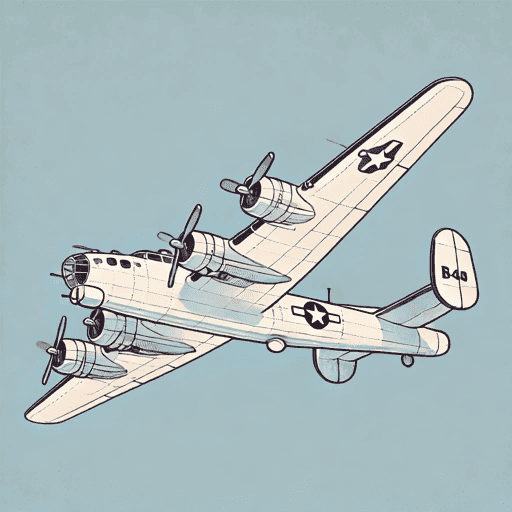
In the briefing room, Henry and his colleagues learn about their mission from the commanding officer. They are to bomb a ball-bearing plant in southern Germany. Just after 5 AM, they eat breakfast in the flying officers’ mess hall, and Henry and Billy engage in some banter. Henry then walks to the B-24 on the landing field. He climbs into the plane, which is called Out of the Blue, and starts to check the controls. Dan joins him and they go through their pre-flight ritual. The plane slowly moves to the take-off point to join the 23 other planes. Then they are all off on their seven- to nine-hour flight.
Chapter 3 Summary
As they climb to 6,000 feet, with clouds below them, the bomb group flies in a diamond formation. Dan hands the controls over to Henry; they ascend to 10,000 feet and eventually will be flying at 20,000 feet.
They come under fire from flak guns as they reach the European coast but are not hit. Then German fighter planes show up, firing their cannons. Jim Wilkinson, Out of the Blue’s tail gunner, returns fire and one of the fighter planes explodes. The German attack continues, and three B-24s explode. Then American fighter planes—Thunderbolts and Mustangs—arrive and the air battle continues.
Chapter 4 Summary
Dan is hit in the leg by a bullet. Billy’s plane is hit and one of the engines explodes. Henry sees five opened parachutes descending and prays that Billy is one of the survivors.
Out of the Blue comes under more fire from a Messerschmitt fighter. As their engines are hit, Dan issues a command for the crew to bail out. Henry drags the wounded Dan behind him and they both leap out of the plane. Dan’s parachute is damaged by a Messerschmitt and he plunges a mile down to earth. Henry shoots at the German plane, and his own parachute gets damaged, but he falls safely into a snow drift, although he injures his ankle. He walks westward, not knowing whether he is in France, Switzerland, or Germany.
Chapter 5 Summary
Walking with difficulty, Henry finds his way to a narrow, muddy road. He encounters an old man on a bicycle who tells him he is in the French province of Alsace. The man, who says he is a teacher and hates Germans, takes Henry to a schoolhouse where he can hide.
The man says he will get Henry to a hospital in Bern, Switzerland. He gives him food and then leaves. Henry injects himself with morphine from his survival kit. He thinks of his mother, who will be receiving a telegram that he is missing in action, and of his dead comrades. Eventually he falls asleep.
Chapter 6 Summary
The next morning, the teacher explains the route they will take to Bern. Since Henry cannot walk because of his bad ankle, they will first travel on the nearby canal to Basel, Switzerland. Henry is grateful that the man is willing to risk his life to help him.
In the evening, another man arrives who has authority to carry goods on the canal on his boat. They begin the 60-kilometer journey to Basel. After several hours, they are intercepted by soldiers calling out in German. Henry hides in a cavern under crates of cabbages. Three times the soldiers thrust bayonets into the cabbages, just missing Henry. Confusion spreads as a bucket of fish is knocked over, and the soldiers depart. The teacher tells Henry they were Swiss soldiers who thought the boat was hiding Jewish civilians.
Chapters 1-6 Analysis
Henry, although only just turned 19, is not exactly a newbie to the war. He has already undertaken 14 bombing missions, all of them dangerous. However, he is still a young man struggling to come to terms with what is happening around him, and who will embark on an important emotional and psychological journey of self-discovery throughout the narrative, introducing the key theme of The Experience of Coming-of-Age.
Henry thinks often of his home and family in Virginia, with his homesickness revealing how emotionally dependent he still is upon his family, and how much he longs to return to them. He contrasts his present dangerous situation with the peace and security of life on the farm. In Chapter 2, for example, Henry thinks of “the warm bacon smell and sizzling sound of his ma’s frying pan as she cooked breakfast” (21). After he is shot down in France and begins his long walk, he comes across a group of houses with beams in a diamond pattern, and thinks they look “just like gingerbread houses pictured in a book of fairy tales his mother used to read him” (48, emphasis added). As he remembers those days of innocence, tears well up in his eyes. These frequent invocations of family life and Henry’s emotional responses to them speak to how Henry must wrestle with loneliness and uncertainty far from his usual comforts, emphasizing how he must develop resilience and self-reliance if he is to survive his ordeals.
In this section, Henry must confront new dangers, introducing the theme of Courage and Resilience in the Face of Fear. Henry exhibits courageous behavior when he refuses to leave Dan behind when his captain orders a bail out. He drags Dan out of the cockpit, ignoring the fact that this slows him down and puts his own escape at risk. When Out of the Blue is destroyed, Henry finds himself in a different kind of danger, alone and injured in a foreign land. While during his missions Henry always had the camaraderie and support of his fellow servicemen to sustain him, he will now have to navigate unfamiliar terrain on his own, which requires a new kind of courage and focus.
The two Frenchmen Henry meets, who look after him and help him on his way, also show courage despite their fear. The old teacher lost all his students when the Nazis forced them to join their army. They were sent to the Russian front and the teacher believes they are likely all dead. He finally decides to take a stand against the Nazis by helping the downed American flyer. He finds the courage to help even though Henry sees that this “frail, mild man” was “obviously afraid” (58), which suggests people can be courageous at any age and even when they might not appear openly strong or heroic. The second man is the father of one of the teacher’s students, which is why he is ready to help too. He does it for his son, Francois. Both men know the danger they face, and the inspection of the boat by hostile Swiss soldiers clearly shows that danger. These two men are the first in a line of French people, members of the French Resistance, who will all show great courage in protecting him, even though that puts them at risk of capture and execution by the Nazis.
After Henry is shot down, he slowly becomes exposed to another view of the war that he had not up to this point considered. He realizes that bombs have victims, and that French civilians have suffered losses not only from the Germans but also from American bombing raids. The schoolteacher tells him that the people of Mulhouse—a German-occupied French city in Alsace—are not well-disposed toward Americans, since they suffered under severe American bombing. Henry and his colleagues had thought of the war as a battle between warplanes and had “never really thought much about the people they were trying to liberate, or what their struggles must be on the ground under a war-torn sky” (51). Now, he will begin to find out.
Amidst the perils of his situation, Henry exhibits signs of a quiet religious faith that will help him through the trials to come, which also introduces the theme of The Importance of Kindness and Human Connection. Henry prays for the protection of other people, not just his own, which emphasizes his empathy and compassion. For example, he says, “God bless the ground crew” (11) about the team that looks after Out of the Blue, since he trusts them to ensure the plane is in perfect mechanical condition, and knows being grateful for their labor is important. In Chapter 4, when he sees Billy White’s plane get destroyed, he offers a prayer to God for Billy’s survival, even though he and Billy did not always get along well. In these ways, Henry demonstrates his connections to others and his desire to treat others with kindness.

Unlock all 51 pages of this Study Guide
Get in-depth, chapter-by-chapter summaries and analysis from our literary experts.
- Grasp challenging concepts with clear, comprehensive explanations
- Revisit key plot points and ideas without rereading the book
- Share impressive insights in classes and book clubs