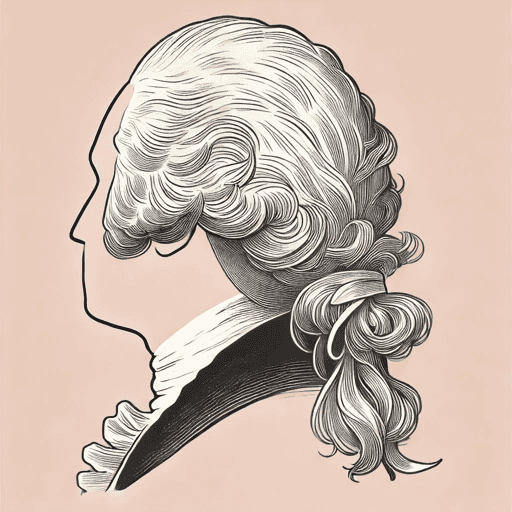
Washington: A Life
59 pages • 1-hour read
Ron ChernowWashington: A Life
A modern alternative to SparkNotes and CliffsNotes, SuperSummary offers high-quality Study Guides with detailed chapter summaries and analysis of major themes, characters, and more.
Part 5, Chapters 46-54Chapter Summaries & Analyses
Part 5: “The President”
Part 5, Chapter 46 Summary: “The Place of Execution”
Congress’s slow certification intensified Washington’s dread as he prepared to leave Mount Vernon. After Charles Thomson delivered official notice on April 14, 1789, Washington departed April 16 and was swept through celebratory stops—Alexandria, Philadelphia, Trenton—before a triumphal waterborne entry into New York. On April 30 at Federal Hall, he took the oath on a borrowed Bible, delivered Madison-drafted remarks stressing humility, unity, and providence, and attended services at St. Paul’s. The chapter also follows Billy Lee’s determined effort to rejoin him and Martha Washington’s reluctant arrival and early duties as first lady, which she found confining.
Part 5, Chapter 47 Summary: “Acting the Presidency”
Washington organized an improvised executive household—Tobias Lear, David Humphreys, and William Jackson—while leaning on James Madison for early constitutional guidance. He confronted symbolic questions shaping the office, rejecting inflated titles, establishing weekly levees, and orchestrating formal dinners as controlled access points. Martha hosted Friday receptions.
Critics, notably Senator William Maclay, decried “courtly” airs; Chernow shows Washington’s stiffness, partial deafness, and cost battles with steward Sam Fraunces. From the cramped Cherry Street mansion, Washington curated republican dignity—walks among citizens, church attendance, theatergoing—while projecting ceremonial authority via dress, equipage, and ritual.
Part 5, Chapter 48 Summary: “The Cares of Office”
Washington’s first year as president was marked by a severe thigh infection that required painful surgery by Dr. Samuel Bard and weeks of convalescence, during which he maintained public decorum and then adopted more exercise. At the same time, his mother, Mary Ball Washington, died; he observed formal mourning amid their complicated history.
Institutionally, Washington navigated unsettled constitutional boundaries—clashes over appointments, a consequential confrontation with the Senate on Creek diplomacy, and the emergence of “senatorial courtesy.” He thereafter corresponded with the Senate in writing, effectively strengthening executive leadership in foreign affairs while John Adams remained sidelined as vice president.
Part 5, Chapter 49 Summary: “Rays of Genius”
Washington confronted a crush of office seekers while defining criteria—merit, constitutional loyalty, experience, geographic balance—for nearly a thousand appointments. He and Congress created State, War, and Treasury, plus the offices of attorney general and postmaster general; Washington then gathered Knox, Hamilton, Jefferson, and Randolph, coordinating them through written opinions rather than a formal cabinet at first. He built the federal judiciary via the Judiciary Act of 1789 and appointed John Jay chief justice. Administratively, he centralized paper flow, encouraged debate, decided slowly but firmly, and—backing Madison—helped advance the Bill of Rights, aiding national consolidation.
Part 5, Chapter 50 Summary: “The Traveling Presidency”
In autumn 1789, Washington undertook a month-long New England tour to gauge public sentiment, dispel monarchical perceptions, and study regional conditions, traveling with a minimal entourage and declining private lodgings. Despite efforts to avoid pomp, he received elaborate civic welcomes, navigated protocol with Governor John Hancock, and briefly fell ill amid a widespread “President’s Cough.” He observed industry, infrastructure, and social equality, then returned to New York rejuvenated. He amplified national unity through portrait sittings (Ramage, Bréhan, Savage, Trumbull) and soon moved the presidential household to a larger Broadway residence, modernized with bright Argand lamps.
Part 5, Chapter 51 Summary: “The State of the President”
In January 1790, Washington established the precedent of delivering an in‑person annual address to Congress, urging public credit, national defense, and encouragement of learning. Hamilton soon unveiled his sweeping Report on Public Credit, igniting controversy over funding, speculation, and federal assumption of state debts, with Madison breaking from the administration. Quaker anti-enslavement petitions stirred sectional anxieties, and Congress tabled them.
That spring, Washington suffered a severe bout of influenza and pneumonia but recovered, prompting renewed attention to his health and schedule while the new government’s institutions continued to take shape.
Part 5, Chapter 52 Summary: “Capital Matters”
In 1790, bitter deadlock over federal assumption of state debts intersected with the fight over the permanent capital. At Jefferson’s Maiden Lane dinner, he, Madison, and Hamilton struck a bargain: Assumption would pass, the seat would move temporarily to Philadelphia, then permanently to a Potomac district Washington would select. Washington soon toured newly admitted Rhode Island and issued his famous letter on religious liberty to Newport’s Jews. Preparing the Philadelphia presidency, he oversaw renovations, backed Hamilton’s excise on whiskey, and—facing Pennsylvania’s gradual abolition law—quietly rotated enslaved household workers to prevent them from claiming freedom.
Part 5, Chapter 53 Summary: “Southern Exposure”
Chapter 53 traces Washington’s dental ordeal and secretive correspondence with dentist John Greenwood, his adaptation to Philadelphia’s lavish social scene, and mounting political clashes over Hamilton’s financial program—culminating in Washington’s deliberate approval of the Bank of the United States after soliciting rival constitutional opinions.
It then follows his arduous 1791 southern tour—meticulous, ceremonial, and physically taxing—used to gauge regional sentiment and foster national unity. The chapter closes with his return to Philadelphia, public acclaim, and yet another health scare—a recurrence of the thigh tumor that had previously sidelined him.
Part 5, Chapter 54 Summary: “Running Into Extremes”
Chapter 54 follows Washington’s effort to steer foreign policy amid cabinet splits over Britain versus France. He tacitly backed Hamilton’s outreach to London while maintaining guarded public support for the French Revolution, even as private letters voiced alarm about mob violence. The chapter also covers L’Enfant’s visionary but contentious plan for the federal city, his dismissal, and the naming of Washington, DC.
On the frontier, US forces suffered disastrous defeats under Generals Harmar and St. Clair, prompting congressional scrutiny, an early assertion of executive privilege, and Washington’s appointment of Anthony Wayne to rebuild the army.
Part 5, Chapters 46-54 Analysis
Chernow uses Part 5 to explore how Washington’s carefully cultivated image begins to clash with growing calls for direct political leadership, invoking The Construction and Control of Public Image. The early chapters find Washington yearning for private retreat, but the pressures of national instability render this impossible. In particular, the unrest surrounding Shays’ Rebellion and the perceived impotence of The Articles of Confederation elevate Washington’s symbolic presence even in absence. Chernow shows how political myth and managerial necessity begin to intertwine, as elite reformers coalesce around the image of Washington as indispensable steward of a fractured republic.
This section also addresses Enslavement and Moral Evolution in the Early Republic in tracing Washington’s discomfort with enslavement, which emerges less as a sudden shift than a gradual, conscience-pricking evolution. Chernow notes that Washington hoped abolition would occur through legislative action, not private initiative, reflecting both moral misgivings and a belief in structural authority. Though he continued to rotate enslaved workers to circumvent local manumission laws, Chernow frames this as a point of mounting inner conflict. The contradiction between Washington’s Enlightenment values and his human property becomes more visible here, marking a subtle but important turning point. Chernow’s approach is layered, allowing readers to see Washington’s discomfort deepen even as his actions lag behind his convictions.
Together, these chapters show Chernow’s approach in positioning Washington as both man and sitting president. The analysis does not idealize Washington, but it does recognize the care with which he negotiated the private self and public expectations, helping to set up the public image of the presidency and the technicalities of government for the new republic.

Unlock all 59 pages of this Study Guide
Get in-depth, chapter-by-chapter summaries and analysis from our literary experts.
- Grasp challenging concepts with clear, comprehensive explanations
- Revisit key plot points and ideas without rereading the book
- Share impressive insights in classes and book clubs