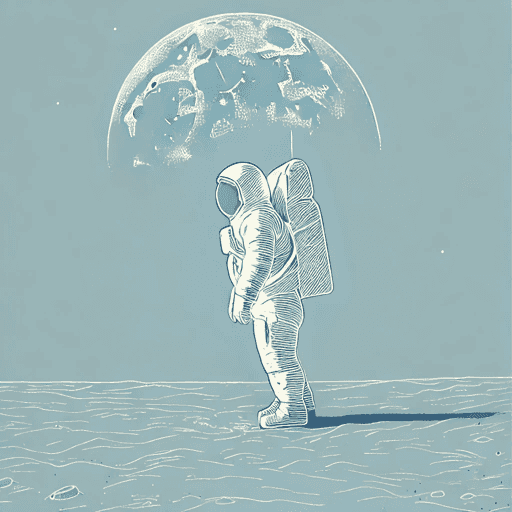
Who Was Neil Armstrong?
40 pages • 1-hour read
Roberta EdwardsWho Was Neil Armstrong?
A modern alternative to SparkNotes and CliffsNotes, SuperSummary offers high-quality Study Guides with detailed chapter summaries and analysis of major themes, characters, and more.
Index of Terms
Aeronautics
Aeronautics is the science of aircraft and flight, which Armstrong studied at Purdue University and in Navy flight school. It became a large part of his job when he worked for the National Advisory Committee for Aeronautics (NACA) and then for NASA. He also dedicated himself to the research and teaching of aeronautics later in life, when he became a professor at the University of Cincinnati in the 1970s.
Apollo 11
Apollo 11 is one of the missions in the Apollo Program—the third NASA program, after Project Mercury and Project Gemini—with the goal of getting human beings onto the surface of the moon. The Apollo 11 mission was headed by Armstrong. His crew consisted of two other astronauts, “Buzz” Aldrin and Michael Collins. These three men piloted a multi-part craft into space and, for the first time in human history, set foot on the lunar surface—an achievement that provides the narrative climax of Edwards’s book and emphasizes its thematic focus on The Importance of Perseverance and Dedication in Achieving One’s Goals. Armstrong was the first to step out of the spacecraft, uttering the famous words “That’s one small step for man, one giant leap for mankind” (87). The Apollo Program ended in 1972, after several more moon landings.
Columbia
Columbia was the command module of the three-part craft used for the Apollo 11 mission. It was carried at the top of the spacecraft, above the Lunar Module and the three-stage engine. Inside Columbia, the three astronauts worked, ate, and slept during their days-long mission. It is also where Collins stayed, continuously orbiting the moon, while Aldrin and Armstrong took the lunar module to the surface of the moon.
Eagle
The lunar module—one of three parts of the craft used for the Apollo 11 mission—was nicknamed the “Eagle.” The Eagle was housed inside a section of the craft called the Lunar Module Adapter, carried near the top, just below the craft’s command module. When Armstrong, Aldrin, and Collins reached the moon’s orbit, Armstrong and Aldrin entered the Eagle and piloted it to the moon’s surface while Collins remained in the command module, orbiting the moon. The lunar module’s nickname cemented its place in history when it first touched down on the surface of the moon and Armstrong transmitted the message to NASA “The Eagle has landed!” (86).
NASA
NASA is the acronym commonly used to refer to the United States government agency called the National Aeronautics and Space Administration. NASA was founded in 1958, taking over the responsibilities of an earlier agency called the National Advisory Committee for Aeronautics (NACA). NASA’s mission is to advance the world’s understanding of space. It conducts research, exploration, and educational programming and develops technology related to this goal. Armstrong became a part of NASA when it was founded, as he was already working for NACA as a pilot and researcher. In 1962, Armstrong became an astronaut as a part of NASA’s mission to reach the moon. Throughout the text, Edwards emphasizes the collective efforts of the researchers, scientists, technicians, astronauts and other contributors from the NASA team to highlight The Significance of Teamwork and Collaboration in Large-Scale Endeavors.

Unlock all 40 pages of this Study Guide
Get in-depth, chapter-by-chapter summaries and analysis from our literary experts.
- Grasp challenging concepts with clear, comprehensive explanations
- Revisit key plot points and ideas without rereading the book
- Share impressive insights in classes and book clubs