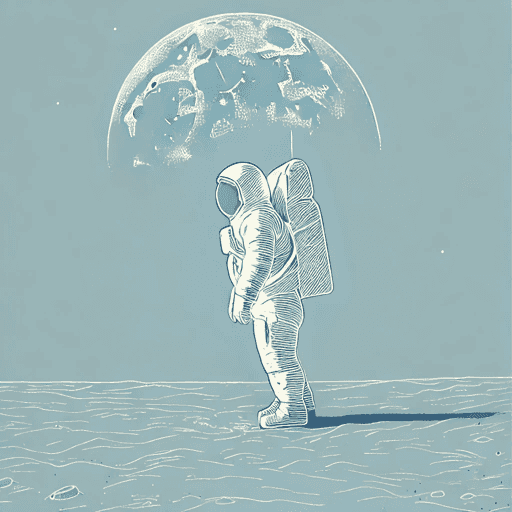
Who Was Neil Armstrong?
Who Was Neil Armstrong?
A modern alternative to SparkNotes and CliffsNotes, SuperSummary offers high-quality Study Guides with detailed chapter summaries and analysis of major themes, characters, and more.
Summaries & Analyses
Quizzes
NEWReading Tools
Themes
The Importance of Perseverance and Dedication in Achieving One’s Goals
Content Warning: This section of the guide includes discussion of illness or death and child death.
One of the main arguments of Who Was Neil Armstrong? is that achieving significant goals requires hard work and determination. Edwards advances the first part of this argument through the details offered in Chapter 2 regarding Armstrong’s part-time work to afford flying lessons. Edwards says that he “was determined to fly” and so “he mowed the lawn at a cemetery. He helped bake doughnuts at a doughnut company—more than 1,300 a night”—details that demonstrate the lengths to which Armstrong was willing to go in order to fly. He didn’t just mow lawns—he mowed the expansive landscape of a cemetery. He didn’t just help make doughnuts—he made “more than 1,300 a night.” Edwards explores Armstrong’s interrupted college career for similar reasons; he could have dropped out after his Korean War service, since by the time he could return to Purdue he was “older than most students,” but instead he was “ready to study harder” (29, 30).
Edwards strategically lays out Armstrong’s series of choices to demonstrate his dedication to his career in aeronautics. He moves the family to California so that he can become a test pilot. After Muffie dies, Armstrong returns to work within a week and then applies to become an astronaut. After he is accepted by NASA, he moves his family again, this time to Texas. He sticks with the “long and thorough training” program, even though it takes him away from his family repeatedly and requires him to do things like survive in the Panamanian jungle, eating “bugs, roots, and worms” (57, 58). In Chapter 6, Edwards provides a rare quote from Jan that emphasizes how dedicated Armstrong was to his training, noting: “the Apollo mission ‘consumed’ [him]” (59). Chapter 7 stresses the dangers Armstrong faced during his NASA career and shows that he was willing to face any risk in order to keep moving toward his goals.
In the final section of the book, Edwards positions the moon landing as the payoff for all Armstrong’s hard work and dedication. These chapters celebrate his accomplishment of being the first human to set foot on the moon to emphasize the ways his perseverance led to a remarkable reward that she frames as well worth all his efforts. Chapter 9 points out that, because the moon has no wind, Armstrong’s footprints are still there today—making the point that Armstrong’s perseverance toward achieving his goal is, in a way, immortalized in human history just as it is on the surface of the moon.
The Role of Curiosity and Passion in Driving Scientific and Personal Advancement
Just as the text argues that dedication leads to achievement, it also argues that curiosity and passion lead to advancement. Early in the narrative, Neil Armstrong is depicted as singularly focused on learning more about planes and flight. Edwards introduces him as “A Boy Who Loved Flying” in the title of Chapter 1. She shows Armstrong constructing model planes and using them for experimental test flights, reading about planes, and drawing them. She makes a point of mentioning that, while his father is terrified by flying in the Tin Goose, then six-year-old Neil is thrilled by the experience. As soon as he is able, Armstrong takes flight lessons. He chooses to pursue aeronautics in college, flies planes and studies aeronautics in the Navy, and then devotes his entire career to the field. Edwards implies that these choices place him in the right place at the right time to participate in developing and flying experimental aircraft for the Air Force and then NASA, eventually leading to his role as the first man to step onto the lunar surface. Through it all, Armstrong’s curiosity and passion never wane. Even after years of being a test pilot, he still refers to the work as “unbelievably exciting.” Even though becoming an astronaut comes with some disadvantages compared to being a test pilot, he willingly switches into the astronaut program because “the dream of reaching the moon [is] a powerful one” (55).
Edwards profiles several other pioneers of flight, highlighting passion and curiosity as the connective link between them and Armstrong. In this way, she emphasizes the idea that passion for flight and curiosity about its mechanics have led to advancements in the field over and over. Her profile of the Wright Brothers depicts them as enthralled with flight from an early age. She points out that Chuck Yeager was so passionate about flight that he disguised broken ribs in order to fly the Bell X-1 and break the sound barrier. During the book’s final chapters, Edwards also frequently mentions the NASA scientists and researchers who worked tirelessly to learn more, create better technology, and ensure a safe mission to the moon when it finally succeeded in 1969. Chapters 7, 8, and 9 are full of illustrations that demonstrate what this kind of curiosity and passion can accomplish. Among the many illustrations of various NASA craft in these chapters, Pages 72 and 73 offer full-page diagrams of the Apollo 11 craft. In addition, page 90 features a large diagram of the parts of a spacesuit. There are two separate two-page spreads diagramming the route the Apollo 11 craft took during its historic mission. Taken together, the details of Armstrong’s life that Edwards chooses to include, the profiles of other pioneers of aviation, and the text’s illustrations all point to the great advancements that can result from passion and curiosity.
The Significance of Teamwork and Collaboration in Large-Scale Endeavors
Edwards undergirds her discussion of Armstrong’s achievements by portraying him as one facet of a much larger team at NASA that came together to send a human being to the surface of the moon. The book offers a clear argument that great achievements are not the result of any one person’s efforts. Neil Armstrong’s achievement of stepping onto the moon is the book’s overall focus, but Edwards takes time to show how others helped make this possible. She lays the groundwork for this theme in the first section of the book, with its interlude profiles of the Wright Brothers, Charles Lindberg, and Chuck Yeager. These profiles convey how many previous pioneers of aviation contributed to advancements in the field before Armstrong ever took command of Apollo 11. The book subsequently offers either interlude or in-chapter profiles or illustrations of many other aviators, as well, focusing attention on the many people who have dedicated themselves to the advancement of flight: Yuri Gagarin, Alan Shepard, Gordon Cooper, Scott Carpenter, Virgil Grissom, John Glenn, Donald Slayton, Walter Schirra, Michael Collins, Buzz Aldrin, Ed White, and Roger Chaffee are all either pictured or profiled.
Each stage of Armstrong’s life depicted in the book points to the idea that he could not have become an astronaut without the help of others. Edwards underscores the fact that Armstrong’s education in aeronautics depended on a whole team of educators. He learned about flying not just at Purdue but also at Navy flight school—and even at the Port Koneta airfield in his hometown, where he took his first flying lessons. Armstrong clearly understood the importance of educators in training new generations of flyers as evidenced by his decision to become a professor after leaving NASA. Edwards suggests that all of this knowledge could only be put to work because of agencies like the Air Force, NACA, and NASA and because of the taxpayer funding that made them possible. Armstrong appreciated the importance of taxpayer support for the research these agencies conducted, as he was willing on many occasions to give speeches to help fundraise for these agencies, despite his discomfort in the public spotlight.
Edwards descriptions of the preparation and attention to detail that went into the Apollo 11 mission indicate that, once he did become an astronaut, Armstrong’s success depended not just on his own knowledge and abilities but on large teams of researchers and technicians all working toward a common goal. For example, Edwards mentions the ground teams helping to direct missions and even controlling much of their flight. She mentions the safety research that took place in the wake of the disaster that killed White, Grisson, and Chaffee. Most significantly, Edwards chooses to close the book with Armstrong’s own feelings about the people who contributed to his immense achievement: “He always said he was part of a great team,” Edwards writes, “He meant all the people at NASA who made the dream of reaching the moon possible” (100).

Unlock every key theme and why it matters
Get in-depth breakdowns of the book’s main ideas and how they connect and evolve.
- Explore how themes develop throughout the text
- Connect themes to characters, events, and symbols
- Support essays and discussions with thematic evidence