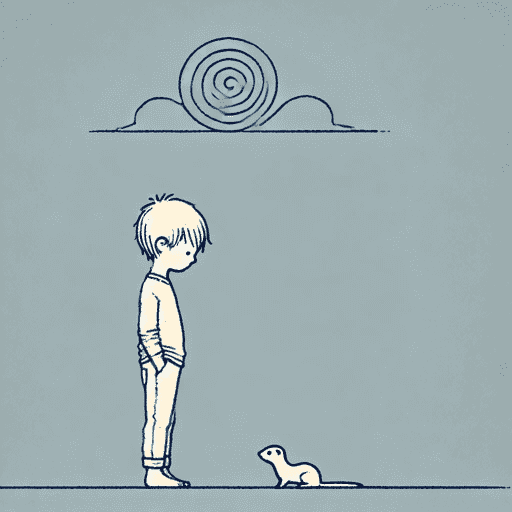
Always Remember: The Boy, the Mole, the Fox, the Horse and the Storm
29 pages • 58-minute read
Charlie MackesyAlways Remember: The Boy, the Mole, the Fox, the Horse and the Storm
A modern alternative to SparkNotes and CliffsNotes, SuperSummary offers high-quality Study Guides with detailed chapter summaries and analysis of major themes, characters, and more.
Introduction-Page 42Chapter Summaries & Analyses
Content Warning: This section of the guide includes discussion of mental illness.
Introduction Summary
Charles Mackesy includes a brief introduction to his book, which he never thought he would write. He celebrates the messy chaos that led to its creation and hopes that it will make those who read it feel just a little “lighter.” Mackesy also introduces the four characters: the reliable horse, the anxious boy, the contemplative fox, and the wise mole. Together, they stand looking out over a vast wilderness, ready for anything as long as they have each other.
Pages 8-16 Summary
The four friends stand overlooking a mighty storm, unsure of where they are headed but still together. They cross a stony river that will one day reach the sea, and the mole reminds the boy that his greatest skill is his kindness. They look at a flower and remember that patience is what helps things bloom.
Pages 17-27 Summary
Pages 28-35 Summary
Pages 36-42 Summary
Introduction-Page 42 Analysis
In the opening section of the book, Mackesy uses loose, flowing lines that give the illustrations a sense of movement and emotional softness. The boy’s face notably has no facial features, framing him as an everyman figure and a reader stand-in. The colors throughout are soft and often muted, which adds to the gentle tone of the narrative. The scrawled, handwritten text adds to the sense of intimacy and authenticity. For instance, when the horse speaks about the boy’s “soft wild heart” (22), chaotic lines and scribbles cross over the characters to visually reinforce the emotional intensity of the moment. Mackesy also incorporates smudgework with charcoal. While the effect of this blurring is often to soften, other images feature loose edges where objects seem to flow together in a way that reflects emotional fluidity and uncertainty. Likewise, Mackesy uses aerial perspective to create a sense of a vast, expansive world, thus emphasizing how small the characters appear within it. Similarly, Page 8 features a black-and-white drawing of huge trees contrasted with the small characters, establishing the magnitude of the journey. The book’s artwork therefore reflects the spectrum of emotions it considers, from contentment to turmoil.
The composition throughout these pages is likewise significant. Mackesy blends drawings directly into the text, such as the boy sitting among flowers while reading a book, underscoring that the book is meant to be viewed as much as read. The text, too, crosses borders: Mackesy often places sentences half on one page and half on another to emphasize how the second part of the thought extends its meaning. There is a large amount of negative space on most pages, which allows for moments of reflection and emphasizes isolation or calm, particularly when juxtaposed with more complex compositions; for instance, a black-and-white page with no frame is paired with a square, framed painting filled with vibrant colors like sunlight touching the snow, trees, boy, and mole, creating contrast between the former’s simplicity and the latter’s emotional warmth. More broadly, the stripped-down nature of most of the artwork lends extra weight to the more colorful and ornate images. Thus, a double splash of the vast world, infused with color and dark skies ahead, hints at possible challenges in the journey, but the friends stand together against it, symbolizing the theme of Optimism amid the Storm. Similarly, a two-page painting blurs characters and scenery into one colorful mixture of form, symbolizing unity between the friends and their environment.
The overall mood of the book is hopeful and optimistic, encouraging readers to hang on through hard times. The occasional use of humor lightens the tone, such as when the mole jokes that the cake ambushed him. Mackesy’s heavy reliance on aphorisms is also meant to render the book accessible and impactful via simplicity of language and a reflective tone. The personal, even confessional, tone of the Introduction similarly works to engage readers’ emotions: Mackesy introduces the book with humility, admitting that he never thought he would finish one book, let alone two. He thus frames himself as someone very much in the process of absorbing the book’s lessons.
In particular, Mackesy reflects on how mess and chaos in life can lead to beautiful outcomes, like this book itself. This idea of celebrating mess and mistakes relates to the theme of Self-Acceptance and Celebrating the Self. Lines such as, “Just to be here and to sing your song is a victory” (4), and, “You have a song in you no one else can sing” (2), introduce this theme while also illustrating the text’s reliance on figurative language and symbolism. Visual metaphors underscore the point: On page 15, a fence is drawn with music notes woven into it, symbolizing hope and the importance of loving one’s own song.
Another key symbol is the river the friends reach, which symbolizes journeys and destinations, particularly when it is noted that the river does not know “where it’s going until it reaches the sea” (11-12). Similarly, the four best friends do not know where they are headed or why, but they are certain of their love for each other, establishing the theme of Healing Through Unconditional Friendship. The characterization of the central figures supports this idea, as each plays a distinct role. The mole consistently encourages the boy, helping to quell his anxiety and bring perspective; he reminds the boy that he is good at being kind and encourages patience with himself. The fox tells him to love himself and appears worried for him, while the horse physically nuzzles him and reminds him to be gentle and less critical of himself. Thus, the horse serves as the grounding force, the fox as the quiet observer, the mole as the adviser, and the boy as the emotional glue that binds them together.

Unlock all 29 pages of this Study Guide
Get in-depth, chapter-by-chapter summaries and analysis from our literary experts.
- Grasp challenging concepts with clear, comprehensive explanations
- Revisit key plot points and ideas without rereading the book
- Share impressive insights in classes and book clubs