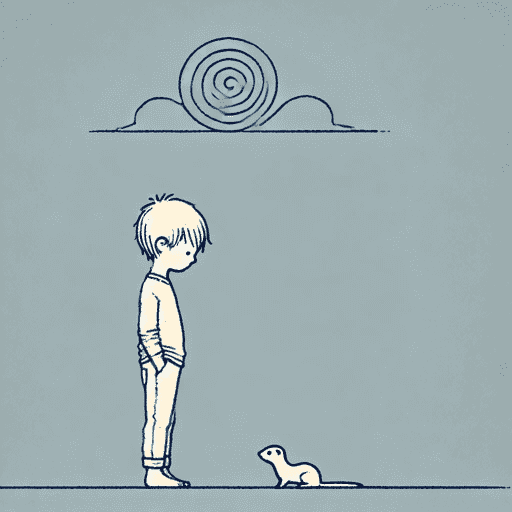
Always Remember: The Boy, the Mole, the Fox, the Horse and the Storm
29 pages • 58-minute read
Charlie MackesyAlways Remember: The Boy, the Mole, the Fox, the Horse and the Storm
A modern alternative to SparkNotes and CliffsNotes, SuperSummary offers high-quality Study Guides with detailed chapter summaries and analysis of major themes, characters, and more.
Themes
Content Warning: This section of the guide includes discussion of mental illness.
Healing Through Unconditional Friendship
One of the key themes in the book is healing through unconditional friendship. The four characters journey through an uncertain wilderness without a clear destination, yet, as the fox says, they are never truly “lost” because they have one another. Their companionship becomes a shelter against both external storms and internal ones. The landscape often reflects emotional turbulence and unease, including imagery of dark skies, pressing winds, massive forests, and vast panoramas in which the characters seem small and powerless. However, the presence of loyal friends transforms these spaces from threatening to survivable. The book suggests that while pain and anxiety are inevitable, facing them alone is not.
This theme is most evident during the sequence when the boy feels overwhelmed and considers giving up. When the fox finds him, the message is that support is always available, even when doubt interferes with perception. The symbolism of the boy’s subsequent ride upon the winged horse goes further still; the horse, a steady companion, lifts the boy above the chaos of the storm to blue skies. Here, friendship carries the protagonist through his turmoil, offering him comfort (the pillowy cloud the horse and boy rest upon) and a new perspective. The line, “It was love that brought me home” (90), encapsulates the emotional resolution of this journey. “Home” is a metaphorical state of belonging created through love and acceptance. The boy’s return to his friends symbolizes the restorative power of connection.
The story therefore presents leaning on others and asking for help as an act of courage. The horse, for instance, explains that asking for help is brave and challenges the misconception that independence is the highest strength. When the boy feels a storm inside, his friends become his shelter, reinforcing that vulnerability shared within trusted relationships leads to healing. The horse also admits his own insecurities, and the mole confesses that being the boy’s friend renewed his sense of wonder, underscoring that such vulnerability, like friendship itself, is reciprocal; the boy may be the stand-in for the reader, but all four friends grow through their relationships with others. Mackesy’s loose lines visually reinforce this point, flowing across characters in ways that evoke their interconnectedness.
If the wilderness journey serves as an allegory for life’s unpredictability, the book thus argues that unconditional friendship makes resilience amid the chaos and challenges possible. Though the friends do not control the storms, they endure them together: Healing occurs through love.
Self-Acceptance and Celebrating the Self
The book stresses self-acceptance and the importance of celebrating one’s inherent worth. The boy frequently struggles with self-doubt and questions whether he is worthy. His posture is hunched over, and he often appears small against vast landscapes, which visually reinforces his insecurity. His arc sees him developing greater confidence and recognizing that he does not need to be strong or brave to deserve compassion—from others or from himself.
The animals consistently counter the boy’s negative self-perception with affirmations that redirect his attention to his strengths. Early in the journey, for example, the mole tells the boy that his greatest skill is kindness. This observation reframes the boy’s identity. Instead of defining himself by fear or uncertainty, which he perceives as weaknesses, he is encouraged to see kindness as a powerful and valuable trait. Self-knowledge and emotional openness emerge as other valuable attributes; when the boy says that he does not feel brave, the horse reframes his honesty as bravery itself. More broadly, the book encourages the celebration of whatever unique qualities one possesses, likening these to a “song” that no one else can replicate.
Just as importantly, the boys’ friends suggest that he does not have to “earn” self-worth through strengths of any kind; simply existing is enough. This dovetails with the book’s emphasis on self-care. The horse, in particular, tells the boy to be gentle with himself. In moments of anxiety, the horse does not demand toughness or emotional suppression. Instead, he encourages patience and self-compassion. This guidance challenges narratives that equate self-criticism with motivation. The book suggests that harsh self-judgment deepens fear, whereas gentleness fosters growth—an idea metaphorically captured in the remark, “Shouting at a flower won’t make it bloom” (16). This advice applies as much to self-acceptance as to anything else; the book frames embracing oneself as an ongoing process that one shouldn’t try to rush.
The boy’s moment alone brings this exploration of self-acceptance to a crisis point. The weasel voices his fears that he is unloved; the choice of animal implies that such fears are often subtle, “weaseling” their way into one’s self-conception. Nevertheless, the boy gradually learns to question these doubts. He decides to be a “friend” to himself, indicating a turning point in his development. By the end of the book, when he confesses that he feels “messy” inside, the mole reassures him that everyone does, a remark that emphasizes that self-worth does not require perfection.
Optimism amid the Storm
Optimism amid the storm shapes both the book’s narrative arc and its visual symbolism. The characters’ journey unfolds against the looming threat of a storm, which represents anxiety, emotional turmoil, and hardship broadly, its swirling lines and dark brushstrokes visually communicating chaos. However, as the horse reminds the boy, these storms are never permanent, and the blue sky is always behind them. This metaphor encapsulates the book’s philosophy regarding hope and how it persists even when it is temporarily difficult to see.
In keeping with this idea, the book distinguishes between optimism as a feeling and optimism as an act. The subjective experience of hope fluctuates, but one can choose to act hopefully regardless, which the book portrays as a series of small, steady steps. The boy is often told “well done” for simply taking another step forward. This emphasis on apparently minor progress reinforces the idea that resilience is built gradually and that life is not a race. Illustrations of footsteps underscore that merely choosing to continue is an act of faith that implies hope of finding something better.
The idea of living for today reinforces the book’s message about optimism. The mole’s repeated references to cake symbolize seizing the present moment rather than postponing happiness. Similarly, the book frequently depicts its characters pausing on the journey to take in the beauty of their surroundings. This philosophy counters anxiety, which often fixates on future uncertainties that are out of one’s control. By focusing on small pleasures and immediate gratitude, the characters cultivate hope even during bleak circumstances.
The culmination of this theme occurs when the boy rides the winged horse through the storm into a vast blue sky. The imagery of emerging from darkness into light visually affirms that struggle can give way to clarity. A rainbow appearing after the storm further symbolizes renewal and promise. The optimism in the book acknowledges hardship while insisting that it is survivable. The message is that storms are part of the journey, but they do not define it.

Unlock every key theme and why it matters
Get in-depth breakdowns of the book’s main ideas and how they connect and evolve.
- Explore how themes develop throughout the text
- Connect themes to characters, events, and symbols
- Support essays and discussions with thematic evidence