Cursed Daughters
Cursed Daughters
A modern alternative to SparkNotes and CliffsNotes, SuperSummary offers high-quality Study Guides with detailed chapter summaries and analysis of major themes, characters, and more.
Summaries & Analyses
Quizzes
NEWReading Tools
Games
Important Quotes
Content Warning: This section of the guide contains depictions of death by suicide, pregnancy loss or termination, illness or death, and cursing.
“Mo lifted her head slowly, and a single drop of water rolled from her hairline and fell, catching the dim light, landing with a small splash on the baby’s forehead […] It was only as she turned away from the cot that Ebun realised her foot was wet; she was standing in a small pool of water.”
(Part 1, Chapter 4, Page 16)
This scene blurs the boundary between the spiritual and physical worlds. The drop of water is a symbolic anointing, connecting the newborn to the spirit of the deceased Monife and introducing the recurring motif of water. The physical evidence of a puddle on the floor validates the dream as a real visitation, suggesting that Eniiyi’s identity will be shaped by her late cousin from the moment of her birth.
“Twelve-year-old Ebun told sixteen-year-old Monife that she didn’t believe in curses. ‘That’s fine,’ said Monife, between the slow chewing of gum, ‘but what if the curse believes in you?’”
(Part 1, Interlude, Page 23)
Monife’s response encapsulates The Self-Fulfilling Nature of Negative Beliefs. Her personification of the curse suggests that its power is inescapable, and this scene suggests that this fatalistic mindset will influence future actions as well. The contrast between Ebun’s youthful skepticism and Monife’s casual acceptance highlights the psychological weight of inherited trauma.
“Her mother turned and eyed her sister. ‘I am not you,’ she said. ‘I know the vows I made. And I hardly think chasing men up and down the place is the way forward.’ ‘I have fun. They have fun. Is it not better than pining for a man?’ Bunmi sucked in her breath before saying, ‘You are practically a prostitute.’”
(Part 2, Chapter 4, Page 47)
This exchange presents two conflicting strategies for survival within a patriarchal society. Bunmi represents adherence to tradition and marital vows, a path that has led her to spiritual desperation, while her sister, Kemi, approaches relationships as a means to achieve financial security and personal pleasure. Bunmi’s condemnation of Kemi as a “prostitute” reveals the limited and harshly judged options available to women in this culture, for society’s expectations compel them to compete against one another in their attempts to reclaim their agency.
“‘We are not going to turn into them, are we?’ She raised her head. Her cousin was holding a photograph of their mothers. […] ‘No. Of course not. We will meet the loves of our life and live happily ever after.’ […] ‘Doesn’t the curse mean that that’s virtually impossible?’ ‘Fuck the curse.’”
(Part 2, Chapter 6, Page 56)
This moment marks a pivotal declaration of intent in Monife’s character arc. The photograph of their mothers functions as a symbol of the fate that both she and Ebun fear. Monife’s profane, defiant response is an act of sheer will that establishes her proactive (but ultimately tragic) quest to break the cycle. This conflict highlights the self-fulfilling nature of negative beliefs and Redefining Female Agency in a Patriarchal Society.
“Grandma West was looking right at her, but she was seeing a woman who had died over two decades ago. Eniiyi felt as though she were the ghost in the room and Monife the one who was flesh and blood.”
(Part 3, Chapter 3, Page 89)
When her grand aunt misidentifies her, Eniiyi feels her sense of self become inverted. The text employs a simile comparing her to a “ghost,” while the deceased Monife becomes “flesh and blood,” and this pointed imagery illustrates the psychological toll of the family’s belief in reincarnation. This scene establishes The Struggle for Independent Selfhood Within Families, for Eniiyi’s existence is clearly secondary to the memory of the dead.
“The sea did not give up her prey so easily.”
(Part 3, Chapter 8, Page 103)
This sentence, which occurs as Eniiyi rescues a drowning man, uses personification to characterize the ocean as sentient. The passage also aligns with the motif of water as a fatalistic force: the same element that claimed Monife’s life. By engaging in a battle with the sea, Eniiyi takes on an active role against this symbolic representation of the curse, reclaiming a life from the water even though Monife willingly surrendered herself to its grasp.
“And then the woman spoke with Eniiyi’s voice: ‘Not again.’”
(Part 3, Chapter 10, Page 107)
This line from a recurring dream marks a critical shift as the silent ghost of Monife speaks for the first time. When Monife uses Eniiyi’s own voice to speak, the two women’s identities merge, suggesting that Monife’s trauma is now Eniiyi’s own. The phrase “Not again” explicitly links past tragedy to the present, foreshadowing a cyclical pattern of suffering and invoking the self-fulfilling nature of negative beliefs.
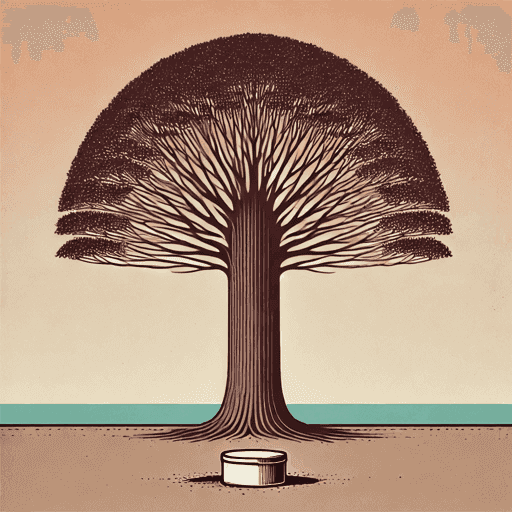
“She watched as Eniiyi walked over to the tree, sat down on one of its large exposed roots and stared into the void. Ebun felt her heart plummet.”
(Part 4, Chapter 4, Page 126)
This passage describes four-year-old Eniiyi’s sleepwalking, which leads her to the family’s iroko tree. The tree represents ancestral roots and acts as the curse’s spiritual foundation; in this light, Eniiyi’s unconscious pilgrimage is a physical manifestation of her inescapable connection to this history. As she sits on the “exposed roots,” this visual suggests that she is bound to the family’s deep-seated trauma, even though she cannot yet understand it.
“‘This isn’t juju.’
‘Then what is it?’
Monife didn’t have an answer for her cousin, and failing to get a response, Ebun left her side. How could she explain the compulsion to hold something that belonged to Golden Boy, and then the subsequent need to bury the item, to keep it safe? To her, it was simply a manifestation of her love.”
(Part 5, Chapter 1, Pages 133-134)
After her boyfriend leaves, Monife buries his handkerchief under the family’s iroko tree. Her inability to articulate her reasoning highlights the blurring line between romantic ritual and the juju she claims to reject, revealing her deep-seated fear of the family curse. When she buries the token under the iroko tree, this choice foreshadows the fact that her relationship is already intertwined with the quasi-magical thinking that defines her family’s approach to fate.
“‘Still,’ began Aunty Kemi, ‘A ò mǫ ñkan tí obinrin ma dì kó tó gbelé ǫkǫ.’ Monife translated it to herself and then repeated it in English for Golden Boy’s benefit—’We do not know what a woman will become until she marries.’”
(Part 5, Chapter 8, Pages 154-155)
At Ebun’s graduation, Aunty Kemi responds to her niece’s academic achievements with a Yoruba proverb that diminishes them. The proverb encapsulates a patriarchal worldview in which a woman’s identity and value are contingent upon marriage, not her individual accomplishments. By immediately translating the saying, the narrative underscores the cultural weight of this belief and presents it as a core tenet of the family curse, illustrating how such ideas are passed down through generations.
“I know you don’t want to hear this, Monife. But this one is a matter for Mama G.”
(Part 5, Chapter 13, Page 174)
After Monife recounts her disastrous meeting with Amara, her mother offers this definitive advice, which positions the spiritualist Mama G as the only logical solution to a problem that is perceived as supernatural. This moment marks the older generation’s explicit endorsement of juju, and their fatalism actively perpetuates a cycle of desperate behavior, making the self-fulfilling nature of negative beliefs a tangible reality.
“Never had she felt more intently the gathered presence of all the women who had resided in the Falodun home, and those who had come before them. […] They were in the hallways, looking out from photographs, whispering to her and appearing before her in dreams.”
(Part 5, Chapter 16, Page 182)
As Monife prepares a love charm, her internal monologue reveals the psychological weight of her ancestry. By invoking the imagery of a “gathered presence,” the author suggests that the family history is an active force in Monife’s life. This passage explicitly connects Monife’s actions to the struggle for independent selfhood within families.
“Perhaps it would have been easier to have a real diagnosis, to be told point-blank: yes, you are a reincarnation, and this is how you deal with it. Instead, she was left to fret, to wonder and to dream.”
(Part 6, Chapter 3, Page 195)
Eniiyi’s internal monologue reveals the psychological weight of her ambiguous identity, implying that her spiritual inheritance is a condition without a cure. Her desire for a “real diagnosis” illustrates her yearning for certainty in a life defined by supernatural belief. This passage highlights the struggle for independent selfhood within families, for the lack of clarity leaves her suspended between her own identity and Monife’s.
“She stared at the picture till it began to blur, but could not find a single physical difference between the self she knew and the woman in the photograph. […] Here was irrefutable proof. She could be a clone. A doppelgänger. What exactly was she? Who was she?”
(Part 6, Chapter 5, Page 204)
Upon finding a photograph of Monife, Eniiyi is confronted with visual evidence that shatters her sense of a unique identity. The listing of synonyms like “clone” and “doppelgänger” are followed by a cascade of rhetorical questions—“What exactly was she? Who was she?”—in order to dramatize the intensity of her identity crisis.
“Was that what it meant to be a reincarnation? Was her child doomed to walk the same path that Mo did? She held her baby to her chest and hushed both their thumping hearts.”
(Part 7, Chapter 2, Page 226)
After Eniiyi nearly drowns as a child, Ebun’s internal questioning reveals that her fear is dictated by the family curse. The questions demonstrate her belief that Eniiyi’s fate is predetermined, linking the child’s near-death directly to Monife’s. The final image of hushing “both their thumping hearts” illustrates their shared trauma and Ebun’s desperate attempts to protect her daughter from a destiny she believes is inescapable.
“Eniiyi seemed to be shedding the burden of living with her grandmothers and mother, the burden of living the life of another, and the burden of carrying all their hopes and fears. As her daughter’s tightly coiled locks fell to the ground, so did Ebun’s tears.”
(Part 7, Chapter 9, Page 245)
The act of cutting Eniiyi’s hair becomes a symbol of liberation and separation from the expectations of the Falodun house. The parallel structure of the final sentence—“As her daughter’s tightly coiled locks fell to the ground, so did Ebun’s tears”—contrasts Eniiyi’s release from her “burden” with Ebun’s sorrow. For Eniiyi, the haircut is an assertion of selfhood; for Ebun, it is the painful acceptance of her daughter’s necessary departure.
“And as she carried her baggage out of her marital home, she thought she saw the curse, watching her through the window and waving.”
(Part 8, Interlude, Page 253)
This quote concludes a brief history of a Falodun ancestor. The use of personification transforms the abstract curse into a tangible, sentient entity that mockingly observes the family’s suffering. By depicting the curse as “watching” and “waving,” the narrative grants it the status of a sentient, malicious antagonist.
“What if the trauma of losing the love, stability and social standing that came with marriage had left epigenetic markers on generation after generation of the Falodun women? […] that was the ‘curse’?”
(Part 9, Chapter 1, Page 262)
As Eniiyi researches her connection to Monife, her internal monologue offers a scientific rationalization for the family’s misfortune. This passage serves as a modern counterpoint to the traditional belief in a supernatural curse, framing the generational suffering through the lens of epigenetics and inherited trauma. This intellectual attempt to redefine the curse demonstrates Eniiyi’s desire to find a logical explanation for her fate.
“Exactly. So if you get one, it’ll be another thing to set you apart from her. Right?”
(Part 9, Chapter 2, Page 264)
Zubby suggests Eniiyi get a tattoo to create a physical distinction between herself and Monife. By doing so, Eniiyi rebels against the identity being forced upon her and attempts to reclaim ownership of her body. The tattoo becomes a permanent, self-inflicted mark of individuality, contrasting with the birthmark her family interprets as a sign of reincarnation.
“‘I want something of yours, to hold on to.’ […] He removed his leather bracelet and handed it over.”
(Part 9, Chapter 6, Page 276)
Eniiyi’s request for a personal item from her boyfriend unconsciously mirrors Monife’s earlier ritual of burying her lover’s handkerchief. While Eniiyi is unaware of the parallel, her action suggests that she is repeating a behavioral pattern tied to the curse, despite her conscious efforts to define herself separately from Monife. The gesture implies the subconscious influence of generational trauma.
“And your daughter? It was Mo’s turn to look stunned. He had a child?! […] Still, she felt an intense wave of loathing towards her cousin in this moment. Ebun was both judging her and crushing her in one fell swoop.”
(Part 10, Chapter 3, Page 292)
This revelation shatters Monife’s romantic fantasy by confirming Kalu has built a life without her. The focus on Monife’s internal shock and “loathing” redirects the emotional consequence from Kalu’s betrayal to Ebun’s delivery of the news. This dynamic foreshadows the more serious betrayal to come and demonstrates that the women can become agents of each other’s suffering, thereby reinforcing the cycle of the curse.
“‘Maybe you should come.’
‘No.’
‘No?’
‘This is mine and Kalu’s…’
Ebun sighed. ‘Whoever you thought Kalu was, he is not that person. You do not want to be tied to that drama for the rest of your life.’”
(Part 10, Chapter 11, Page 310)
This exchange highlights the contrast between the cousins’ perspectives, as they have widely differing relationships to the family curse. Monife’s response frames her pregnancy as part of a tragic love story, demonstrating her fatalistic attachment to Kalu. With Ebun’s dismissive reply, she pragmatically sees the situation as “drama” to escape from, and her detached viewpoint conceals the fact that she has no intention of going through with her own pregnancy termination.
“‘Monife?’
Laughter bubbled up inside her. Perhaps she was still dreaming.
Even here, she was tethered to her aunt. She felt a headache coming on. She sighed, gathered herself. ‘No. I’m the long shadow she left.’”
(Part 11, Chapter 1, Pages 325-326)
Kalu mistaking Eniiyi for Monife vocalizes the central conflict of her identity, illustrating the theme of the struggle for independent selfhood within families. Eniiyi’s weary, metaphorical response, “I’m the long shadow she left,” defines her existence not as her own but as an inescapable consequence of her aunt’s tragic life. The language of being ‘tethered’ emphasizes her feeling of being controlled by a past that is not hers.
“‘I slept with Funsho,’ she blurted. ‘I’m sorry.’
He dropped her hands, and it felt as though she had been pushed into the void.
‘Wha—? Why?’ […]
‘I needed to know. I need to know that I can forge my own path, that I am not being manipulated by a dead—’”
(Part 11, Chapter 11, Page 352)
Eniiyi’s confession is a deliberate but destructive act of reclaiming her autonomy from Monife’s spiritual influence. When she sleeps with Funsho, she is trying to seize her own agency and “‘forge [her] own path,” proving that her feelings are not simply an echo of Monife’s obsession. The description of being “pushed into the void” symbolizes the loss and isolation that accompanies this violent severing of her connection to both Zubby and the ghost of her aunt.
“‘The day before she…you left her a message on the answering machine.’
‘I remember. I told her I wanted the child. That I was sorry.’
‘She had already…The baby was gone by then. I thought the message would only cause her more pain. I deleted it.’”
(Part 11, Chapter 12, Page 356)
Tolu’s confession reveals the final piece of the family’s tragedy, and it is clear that his misguided attempt to protect Monife sealed her fate. The deleted message therefore represents lost hope and the catastrophic consequences of secrets. This dialogue underscores the self-fulfilling nature of negative beliefs, where actions intended to mitigate suffering ironically conspire to ensure the most tragic outcome.

Unlock every key quote and its meaning
Get 25 quotes with page numbers and clear analysis to help you reference, write, and discuss with confidence.
- Cite quotes accurately with exact page numbers
- Understand what each quote really means
- Strengthen your analysis in essays or discussions