I Like to See It Lap the Miles
A modern alternative to SparkNotes and CliffsNotes, SuperSummary offers high-quality Study Guides with detailed chapter summaries and analysis of major themes, characters, and more.
Literary Devices
Form and Meter
Similar to the train’s subversion of categories and transgression of spaces, the form and meter of the poem deviates from expected norms. Instead of writing four quatrains (stanzas with four lines), Dickinson disrupts the uniformity by turning Stanza 3 into a quintet (a stanza with five lives).
The train receives “a Quarry pare // To fit its sides” (Lines 8-9), but Dickinson doesn’t “fit” the action into one line. By breaking it up and using enjambment—a line that continued without grammatical pause onto the next—she highlights the fragmented quality of technology. As with the form, the train is resourcefully adaptable and moves in unforeseen ways. Eight lines qualify as enjambments, which advances this sense of unpredictable and onrushing movement. The enjambments sweep up the reader and mimic the momentum of the train. More so, the enjambments reflect the fast pace of technology.
The meter alternates between iambic tetrameter (four iambs, or pairs of syllables, one stressed and one unstressed) and trimeter (three iambs). For instance, Line 1 scans, “I like to see it lap the Miles.” The meter matches the form when Dickinson reduces it to four iambs in Lines 9-10. To match the excised quarry, Dickinson cuts away iambs from the lines. As with the train and the form, the meter is malleable and in motion.
Metaphor
A metaphor is a comparison that doesn’t include “like” or “as.” The comparison is implicit instead of explicit. A symbol is a thing, person, place, or idea that represents something else. The literary devices go together in Dickinson’s poem. In an extended metaphor, Dickinson compares trains and horses throughout the poem; she also uses the train as a symbol for technology in general.
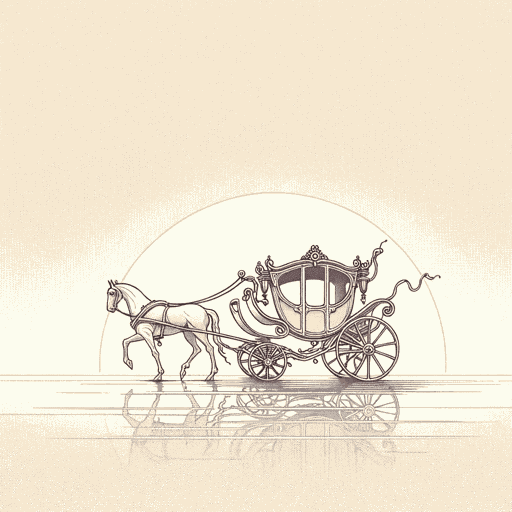
The metaphor illustrates technology’s reliance on precedence. The train hasn’t sprung from a vacuum, but was invented by humans drawing on things already in existence: The train is a new, arguably better kind of horse that can travel greater distances without tiring. In fact, one admiring term for steam trains in the early 1800s was “iron horses.”
However, the comparison can only go so far, as the train also represents something new, with positives and negatives that differ from those of domesticated animals. The train is more reliable “than a Star” (Line 15), but it generates “horrid” sounds (Line 12) and sidelines humanity. Dickinson thus suggests the complex dynamic between people and technology.
Personification
Personification is a literary device where the poet attaches human traits to animals or objects. Not only does Dickinson compare the train to a horse, but she also gives it human features. Personification makes it easier for the speaker to form a connection with the train and to praise it. Its flaws—such as unpleasant noise—become relatable complaints. Its potentially dangerous level of power is that of a docile servant. Personification turns the train into the poem’s main character—an admirable protagonist.
Dickinson’s nonstandard capitalization also personifies other nonhuman nouns: The train interacts with “Miles” (Lines 1), “Valleys (Line 2), “Tanks” (Line 3), “Mountains” (Line 5), and “Quarry” (Line 8). At the same time, the poem ignores the real human lives consumed by the construction of the railroad, which killed countless workers. This purposeful omission highlights the train’s harmful, greedy approach to the environment.
Still, the speaker sees themself in the train. Its “horrid—hooting stanza—” (Line 12) makes it a poet producing verses. The speaker identifies with the train, linking its material power to the poet’s vigorous imagination and intellect.

Get in-depth, chapter-by-chapter summaries and analysis from our literary experts.
- Grasp challenging concepts with clear, comprehensive explanations
- Revisit key plot points and ideas without rereading the book
- Share impressive insights in classes and book clubs
Related Titles
By Emily Dickinson