Kingdom of the Feared
A modern alternative to SparkNotes and CliffsNotes, SuperSummary offers high-quality Study Guides with detailed chapter summaries and analysis of major themes, characters, and more.
Summaries & Analyses
Quizzes
NEWReading Tools
Symbols & Motifs
Content Warning: This section of the guide includes discussion of graphic violence.
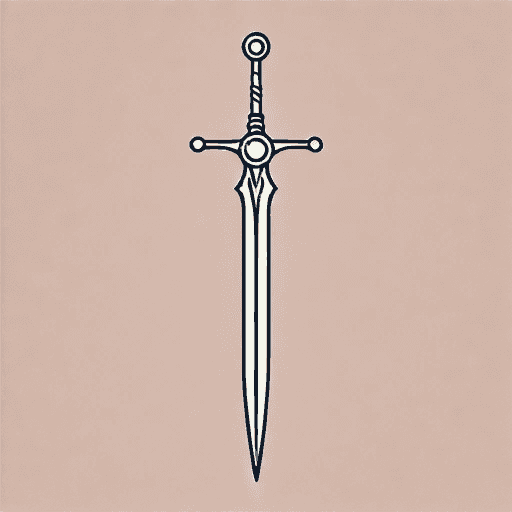
The Blade of Ruination
The Blade of Ruination functions as a symbol representing the paradox that true liberation demands willing sacrifice. Created by the First Witch as a hexed object capable of killing even a prince of Hell, the blade carries a reputation built on destruction. When Emilia discovers its deeper purpose through the Well of Memory, its symbolic meaning shifts from a weapon of annihilation to an instrument of redemption—one that can sever curses only if both the person who sacrifices and the person who strikes act from genuine consent.
This conditional magic gives the blade its symbolic weight. Unlike ordinary weapons that reward brute strength, the Blade of Ruination operates on a logic of voluntary surrender. Claudia explains that “the cursed one needs to feed the blade [another’s] magic until it collects each drop” and that any attempt at force or deception will destroy the weapon permanently (328). The blade therefore embodies a vision of power that is inseparable from choice, rejecting the coercion that characters like Greed and Sursea rely on throughout the novel. Emilia’s willingness to relinquish her restored goddess magic connects the symbol to the theme of destiny and self-determination. She does not passively accept what fate demands but actively decides that freedom from the curse matters more than the power she only recently reclaimed. When Wrath plunges it into Emilia’s chest during their kiss, destruction and devotion become indistinguishable. The curse shatters not because the blade overpowers it through force but because two people chose love over self-preservation. In this way, the Blade of Ruination symbolizes the novel’s central conviction that the most transformative power is not seized or inherited but willingly released.
Hearts
Hearts symbolize vulnerability, the core of one’s identity, and the painful sacrifices required for transformation. Most significantly, Emilia’s spell-locked mortal heart is the physical manifestation of her suppressed divinity and her tether to a life that was itself an illusion. This symbol is central to the theme of destiny versus self-determination, as Emilia’s journey is defined by the struggle to reclaim her true self by literally removing the heart that cages it. The heart represents a forced, manufactured humanity that prevents her from accessing the full scope of her power as the goddess Fury. This connection is made explicit when Vittoria urges her to complete her transformation, stating, “All you have to do is let me remove that mortal heart they gave you” (128). The line frames the heart as a foreign object that must be excised for Emilia to be whole.
The removal of Emilia’s heart is the climactic moment of her personal arc, symbolizing her ultimate choice to embrace her divine nature. The act itself is a profound demonstration of the theme of sisterhood, as it requires Emilia to place her life and soul entirely in the hands of Vittoria, the very person whose betrayal initiated her painful journey. By trusting Vittoria with this act, Emilia proves that their bond transcends deception and divine politics. Shedding her mortal heart is not just an exchange of one identity for another; it is a conscious, painful choice to integrate the love and compassion she learned as a mortal with the immense power of a goddess, thereby forging a new identity on her own terms.
Skulls
Skulls operate as a motif in Kingdom of the Feared, recurring across rituals, threats, and revelations to examine how knowledge is controlled, weaponized, and withheld by those who seek power over others. Whether resting on an altar as offerings, enchanted to deliver menacing rhymes, or shattered to fuel forbidden visions, skulls appear at moments when characters attempt to manipulate the flow of information, binding the motif closely to the theme of Gaining Power through Cunning Rather than Force.
The motif is established in the novel’s Prologue when Sofia places two stolen human skulls beside a black mirror and shatters them to fuel her scrying spell. When the first skull’s power runs out, she selects one with “rubies in its eyes, an added gift for the goddess who ruled over the dead” (6). The rubies mark the skull as currency in an exchange with divine authority, and the knowledge that Sofia purchases with it proves so dangerous that another witch destroys her mind to keep it contained. From this opening scene, skulls become associated with the volatile link between knowledge and power.
That association deepens when enchanted skulls surface as instruments of political manipulation. Vittoria sends Emilia skulls that speak in her voice, delivering cryptic guidance across realms. Greed receives a skull laced with a threatening rhyme and ruby eyes, which he presents as proof of Vittoria’s guilt. Yet Emilia notices a critical discrepancy: The skull delivered to Greed “d[oes]n’t sound like [her] twin” (60), and the rubies don’t match any skull that Vittoria sent to her. These details reframe the skull as planted evidence, suggesting that Greed either fabricated or commissioned the threat to justify his demand for blood retribution. The same object that once purchased hidden knowledge in the Prologue now serves to manufacture a false narrative, illustrating how those who understand the symbolic weight of skulls can exploit that meaning to deceive an audience and direct events without drawing a single weapon.

Unlock the meaning behind every key symbol & motif
See how recurring imagery, objects, and ideas shape the narrative.
- Explore how the author builds meaning through symbolism
- Understand what symbols & motifs represent in the text
- Connect recurring ideas to themes, characters, and events
Related Titles
By Kerri Maniscalco