Phineas Gage: A Gruesome but True Story About Brain Science
Phineas Gage: A Gruesome but True Story About Brain Science
A modern alternative to SparkNotes and CliffsNotes, SuperSummary offers high-quality Study Guides with detailed chapter summaries and analysis of major themes, characters, and more.
Summaries & Analyses
Quizzes
NEWReading Tools
Chapter 1Chapter Summaries & Analyses
Content Warning: This section of the guide includes discussion of illness.
Chapter 1 Summary: “‘Horrible Accident’ in Vermont”
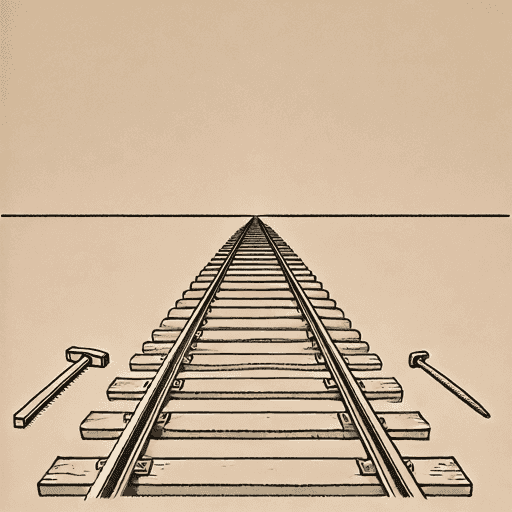
Fleischman presents Phineas Gage in Chapter 1 just before the incident that would make him famous around the world. The year was 1848, and Gage was a 26-year-old skilled foreman overseeing a group of workers building a new rail line near Cavendish, Vermont. His crew was using explosives to blast through rocks to lay track. Gage was known for being able to complete tasks well. He was physically strong, mentally disciplined, and a respected member of his team. However, his life was about to change. Even though he would recover from the accident, he would never regain his identity as it had once been. Many years later, people who knew him would say that the accident changed his nature and personality so significantly that he “was no longer Gage” (2).
Fleischman discusses how physically demanding it was to construct railroads in the United States during the 1840s. Railroad crews relied on manual tools, horse-drawn carts, explosives, and iron drill bits rather than machinery. Gage’s specialty was blasting. As described in detail by Fleischman, blasting involves loading an explosive charge (gunpowder) into a hole created by drilling into rock. A fuse is lit and placed over the gunpowder. Sand is then poured into the hole to protect the gunpowder from the heat generated when the fuse burns. The sand is packed tight with a tamping iron (a long, heavy, metal bar). If done correctly, the explosion breaks the rock below. Blasting is dangerous and requires adhering strictly to established protocols.
The day of Gage’s accident was different. The sand that normally covers the gunpowder never filled the hole. The exact details of what occurred next are disputed, but everyone agreed on what happened last. While Gage was manipulating the tamping iron, it somehow came into contact with a rock and produced sparks that ignited the gunpowder. The force of the explosion propelled the tamping iron upward through Gage’s face and skull. The tamping iron entered beneath Gage’s left cheekbone, continued behind his left eye, went through the front portion of his brain, and exited out of the center of his forehead. The tamping iron landed several feet away. Gage suffered severe damage to his head and face. Because of the extent of damage caused by the tamping iron passing through his brain, it is surprising that Gage didn’t die immediately.
Fleischman describes medical knowledge in 1848. Gage’s injury presented two major dangers: physical damage to the brain and potential infection due to his open wound. Medical professionals had already been observing microorganisms through microscopes for hundreds of years and had identified individual cells. Nonetheless, they didn’t believe that these small organisms could cause illness. Fleischman explains that future researchers such as Louis Pasteur and Joseph Lister developed methods to prove that germs cause infections and crafted clean surgical techniques. Neither of these developments were available to help Gage.
Gage survived his injury due to his physical strength, good care from nurses, and proper treatment provided by Dr. John Harlow. Dr. Harlow watched for swelling and signs of infection, cleaned and bandaged Gage’s wound, and eventually drained an infected abscess above Gage’s eyes. Gage developed a high temperature and weakness but began to heal once the abscess was opened. Fleischman states that Dr. Harlow followed accepted medical practice at the time, though some of his procedures were based on outdated concepts.
During Gage’s convalescence, he became restless and disobedient. To correct Gage’s behavior, Dr. Harlow prescribed large amounts of medication designed to restore balance to Gage’s body. Additionally, Dr. Harlow forced Gage to stay in bed. Dr. Harlow declared Gage cured approximately 10 weeks after his injury. By that time, Gage could walk, talk, count money, dress himself and perform other daily tasks. Nevertheless, Harlow noticed that Gage’s mental abilities seemed amiss. In particular, he exhibited poor judgment.
Within a short period of time, others noted significant changes. When Gage tried to return to his job as foreman, his employers decided that he was no longer fit for the role. He had become unreliable, impulsive, and rude and would frequently leave projects. Friends turned against him. Dr. Harlow wrote that the injury destroyed both his mind and personality. The chapter concludes with an increasing number of physicians showing interest in Gage’s situation, most notably physician Henry J. Bigelow from Boston, Massachusetts, who wanted to study and formally present Gage’s case.
Chapter 1 Analysis
Fleischman uses Gage’s story as a portal into science writing. Rather than starting off with abstract information regarding the brain, he presents Gage as a worker in the physically demanding environment of railroad labor and blasting. This aims to draw young readers into the story. Medical material is placed within a man’s individual tale. Fleischman evokes a life of routine, skill, and danger: “Building a railroad in 1848 is muscle work” (2).
The chapter is divided in stages. Fleischman describes Gage as a working foreman, then recounts the accident itself, and then provides the broader, historical context. This also aims to make the material digestible to a young audience. Fleischman doesn’t present the injury as a freak occurrence separate from the general practices of railroads during the labor years. Instead, he positions the injury within those practices and the limitations of mid-19th century medicine.
Fleischman shows how Gage was medically vulnerable. He writes, “[N]o scientist in America or Europe, has the slightest notion that bacteria causes infection” (11). By including scientific context, Fleischman demonstrates that Gage’s survival was remarkable. He not only survived the iron but lived in spite of not having access to antibiotics and modern antiseptic practices.
Fleischman acknowledges that not everything about the accident is clear. However, he provides detail in an attempt to recreate the scene and establishes Dr. Harlow as both a caregiver and observer. He uses tools of fiction, such as characterization and setting, in spite of the book being a nonfictional account.

Get in-depth, chapter-by-chapter summaries and analysis from our literary experts.
- Grasp challenging concepts with clear, comprehensive explanations
- Revisit key plot points and ideas without rereading the book
- Share impressive insights in classes and book clubs