Phineas Gage: A Gruesome but True Story About Brain Science
Phineas Gage: A Gruesome but True Story About Brain Science
A modern alternative to SparkNotes and CliffsNotes, SuperSummary offers high-quality Study Guides with detailed chapter summaries and analysis of major themes, characters, and more.
Summaries & Analyses
Quizzes
NEWReading Tools
Important Quotes
Content Warning: This section of the guide includes discussion of illness and death.
“Phineas will never be his old self again. His ‘character’ will change. The ways in which he deals with others, conducts himself, and makes plans will all change.”
(Chapter 1, Page 2)
This statement introduces the chapter’s core idea: Gage survived the accident, but his injury altered his character, personality, and behavior. This also sets up the book’s larger idea: that Gage’s injury could possibly show us how our brains function. The repetition of “change” underscores how Gage’s life was forever altered.
“Building a railroad in 1848 is muscle work. There are no bulldozers or power shovels to open a way through Vermont’s Green Mountains for the Rutland & Burlington Railroad.”
(Chapter 1, Page 2)
This quote presents essential background information about the historical time period that Gage lived in. It illustrates how laborious and perilous railroad construction was during the middle of the 19th century and illuminates the physical environment in which Gage and his fellow workers were required to operate each day.
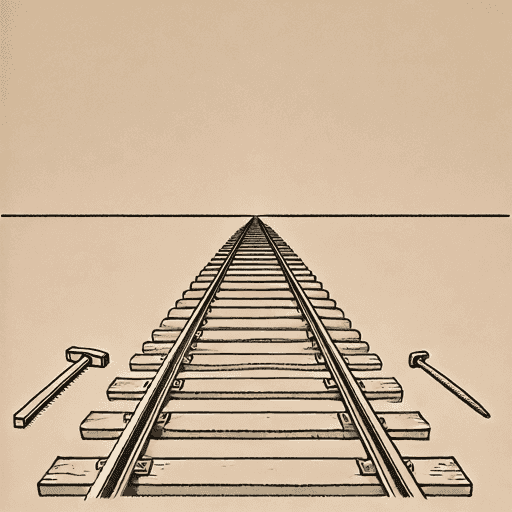
“Phineas had his tamping iron made to order by a neighborhood blacksmith. It’s a tapering iron rod that is three feet, seven inches long and weighs thirteen and a half pounds. It looks like an iron spear.”
(Chapter 1, Page 4)
Fleischman emphasizes the length and weight of the tamping iron. He describes why the tamping iron is such a critical item in Gage’s story and medical legacy.
“But something goes wrong this time. The sand is never poured down the hole; the black powder and fuse sit exposed at the bottom.”
(Chapter 1, Page 5)
This quote depicts the blunder that resulted in Gage’s accident. It illustrates how a single break in a routine procedure in a hazardous occupation can lead to disastrous outcomes.
“See the pointy end of the rod enter under his left cheekbone, pass behind his left eye, through the front of his brain, and out the middle of his forehead just above the hairline.”
(Chapter 1, Page 5)
Fleischman describes how the tamping iron passed through Gage’s skull. Gage suffered damage to his frontal lobe, which eventually became central to scientific interest in his case. The passage—“See the pointy end”—addresses the reader directly and aims to create a tone of intimacy.
“No one in Cavendish in 1848, no scientist in America or Europe, has the slightest notion that bacteria cause infection.”
(Chapter 1, Page 11)
This passage establishes the limits of medical knowledge at the time of Gage’s injury. It highlights why infection posed such a great risk and how lucky Gage was to survive. The repetition—“No”/“no”—emphasizes lack of knowledge.
“His old employers on the railroad quickly come to the same conclusion. The new Phineas is unreliable and, at times, downright nasty.”
(Chapter 1, Page 21)
This passage touches on The Relationship Between Injury and Personality. Gage’s injury impacted more than his physical health. His personality was altered, made him lose his job, and affected how others perceived him.
“No one is wearing surgical scrubs. No one is wearing surgical gloves, masks, or booties. These doctors may not wash their hands until after the operation. These men know nothing about bacteria—but they think they know all about the brain.”
(Chapter 2, Page 24)
Fleischman describes the limitations of 19th-century medicine. He juxtaposes physicians’ presumption of knowledge with their ignorance of contamination, infection, and fundamental hygiene techniques. Again, he uses repetition—of “No one” and “These”—for emphasis.
“He is Dr. Bigelow’s guest but also his prize specimen. Phineas is examined, measured, and discussed.”
(Chapter 2, Page 24)
Gage was viewed as both a person and a medical curiosity. This quote encapsulates the chapter’s emphasis on how unusual cases serve as ways for physicians to validate scientific claims.
“A physician who holds in his hand a crowbar, three and a half feet long, and more than thirteen pounds in weight, will not readily believe that it has been driven with a crash through the brain of a man who is still able to walk off, talking with composure and equanimity of the hole in his head.”
(Chapter 2, Page 25)
This quote uses imagery—“a crowbar, three and a half feet long, and more than thirteen pounds in weight”—to show why Gage’s injury seems impossible. The passage illustrates the extreme nature of Gage’s injury and explains why Dr. Bigelow had to make considerable effort to convince his peers that Gage’s case truly existed.
“By 1850, all doctors know the gross anatomy of the skeleton, internal organs, muscles, and, of course, the brain. They just don’t know how the brain works.”
(Chapter 2, Page 27)
This passage summarizes the scientific dilemma described by this chapter. Physicians of the time were knowledgeable about structural aspects of the brain; however, they didn’t have a solid comprehension of how the brain operates.
“The cortex is where you think, remember, learn, imagine, read, speak, listen, and dream.”
(Chapter 2, Page 27)
Fleischman explains why Gage’s injury is so significant. He aims to help younger readers understand what role the cortex plays in everyday human cognitive and thought processes and uses simple rather than scientific language— “think, remember, learn, imagine, read, speak, listen, and dream.”
“If Phineas survived with a large piece of his cortex destroyed, then what does the cortex do?”
(Chapter 2, Page 34)
This question is the central scientific query presented throughout this chapter. It identifies why Gage became important to studies of the brain: He allowed doctors to challenge what various areas of the brain are responsible for performing.
“The human brain, it turns out, is both localized and interconnected.”
(Chapter 2, Page 41)
This quote defines the chapter’s key conclusion about brain science. Neither of the two previously established theories regarding brain science is correct. The quote also relates Gage’s case to an enhanced contemporary model that explains how humans use their brains.
“Phineas returns from New York to the family’s New Hampshire home early in 1851 to work for Mr. Jonathan Currier in his livery stable in the nearby town of Hanover. Whatever Phineas’s problems with people, he gets on well with horses.”
(Chapter 3, Page 46)
This chapter explores the relationship between injury and personality. Gage had a disability due to his injury and could no longer interact productively with humans. However, he continued to work and assume demanding duties. In this way, he was both permanently altered and resilient.
“In August 1852, Phineas leaves New England forever, bound for Chile and a new life as a stagecoach driver.”
(Chapter 3, Page 46)
This quote signifies a pivotal point in Gage’s post-injury life. Even though he was injured, he remained capable of extensive travel and prolonged labor. The book shows how Gage’s life continued even when his old life had come to an end.
“According to his mother, Phineas drives for nearly seven years on a regular schedule over the primitive roads between Valparaiso and Santiago.”
(Chapter 3, Page 47)
This statement suggests that Gage continued to maintain control over demanding physical and mental labor for many years after sustaining his injury. It suggests how physically and mentally taxing Gage’s work as a coachman was. Again, the book illustrates Gage’s abilities within the parameters of disability.
“We know one other thing about Phineas in Chile. He has his tamping iron with him. Stowed under the seat or ready to hand, the tamping iron goes everywhere Phineas goes.”
(Chapter 3, Page 49)
Gage was identified with the tamping iron in the last chapters of his life. The tamping iron symbolizes how attached to the past he was—he literally didn’t let it go.
“A fit is an epileptic seizure. Epilepsy is not a disease but a complex of symptoms. Basically, a seizure is an electrical storm in your brain’s nerve cells.”
(Chapter 3, Page 50)
This passage describes Gage’s decline. It aims to help young readers understand what a seizure is and the reasons behind Gage’s symptoms. The language combines imagery (“an electrical storm”) with science (“nerve cells”).
“At last Dr. Harlow is at liberty to tell the full story of Phineas Gage’s ‘recovery’ twenty years before.”
(Chapter 3, Page 59)
Fleischman explores the nuances of Gage’s injury and recovery. While he recovered almost every aspect of his physical capabilities, his ability to function socially and personally remained impaired.
“All have trouble making decisions on personal or social matters. All react with little empathy and seem to find emotion a foreign language.”
(Chapter 4, Page 65)
This quote links Gage to modern patients whose brains have been damaged in the same frontal-lobe area. The problems presented in Gage’s case are not isolated incidents and illustrate the consequences of frontal-lobe damage.
“The emotional colors of their world seem to have drained away.”
(Chapter 4, Page 67)
This passage uses imagery—the dimming “emotional colors of their world”— to convey what it’s like to sustain brain damage. Diminished emotional responsiveness can occur regardless of whether cognitive skills remain unimpaired.
“The brain is a very small place, and a very small change in the path of the iron would have had very different results.”
(Chapter 4, Page 69)
Gage narrowly escaped death because so much depended on the exact trajectory taken by the tamping iron. This passage foreshadows the reconstruction of Gage’s accident using modern imaging techniques.
“What is so remarkable about Phineas Gage’s injury is not only where the rod went in his head but where it did not go.”
(Chapter 4, Page 72)
This quote summarizes one of the chapter’s central arguments. Gage retained various abilities since the rod missed major brain centers involved in speech, motor function, and sensory processing.
“He was limited in ways that are important to all human beings, but he found a way to live, working with horses. He took care of himself. He saw the world. He died with his family around him, the only people who knew both the old and new Phineas.”
(Chapter 4, Page 75)
Fleischman portrays the damage that Gage suffered but also how he continued to work, travel, and maintain contact with his family members. The passage uses anaphora, where each sentence begins with the same word, in this case “He.” This aims to create rhythm, emphasis, and resonance to drive home the nuance of Gage’s life.

Unlock every key quote and its meaning
Get 25 quotes with page numbers and clear analysis to help you reference, write, and discuss with confidence.
- Cite quotes accurately with exact page numbers
- Understand what each quote really means
- Strengthen your analysis in essays or discussions