Raising Hare
Raising Hare
A modern alternative to SparkNotes and CliffsNotes, SuperSummary offers high-quality Study Guides with detailed chapter summaries and analysis of major themes, characters, and more.
Summaries & Analyses
Quizzes
NEWReading Tools
Games
Key Figures
Chloe Dalton
Chloe Dalton is the book’s author and narrator. She is a writer, political analyst, and foreign policy expert living in London at the beginning of the COVID-19 pandemic. She initially self-identifies as an urbanite, noting: “Life and its beating heart lay for me in the city” (17). She is a driven, work-oriented individual who derives much of her identity from her career. She enjoys her job, her life in London, and the opportunities for far-flung travel that work affords her. She does not initially consider moving full-time to the countryside, and she explains that she purchased the property as a project and to have a weekend retreat. Chloe grew up in a rural area and loved nature as a child, but as an adult, she balks at the idea of leaving the city. Initially she finds it difficult to acclimate to the slower pace of rural life. She is still working remotely, and her life lacks the structure it had pre-pandemic. Chloe undergoes a distinct set of changes, however, as she cares for the leveret. Researching hares energizes her and provides her with a new sense of direction. She realizes that the slower, simpler pace of rural life is soothing, as is devoting so much of her time to the care of an animal. Caring for the hare also gives her the opportunity to think more deeply and critically about humanity’s relationship with the environment. She frames her understanding of humanity’s impact on the natural world through hare-human relations. She also finds herself reconnected to the natural spaces she valued so much in childhood. She is better attuned to the sounds of the area around her house and to the seasonal changes of the countryside. In part because of her shifting perspective and in part because the hare chooses to remain with her, Chloe abandons plans to return to London full-time, making the country house her new home base.
Lewis Carrol
Chloe’s research turns up both practical information about hares’ habits and behaviors and a historical survey of how hares have been perceived across various cultures. She is puzzled by the association between hares and “madness,” and ultimately comes to believe that authors like Carrol did much to perpetuate the idea that hares are wild, unpredictable, and prone to fits of mania that manifest in wild, seemingly purposeless leaps and spins. In Alice’s Adventures in Wonderland, Carrol details the exploits of the “Mad” March Hare, an anthropomorphized hare characterized by his seemingly irrational behavior. What Chloe comes to believe is that the wild jumps and turns of the hare are in part an effort to maintain cleanliness (jumping and spinning allow the hare to remove water and dirt from its fur) and in part an expression of their innate playfulness. Chloe’s hare enjoys leaps and bounding through the garden, and she believes that it expresses happiness through spinning in circles. She also theorizes that by using its powerful legs regularly, the hare maintains its muscle tone so as to better evade predators. Additionally, she learns that one particular spinning and boxing “dance” that hares perform is part of an elaborate mating ritual. Hares are not “mad.” They are simply misunderstood.
William Cowper
William Cowper is an 18th-century poet whom Chloe stumbles upon while researching hares. She finds a wealth of information on how to hunt and prepare them, but very little on their care. Cowper wrote about hares after being given one during a time of deep depression. He named it Puss, realized that caring for it helped him to improve his mood, and promptly adopted two more: Tiney and Bess. “By his own account, Cowper loved his hares” (51) and published several poems and an essay about the care of leverets. From Cowper, Chloe learns that hares should eat dandelion, sow thistle, lettuce, green corn, aromatic herbs, apples, oats, and bread cut into small squares. Chloe uses Cowper’s book as a guide, and with varying degrees of success, she gets her hare to eat many of the foods that Cowper suggests. Chloe and Cowper share a reverence for hares, and each writer makes observations about how beautiful, strong, and agile the creatures are. The two writers also share an appreciation for the soothing experience of dedicating time and energy to the natural world. The hares help lift Cowper out of a depression, and they provide Chloe with focus and direction during the uncertainty of the COVID-19 pandemic.
George Gascoigne
Chloe is struck by the fact that many of the most moving accounts of hares’ lives and habits were written by hunters. Gascoigne published a detailed hunting guide for hares in 1575 that includes a poem written in the voice of a hare to its hunters. Gascoigne was an avid huntsman who enjoyed both the pursuit of hares and the sumptuous meals that they provided. He did not advocate for the welfare of hares or encourage people to refrain from killing them. Still, he had a great deal of admiration for hares as a species. He notes their powerful bodies, the skill with which they evade capture, and how well-suited they are for life in even the harshest of conditions. In his poem, he castigates hunters for failing to realize that hares are sentient, feeling beings. He notes that they are “harmless” creatures who “cannot make defense” (74). He explains that unlike some animals, they do not bite, sting, or wound their pursuers. Gascoigne’s writing is striking to Chloe because it contains many of the observations that she herself has made while caring for her hare. For Chloe, as well as for Gascoigne, the hare is a lesson in the wonders of the natural world: It is perfectly designed, adapted, and habituated to the conditions in which it lives. It is, to both, a creature of great beauty.
The Leveret/Hare
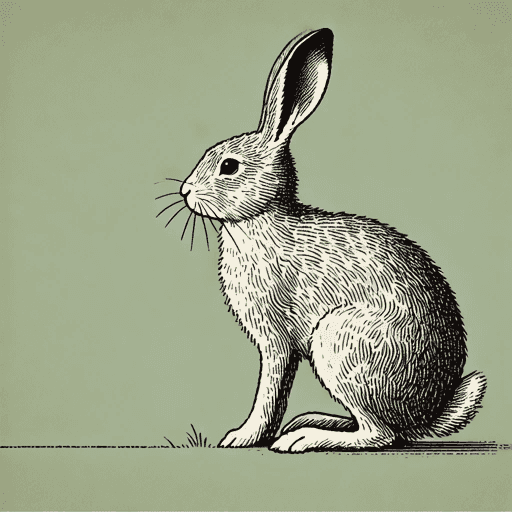
Although not human, the hare is one of this book’s most important figures. The author finds it alone, unsheltered, and separated from its mother. Although her sister and a local wildlife expert caution Chloe that hares cannot be domesticated and that the young creature might die despite her efforts to save it, Chloe decides to try to raise it until it is old enough to return to the wild. Caring for the leveret becomes therapeutic for Chloe. It teaches her the value of simplicity. She finds that when so much of her focus is on the hare, she has less time to worry about the trivialities of life. She also develops a genuine appreciation for hares as a species. Because the creature is not her pet, and she makes a concerted effort to refrain from anthropomorphizing it, she is able to admire its innate qualities. The hare is muscular, lithe, and uses its strength to evade capture by a host of predators. It is adept at camouflaging itself and can disappear into various backgrounds. It is highly attuned to the world around it and is always aware of other animals in the area. The hare is also a creature of habit. It moves around Chloe’s house and garden with a regularity that she finds noteworthy. She can almost always find it based on the time of day: The hare chooses one particular resting spot for each portion of the morning and afternoon. Chloe also ruminates on the nature of human-hare interactions and the way hares are perceived and depicted in popular culture. She realizes that the image of the “mad” hare is rooted in the hare’s innate playfulness but also in the works of authors like Lewis Carrol, whose hare character has done much to shape human understandings of hares. Chloe also researches human impacts on hare habitats and comes to realize the damaging impact of industrialized agriculture on hare populations. Ultimately, the hare re-shapes Chloe’s entire life, although she remains invested in appreciating the hare for its own distinct qualities rather than because of the effect it has had on her. She remains grateful that it has let her into its life, noting: “I was only able to share its space because it allowed me to” (47).
Chloe’s Sister
Chloe’s sister is never named and plays a secondary role in Chloe’s narrative. She remains an important figure however because of her orientation toward nature and her knowledge of local plants and animals. Chloe and her sister grew up in the countryside, but when Chloe left for London, her sister stayed. She and her family live on a farm and have both pets and livestock. Additionally, Chloe’s sister has developed a working knowledge of animals like hares, rabbits, stoats, and the many birds of prey that are part of the ecosystem in which she lives. While Chloe initially values urban life more and spends all her time in cities, her sister has the appreciation for nature that Chloe develops through her experience with the hare. Chloe’s sister, because she has spent so much time raising a variety of animals, is able to help Chloe when she first finds the leveret. Because of her knowledge of young animals, she can provide Chloe with a powdered milk mixture that can be fed to the leveret. Chloe consults her sister at various other points, including when the leveret becomes injured, and her sister helps to the best of her ability. She represents the kind of harmony with nature that it is possible for humans to achieve, and by the end of the book, Chloe’s life resembles her sister’s far more than it does her colleagues’ lives in London.
The Vet
The vet, who is also not named and appears only briefly, is also important in that Chloe’s interactions with him speak to human attitudes toward animals, both wild and domesticated. Chloe consults him when the leveret injures her leg. She knows that an injured leveret is much more vulnerable to predation than a healthy creature and worries that if she does not intervene, the leveret might die. The vet first asks her to bring the leveret into the office and then, when Chloe decides against it, asks to come and examine it himself. Chloe ultimately realizes that both options might be too stressful for the injured creature and instead sends the vet a video. When he prescribes a painkiller that he admits might harm the leveret, Chloe decides to let nature take its course. This experience reveals Chloe’s shifting attitudes toward human-animal interactions. Although her impulse is to use veterinary care to help the leveret, she comes to the realization that the leveret is a wild creature. She must leave it to its destiny, even if that destiny is an early death. This decision pains her, but she knows it is the right one. She makes peace with it, and in so doing begins to develop the ability to let go of difficult decisions and emotions. The idea of letting nature take its course, which she first applies to the leveret, can be transferred to other areas of her life. It becomes part of the personal philosophy that she develops as a result of her time with the leveret.

Unlock analysis of every key figure
Get a detailed breakdown of each key figure’s role and motivations.
- Explore in-depth profiles for every key figure
- Trace key figures’ turning points and relationships
- Connect important figures to a book’s themes and key ideas