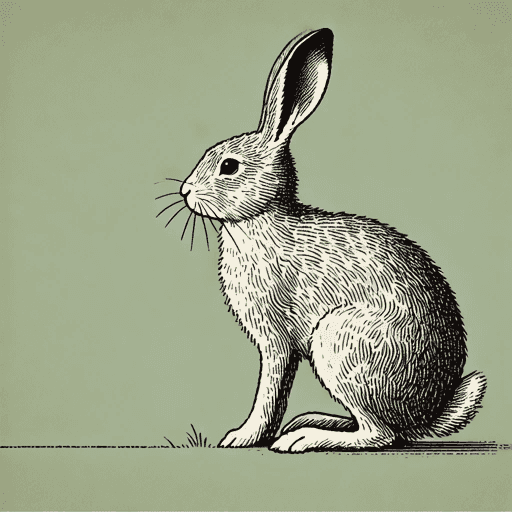
Raising Hare
Raising Hare
A modern alternative to SparkNotes and CliffsNotes, SuperSummary offers high-quality Study Guides with detailed chapter summaries and analysis of major themes, characters, and more.
Summaries & Analyses
Quizzes
NEWReading Tools
Games
Part 1, Chapters 5-8Chapter Summaries & Analyses
Part 1, Chapter 5 Summary: “May Days: Witch-Hare”
By May, the fields are full of bluebells and the weather is warmer. The leveret loves to sunbathe and frolic in the garden. Although others who have written about raising hares have noted their disinterest in humans, Chloe’s leveret often seeks out her company. Its habits are regular and observable: It loves to wedge itself into tight spaces and sits on Chloe’s ankles when she is in the garden. It dislikes bumblebees and will avoid them whenever possible. It fastidiously shakes the moisture from its body so that it never accumulates. The leveret is always clean and dry. It develops a fascination with seams and enjoys running its increasingly large teeth gently along the seam on Chloe’s trouser leg. Twice a day, at dusk and dawn, it races into her room and leaps around on the bed. Although she cannot prove it definitively, she is certain that it prefers some fabrics to others. The leveret is adept at camouflaging herself and spends an increasing amount of time among the tall grasses in the garden.
Chloe continues to read about hares and is bemused to find descriptions of their behaviors and habits that contradict her observations. She has not seen the kind of crazed, erratic movements that so many people write about. Her own leveret has established habits and does not fly around in fits of frenzy. She reads that hares have often been the subject of folklore: Pregnant women, upon seeing a hare, were once encouraged to tear bits of their dresses so that their children were not born with “hare lips.” (cleft palates). Witches were said to take the form of hares when they move about the countryside. Chloe muses that merely keeping a hare in her home would have, during a different era, likely marked her as a witch as well. Hares are also associated with the divine, with some cultures refusing to eat them because of their sacredness. In the ancient world, hares were thought to be hermaphroditic. This may be a result of their lack of sexual dimorphism: There is no discernable difference between males and females. There is much contradiction about hares in the literature, and Chloe wonders how one species could be labeled both sacred and profane, both harmless and supernaturally menacing. She does see how hares could have developed an association with the otherworldly though: They are active at night, like cats (which are also associated with witchcraft); they scream at the moment of death, suggesting the possible presence of a spirit within; and they can run swiftly and move with exceeding agility.
Part 1, Chapter 6 Summary: “Independence”
After watching the leveret spend so much time frolicking in her garden, Chloe is moved to plant flowers and bushes. Although the end result looks rather haphazard, she is proud of it. She is chagrined one morning to find that the leveret has chewed the bottom portion of one of her evergreen bushes and hollowed out a space in the dirt beneath it. She makes an effort to block off this space with chicken wire to prevent further damage, but the leveret merely leaps over it. At that point, she realizes that it has created the perfect burrow for itself and leaves it alone. The bush remains healthy, and the leveret is happy. As it grows, she observes that it has predictable daily movements. She can usually locate the creature in the garden depending on what time of day it is: It rests in one particular place for the same portion of each day. Speaking to a friend who specializes in wildlife, she learns that other animals too follow these predictable behavioral patterns. This surprises her, and she ruminates on the information.
The leveret is growing quickly, and Chloe observes the way that it keeps itself clean, how alert it is when eating, and that it maintains an erect ear position even in repose so as to keep itself safe from predators. It never defecates in its resting places or in her house. Its extreme cleanliness, independence, and nocturnal nature make it seem almost cat-like to Chloe, but she knows that hares are wild and cats domestic. They exist at opposite ends of the food chain: Hares have always had to contend with animal predators and human hunters. Cats have been selectively bred for traits pleasing to humans such as hair length, eye color, and size. Hares remain as nature made them, perfectly adapted to their wild lives. Cats, although independent, allow themselves to be handled and even enjoy human touch. Hares will not sit in a lap or tolerate petting.
Observing the leveret in the garden, where it spends an increasing amount of its time, re-orients Chloe toward the natural world. She finds that she notices when trees first bud and can distinguish different wild animals by sight. All rabbits no longer look the same to her. She notices slight variations in feather patterning in the birds she sees. As the leveret matures and explores more, she begins to worry about it. She does her best to safeguard it from predation, but she understands that it is a wild animal and needs to hone its own instincts. She also realizes that one day she will have to let the leveret leave her garden for good.
Part 1, Chapter 7 Summary: “Four Months Old: Home Range”
At the age of four months, the leveret leaves Chloe’s garden without warning. Although she has prepared herself for this moment and once even welcomed the day when she would know she was free to return to London, she finds herself grief-stricken. She realizes that she will never know the small creature’s fate and does not know how to live with the uncertainty. She even cries when she finds a stray oat from the one of the leveret’s final meals with her. But then, just as suddenly, the leveret reappears in her garden and hops into her house. It resumes its life with her, although it leaves each night to roam the countryside around her home. She is particularly heartened to see it one evening in the company of another hare. She’d been worried that it would be rejected by its kind after an early life spent in the company of a human.
Now that the leveret’s habitat is larger, Chloe realizes how many wild animals actually make use of her land. Seeing the leveret’s tracks and trails in her garden, she recognizes other animals’ tracks and trails there as well. She understands how much humans impact wild animals’ habitats: Even cutting down a stand of trees, cutting a trail, or erecting a fence might alter an environment animals have been using for countless generations.
Chloe also realizes that so many months observing the leveret changed her too. She is more attuned to nature, but she is also less interested in work. She no longer feels as though her career is her entire identity. She wonders if she is as excited to return to London as she once had been. She thinks that she and the leveret both consider her rural home to be their base, the center of their habitat. When she tries to get rid of an old piece of furniture, the leveret is disconcerted, and she ends up bringing it back into the house. She contemplates both her and the leveret’s future, wondering what their next steps will be.
Part 1, Chapter 8 Summary: “August: Light Foot”
At six months old, the leveret is now almost fully grown. Chloe observes the length of its ears and the delicate power of its legs. It still returns to her home each morning after a night in the countryside, and one day she notices that the leveret is limping. For several successive days, it limps into her garden at first light, and she finds it increasingly difficult to let it go at nightfall. She knows that it is at increased risk of predation in its injured state, but she also knows that she should allow the leveret’s life to run its own course. She calls her sister, who suggests seeking a vet’s counsel. The vet wants her to bring the leveret in or at least to examine it in her home, but Chloe fears that either option would be traumatic for the leveret. The vet then suggests giving the leveret a painkiller and prescribes her a dose of a canine painkiller. He warns her that there is no way of knowing how the leveret will react to the medication, and it might harm it. Chloe decides not to give the painkiller to the leveret, and instead tries to make sure she has as much food on hand as possible for it. Hopefully this will decrease the amount of time it must spend in the wild. Slowly, its leg heals, and life returns to normal. Then, however, plowing season begins. The fields are dry stubble with no food and little cover for animals. Chloe knows through her research that the onset of agriculture and the increased mechanization of agricultural techniques is the single greatest factor in Europe’s declining hare population. She still worries about its safety and frets when it remains outside the garden for several days. As winter approaches, however, the hare spends an increasing amount of time with her and even begins staying indoors for longer periods.
Part 1, Chapters 5-8 Analysis
These chapters focus on The Therapeutic Effects of Nature, as the daily rituals of caring for the leveret provide a sense of stability for Chloe amid the uncertainty of the pandemic. Chloe continues to be impressed with the leveret’s agility and enjoys observing its habits and burgeoning personality. Although it is clearly a wild animal, it has become habituated to her presence and seeks out her company. She finds the leveret soothing and notices how much calmer she is when it is sitting quietly next to her. The leveret also inspires her to improve her garden. She selects and plants flowers, shrubs, and grasses she knows that it will like, but she also rekindles her childhood interest in the natural world. She learns to identify all the key plant species in her garden and the surrounding area. She also begins to be able to identify an increasing number of animal species and has a better understanding of how they function together to form an ecosystem. This deepening attention to the natural world allows her to feel integrated into her surroundings and escape the confusion and helplessness that many people felt during the early days of the pandemic.
As Chloe finds ways to nurture the leveret without infringing on its inherent wildness, she learns about The Challenges and Rewards of Caregiving. She takes every possible opportunity to observe the leveret, building a thorough understanding of its behavior, schedule, and habits. Hares, she notes, are characterized by “cleanliness, independence, and nocturnal nature,” and she initially muses that the leveret resembles a house cat. And yet, she realizes: “[O]ne is wild and the other has been domesticated for thousands of years” (103). The wildlife expert cautioned Chloe that because hares were never domesticated, she will be unable to tame this one, but it is a lesson that she must learn and re-learn for herself. Because she does her best to remain aware of the leveret’s wildness, she is able to refrain from petting it and she lets go of the expectation that it will ever want to sit in her lap. This becomes a valuable lesson for Chloe, however, and it is at the root of her ability to appreciate the creature for its own sake, rather than because of its relationship with her. Admiring nature for its own sake, without desiring to interfere with it, becomes a key part of Chloe’s burgeoning personal philosophy as it applies to the environment.
When the leveret leaves her garden for the first time, the challenges of caregiving come to the foreground. Her goal was rehabilitation and release, but she feels a distinct sadness when it seems likely that the leveret is gone for good. This moment crystallizes Chloe’s growing awareness that to love another living thing is to accept the risk of loss. She has a similar moment of difficulty when the leveret injures its leg. Because it is a wild creature, she has made a pact with herself not to interfere with its fate beyond feeding it until it is ready to care for itself. This means that she cannot always safeguard it from predators and that she shouldn’t attempt to treat its injury. Although the vet does prescribe a painkiller, Chloe chooses not to administer it: There is no telling how the leveret will respond to the drug, and she cannot risk an adverse reaction. Although it pains her to do so, she merely provides the leveret with food and hopes for a positive outcome. Again, she manifests a distinct philosophy as it relates to the environment: Protection without intervention.
In keeping with the conventions of the nature memoir genre, Chloe’s relationship with the leveret is a catalyst for her personal development. After caring for the leveret for several weeks, she can see marked differences in her orientation toward work, city life, and contemporary society. She notes that she is less interested in work and that it no longer defines her as an individual. She sees herself as someone more attuned to the natural world and more oriented toward the small details in the world around her. She finds that she increasingly values simplicity and uses that principle to order her days. She also continues to think critically about Humanity’s Changing Relationship With Nature. Her reading on the folklore surrounding hares points to this changing relationship. Hares have often been seen as emblematic of wildness, and their depiction in folklore reflects human attitudes toward nature itself. Chloe observes that in some cultural contexts, they have been treated as almost sacred, while in others they have been viewed as adjacent to evil. She notes that in early modern England, the presence of a hare in her house might have marked her as a witch. While such attitudes suggest a fear of nature, they are ultimately less destructive than present-day attitudes, in which most people rarely think about hares at all. In the 21st century, few people hunt hares, and yet they are being killed in record numbers through careless development and industrial agriculture. For Chloe, the oblivious destruction of the hare is emblematic of humanity’s oblivious destruction of nature more broadly, and she strives to avoid such unthinking harms in her own life. When re-planting her garden or contemplating the construction of trails and hedges, she thinks about the impact of those choices on the small animals surrounding her house: “Walls, roads, and traffic create barrier effects that interrupt the natural habitat of animals” (127). Even the construction of a new row of hedges might disrupt the moles, mice, rabbits, and small birds that relied on whatever was in that space before. She uses her newfound awareness to guide her decisions, thereby hoping to live more harmoniously with the natural world.

Get in-depth, chapter-by-chapter summaries and analysis from our literary experts.
- Grasp challenging concepts with clear, comprehensive explanations
- Revisit key plot points and ideas without rereading the book
- Share impressive insights in classes and book clubs