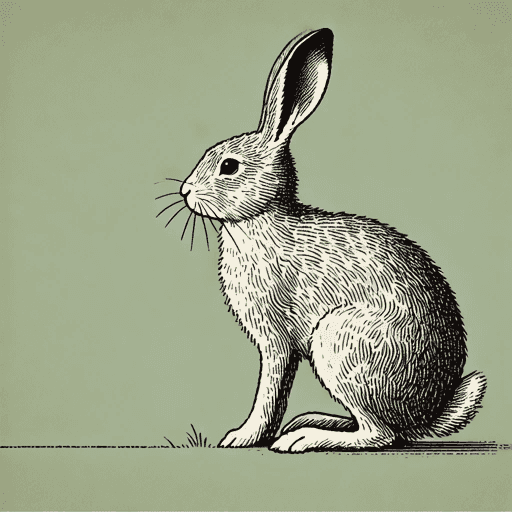
Raising Hare
50 pages • 1-hour read
Chloe DaltonRaising Hare
A modern alternative to SparkNotes and CliffsNotes, SuperSummary offers high-quality Study Guides with detailed chapter summaries and analysis of major themes, characters, and more.
Part 2, Chapters 12-15Chapter Summaries & Analyses
Content Warning: This section of the guide includes discussion of animal death.
Part 2, Chapter 12 Summary: “Harekind”
Two days pass without another sighting of the new leveret. Chloe is especially concerned for its safety because she’s seen a stoat slinking about the garden during the last week. Stoats are beautiful, weasel-like creatures that are ruthless predators. Their lithe, muscular bodies were designed for hunting, and they can fit into the tiniest of spaces, springing forth to capture their prey with ease. She knows that there is nothing she can do to drive the stoat from her garden and that ultimately it would be impossible to protect the leveret. She is relieved when she catches sight of it, but she understands that she cannot alter its fate. The other leverets stick together and mostly remain inside, although as they grow larger and stronger, they too begin to explore the garden. Chloe notes with interest the difference between the leverets’ personalities. The larger, which she assumes is male, is more assertive in his movements. She often wonders if he bothers his mother too much: The hare at times seems irritated with his presence and avoids him when she is not feeding him. He also bullies his sibling, a smaller leveret whom Chloe assumes is female. The male chews objects in the house with greater regularity than the female, and he also seems more comfortable exploring new places. The hare and the leverets enjoy Chloe’s exercise ball, and she often finds them bouncing it back and forth.
Part 2, Chapter 13 Summary: “Bolt from the Blue”
Chloe enjoys observing the young leveret in the garden. It does not interact much with the other pair of leverets, and its personality seems different, more reserved despite the wild jumps and spins that characterize all leverets. She notices that it is adept at camouflage and often hides in places that even she, who by now knows all of the best hiding spots in her garden, cannot locate. She continues to observe the differences in each leveret’s personality and is struck by how individualized they all are. She knows that her friends, colleagues, and even family members find her choice to live with hares and leverets markedly bizarre. That she has a hare-door cut into the side of her home is particularly baffling to people, even the workman who installed it shook his head in disbelief at her request. And yet, she values the time she spends with the hare and her leverets and is humbled by the trust that the mother hare especially places in her. She raised the first hare from infancy, and although not domesticated, it is habituated to her presence and even seeks her out at times. One day, quite suddenly, the youngest leveret falls ill. There are no outward signs of injury, but she seems unable to move, and her body is oddly slack. Chloe calls the hare over to inspect her offspring, and she gently passes the leveret back to Chloe. It dies silently in her lap. She has no idea what caused its death: She has no plants in the garden that are poisonous to rabbits and hares. She has made sure of this. She does not use pesticide. Perhaps it is weaker because it was the product of superfetation. Chloe will never know. Sadly, she buries it beneath the rose bush, wondering if the mother will feel its absence.
Part 2, Chapter 14 Summary: “Blood in the Harvest”
On the day after the leveret’s mysterious death, area farmers begin harvesting potatoes in the fields surrounding Chloe’s home. Chloe’s heart sinks. She knows how destructive agricultural machines are to hares and other small animals. With a sinking heart, she goes out the following morning to inspect the fields. Just as she feared, she finds numerous hare and leveret corpses, mangled by the large harvesters. She reflects on the damage that industrialized agriculture has done to hare populations, but also thinks about how divorced humans have become from ecosystems. They have, she argues, forgotten that they too are supposed to have a place within the natural world. Each species plays its own role, none more important than the other. There is no waste. Every animal has its habit. Humans have disrupted this delicate balance, and the hare is the perfect example: Humans could be more judicious about the way that they use land and the tools they use to farm it. They could also focus conservation efforts not only on large, flashy species like elephants, but also on the smaller animals that are important parts of their individual ecosystems. Wanting to know more about the natural world around her, Chloe begins to gather various plants and grasses. She realizes that she knows very little about the local flora and decides that learning to identify the plants that are native to her region might fill her with a sense of purpose and renewal. She returns home with her haul and begins to sort and identify each plant. She still feels heartbroken over the sight of so many dead creatures in the fields, but now she has a new project to throw herself into.
Part 2, Chapter 15 Summary: “Secret Paths”
The leverets are now four months old. The female spends more time inside the house and especially enjoys resting on the sofa. Chloe is struck by how dignified hares are. The mother hare especially has taught her that hares are curious, interested in their surroundings, capable of learning, and solitary only out of caution. If they feel safe and have an escape path identified, they will investigate all manner of curiosities, Chloe included. As she watches the leverets in the garden, Chloe thinks about how much her experience with the hares has changed her. She did not immediately run back to London, and she is grateful for her country life. She feels much more integrated with the land than she once did and is attuned to the lives of animals in a new way. The hare taught her patience, the value of silence, and how to appreciate the simplicity of life. She now finds joy in small, beautiful moments without feeling sadness about the ephemerality of those experiences. Life is built on cycles and change, and one must accept that truth. She realizes that the hare will leave one day and not return. It has left only the smallest of physical traces in her home, but the emotional trace it left on her is immeasurable. She hopes that she can take comfort in the memory of her time with it, in the knowledge of the ways that it altered her, and in the fact that it is connected to all of the other hares she can see in the garden and in the fields surrounding her home.
Part 2, Chapters 12-15 Analysis
This set of chapters opens with a series of Chloe’s observations about the hare and its leverets. It is evident that Chloe’s interest in the animal remains rooted in the species’ unique qualities and that her admiration for hares is genuine. In not attempting to tame her hare, she’s allowed it to retain its natural habits, behaviors, and qualities. Her treatment of the hare represents what has become her personal philosophy about wildlife in more general terms: She advocates for observing wild animals without disrupting their lives, developing a thorough body of knowledge about them, and preserving the sanctity of their habitats.
When the youngest leveret dies for reasons that Chloe cannot identify, she is forced to think more deeply than ever about The Challenges and Rewards of Caregiving. She must let go of the creature and confront her own grief for having lost it. This incident highlights the tension between her role as a caretaker and her desire to preserve the hares’ autonomy and wildness. She recognizes that if she wants to allow the hares to remain wild, she cannot protect them from every misfortune. Her acceptance of the leveret’s unexplained death marks her mature perspective: She recognizes that the hares cannot live full lives without the risk of death. Throughout the novel, incidents like the original hare’s injured leg and the presence of a stoat in the garden have foreshadowed this moment, reminding Chloe that love and caregiving come with the risk of grief. Now, that narrative tension has come to fruition, and her capacity to accept loss is put to the test.
The penultimate chapter, “Blood in the Harvest,” highlights the destruction wrought by Humanity’s Changing Relationship With Nature. In previous chapters, Chloe’s research on hares has shown her that they occupied a central place in the human imagination for centuries. Sometimes loved, sometimes feared, often hunted, they were nonetheless consistently the subjects of myth and poetry, viewed as an avatar of nature itself. Now, the potato harvesters kill hares by the dozen without anyone even noticing. Chloe goes out in the just-harvested fields and observes that: “the earth was scoured raw” (240). Not only have hares and other small animals been killed, but the plants that offer food and shelter to animals and insects are gone. This careless destruction, aimed at maximizing the efficiency of the harvest without regard to ecological consequences, demonstrates the obliviousness that characterizes humanity’s relationship with nature in the 21st century. The incident prompts Chloe to reflect on the damage that humans have done to hare (and other) populations, and she provides more information about the impact of mechanized agriculture specifically. This in-depth look at farming practices becomes one of the book’s key moments of engagement with conservation philosophy. She notes her own changing attitudes toward conservation: As a young person, she recalls large-scale media campaigns calling for protection for lions, white rhinos, zebras, and other large mammals that conservationists call “charismatic megafauna.” She doesn’t discount the need to preserve and protect those species, but now believes that smaller species, like the hares, stoats, and foxes in her area, also deserve protection. She argues that because agriculture has done more to adversely impact animal populations, humans owe it to the impacted species to protect them. Although her book is a memoir more focused on her own growth trajectory and the hare as a species, it is also an oblique endorsement of small-scale conservation practices. Nowhere is that more evident than in these chapters.
Chloe closes her discussion of The Therapeutic Effects of Nature with an in-depth look at the lessons she’s learned while raising, caring for, and living alongside the hare. She notes her newfound interest in simplicity. Her days have a different rhythm now that her priorities have been simplified. She has stripped away the portions of her life that did not matter to her, and she feels an increased sense of clarity as a result. She has come to realize that life, like nature, is built on cycles and change. Accepting the possibility that her hare and its leverets may leave for good or die is part of accepting the cyclical nature of life. Living with the hare taught her to accept a range of outcomes, not only for the hare but also in other areas of her own life. It also taught her about ephemerality: The hare’s life cycle is only about 3 to 4 years. She will ultimately have to say goodbye to it. She hopes that she will be able, when the time comes, to appreciate the opportunity she had with it rather than focus on the pain of losing it.
Chloe ends the book without revealing whether the hare has died. While it is possible that the creature was still living when she wrote the memoir, her decision to finish the narrative without resolution is ultimately grounded in the personal philosophy she developed as a result of living with the hare. Acceptance of both life’s ephemerality and the possibility that she might never have closure were key facets of what she learned from the hare. She does not provide readers with the “end” of the hare’s story as a way to mimic the experience of living with the wild creature. Like the author, readers are left with only one choice: to accept the possibility of an ending without knowing what that ending might be.

Unlock all 50 pages of this Study Guide
Get in-depth, chapter-by-chapter summaries and analysis from our literary experts.
- Grasp challenging concepts with clear, comprehensive explanations
- Revisit key plot points and ideas without rereading the book
- Share impressive insights in classes and book clubs