Raising Hare
50 pages • 1-hour read
Chloe DaltonRaising Hare
A modern alternative to SparkNotes and CliffsNotes, SuperSummary offers high-quality Study Guides with detailed chapter summaries and analysis of major themes, characters, and more.
Prologue, Part 1, Chapter 4Chapter Summaries & Analyses
Prologue Summary
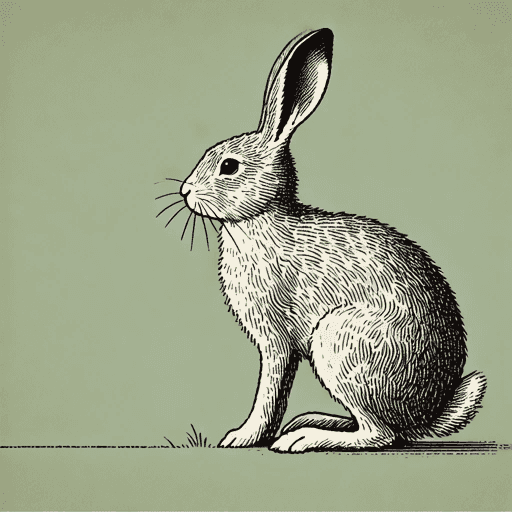
Winter is bitterly cold, and snows blanket the ground for the entire first two months of the new year. A hare gives birth, feeds and protects her young leveret (a baby hare), but is forced to leave it when she forages for food. The tiny creature patiently waits for its mother, but freezes in terror when it hears the approach of an advancing hound.
Part 1, Chapter 1 Summary: “A Winter Leveret”
Chloe hears the sound of barking and then a man. There is no reason for a dog to be nearby, so she goes outside to investigate. She lives alone in a small house surrounded by farmland, streams, hedgerows, and stands of trees. Growing up in the country, she heard stories of poachers and hunters sneaking onto their neighbors’ land with their dogs, and she wonders if someone is trespassing. On the other hand, it is equally possible that a neighbor’s dog, excited to be out in so much open space, bounded away from its owner. Perhaps this is what happened, and the human voice she heard was someone looking for their dog. Right in the middle of a path, she finds a leveret. It is alone and unsheltered. The author wonders why: Leverets are typically tucked away in a burrow while their mothers search for food. Something must have happened to this leveret’s mother. The author knows that the leveret is in danger, but she also fears that if she touches it, its mother will reject it if she does return. She decides to let nature take its course. However, a few hours later, the leveret is still there. Lining her hands with grass to avoid getting her scent on it, she picks it up and brings it home.
Seeking advice on how to proceed, she consults a wildlife expert she knows. He cautions her that leverets, unlike badgers and even foxes, cannot be domesticated. The tiny animal will likely die. Chloe feels a wave of shame and regret wash over her: She should have left the leveret alone. She is unprepared to care for it, both now and as it grows older. Although she grew up in the countryside, she’s long lived in the city. She works as a political analyst and often travels for work. She loved animals as a young girl, but as an adult she’s had no time to care for a pet. She is only in the countryside because of the pandemic and plans to return to London as soon as she can. Still, she cannot let the leveret die. She calls her sister, who lives on a farm nearby, to get her opinion. Her sister brings over a tub of powdered, lactose-free milk that she uses to feed her lambs. Chloe sterilizes a small bottle and attempts to feed the leveret. She cannot tell how much of the milk it consumes and how much ends up dribbled down its fur, but soon the creature falls peacefully to sleep, leaving Chloe to think back to childhood pets from whom she learned about nature, life, and death.
Part 1, Chapter 2 Summary: “Bonded”
Chloe rushes downstairs the next morning. Before going to bed, she placed the leveret in a shoe box full of grass. She finds that it has made itself a small nest inside the box. Her sister has procured a different kind of milk, a variety that is labeled as appropriate for kittens, hedgehogs, and rabbits. There is no mention of hares, but Chloe must make do. She successfully feeds the tiny creature, then moves it into one of the back bedrooms, where it will have more peace and quiet. Chloe is living in a converted barn, a place she bought as a retreat outside of the bustling city. As quiet as her home is, she realizes that its sounds are entirely unlike those the hare is habituated to. She makes an effort to move about her space quietly. She and the hare develop a rhythm. She feeds it three times each day and afterward brushes the drops of spilled milk out of its fur. Hares are unlike rabbits in several key ways: They have large incisors, their feet are furrier, and their tails longer. It instinctively knows how to groom itself, and although it explores the room a little bit, it mostly remains in the shoebox. This, she learns from an instructional website, mirrors hares’ behavior in the wild: Leverets remain motionless in their nests while their mothers are away. She also learns that she should, after a month, transition it to solid food and then release it into the wild.
The only mistake she makes is to try to create a pen for the leveret. After she does so, it begins urinating in the pen, and she can tell that it is stressed. Leverets do not like a dirty burrow, and in the wild they never urinate or defecate in their hiding spots. Noticing this change, Chloe removes the pen and allows the leveret to roam. It now urinates and defecates outside only: She brings it to the yard after she feeds it. As the leveret grows larger and stronger, it begins to explore her house. It figures out how to hop up the stairs and often spends time with Chloe as she works. She even hears it creeping into her room at night. It allows her to hold it during feedings, but Chloe senses that it would not like to be handled or petted when it is not eating.
Part 1, Chapter 3 Summary: “One Month Old: Little Hare”
Chloe does her best to care for the leveret but worries constantly that she does not fully understand how to prepare it for a life in the wild. The library is closed because of the pandemic, but the librarians agree to gather all the books they can find on hares. Most of the texts are devoted to hunting and cooking, but she stumbles across one book that contains the poems and essays of William Cowper, a 17th-century poet who was gifted a young hare during a period of deep depression. Caring for it soothed him, and he soon adopted two more. From Cowper, she learns that hares eat dandelion, thistle, apples, aromatic herbs, and can even develop a taste for bread. She tries his suggestions with mixed results, finding that the leveret has particular tastes. It ignores carrots and strawberries, but loves raspberries. It adores coriander, but only nibbles on parsley. As it grows, its tastes evolve, although it always enjoys oats.
Chloe reads extensively about hares, learning that her leveret is a European brown hare. They are descended from an older species that traveled out of the Middle East after the last ice age and settled in Europe. Hares, unlike rabbits, have to fend for themselves immediately after they are weaned, and are not born hairless and blind. Chloe’s hare cleans itself incessantly because in the wild, wet hair can mean death. They are often born in late winter or early spring and must contend with snow, wind, and harsh conditions. Hares have adapted to survive in many different landscapes, although their populations have been in steady decline in Europe since the beginning of the 20th century. Young leverets are extremely vulnerable, and only a quarter of all leverets born reach adulthood. Adults, in part because of the way they freeze when scared, remain vulnerable. They are no match for humans, agricultural equipment, dogs, and other natural predators. In the wild their typical lifespan is 1-3 years. As Chloe’s leveret grows, it begins to molt. Although it looks disheveled, its muscles are well developed. When it stands on its hind legs, it is nearly 15 inches tall.
Part 1, Chapter 4 Summary: “No Name”
The leveret is now 10 weeks old. Chloe’s friends and family begin to suggest names for it, but Chloe feels that a name would diminish the creature, which she does not regard as a pet. Although humans have kept rabbits for thousands of years, hares were never domesticated. They belong to a different genus of the family Leporidae, and they never interbreed with rabbits. In parts of North America, hares are called jackrabbits. They have similar skeletal structure in their heads, although hares are typically twice as large as rabbits. Rabbits have shorter, stockier bodies, while hares are long and lean. Rabbits are usually gray, while hares are brown. Most rabbits live in large, underground tunnel systems called warrens. Hares have evolved to live aboveground, seeking shelter only in small burrows from which they can still observe the presence and approach of predators from as many angles as possible.
Many people, Chloe notes, confuse hares with rabbits. Up close, however, it is impossible to conflate the two species. Chloe’s hare begins to move about with greater ease and speed. Its long legs make it an excellent jumper. It is playful and often invites Chloe to chase it around the garden. Full grown, leverets can run 30 miles an hour compared to the six that the average human can manage. They can leap six feet high and nine feet forward. They can even swim. They are, however, prone to overexertion, and this becomes a vulnerability. Hares have been hunted, nearly to extinction in some places, for thousands of years. Evidence exists in the fossil record of humans eating hares even in the earliest European settlements. In the many accounts she reads of hare hunting, Chloe is struck by the reverence that hunters feel for their prey. One author, George Gascoigne, even wrote a poem from the perspective of a hare, so appreciative is he of the species.
Prologue-Part 1, Chapter 4 Analysis
In introducing the leveret before she introduces herself, Dalton centers the animal within her memoir, foreshadowing its importance in her story. While the book is a memoir and thus ultimately focuses on its author/narrator’s personal growth, Dalton aims to respect the hare as an autonomous being in its own right, not to treat it as an adjunct of her human story. As such, it is important for her to foreground the leveret/hare early in the book. When she does introduce herself, it is through the framework of her career and her life in London. Chloe’s growth arc is a key facet of the memoir, and the picture she paints of herself at its beginning will contrast markedly with who she has become by its conclusion. She is a self-avowed urbanite, a driven, career-oriented individual who loves the fast pace of life in the city and her far-flung travel schedule. She purchased the country home for use as a weekend retreat and never intended to live there full time. The stark contrast between the book’s urban and rural settings provides a foundation for Chloe’s later development, as she lets go of the pressure to excel professionally and embraces a quieter life. She does note that she grew up in the countryside and, as a young girl, loved animals and enjoyed spending time in nature. Those early experiences will turn out to be more formative than she realizes.
As these early chapters detail the days, weeks, and months following the leveret’s rescue, the memoir explores The Challenges and Rewards of Caregiving. At this point, the leveret’s care is quite involved and consumes much of Chloe’s time. Her initial worry about whether she was right to rescue the leveret at all points to an underlying uncertainty about her place in the natural world. She worries that the leveret’s mother may reject it if it carries the scent of a human—a common myth rooted in the perception that human presence inevitably corrupts the purity of nature. She also wonders about the ethics and the emotional risk of beginning to care for a creature that she may have to abandon when the lockdown is lifted. At this stage, her relationship with the leveret is a continual negotiation between tending to the tiny creature’s needs and respecting its autonomy—a tension that will only intensify as leveret matures.
As Chloe begins to research hares in order to better understand their habits and diet, the reading itself becomes an important aspect of Chloe’s self-care as well as her care for the leveret. A researcher by trade, she understands the value of lifelong learning and is always looking to add to her body of knowledge. She throws herself into learning about hares in order to help the leveret, but the process also helps her to distract herself from the stress and uncertainty of the pandemic. It is a project that allows her to connect with her own creativity and interest in learning during a period when she is forced, because of lockdowns, to have more downtime than she is accustomed to. In this way, researching the leveret becomes an example of The Therapeutic Effects of Nature. Research is soothing to Chloe in that it allows her to understand situations that would otherwise be overwhelming.
Through reading about the history of human interactions with hares, Chloe learns about the role that humans have played in the decline of hare populations: “According to conservationists, Britain has lost nearly 80 percent of its hare population in the last hundred years” (57). Human population growth, hunting, and human encroachment into the hares’ natural habitats have all had an enormous impact on the health and wellbeing of hares, both as individual animals and at the level of population. This information leads Chloe to ruminate on Humanity’s Changing Relationship With Nature. This is one of the broader goals of this book: to introduce its readership, through the hare, to the damage humans do to their environment and to suggest how we might begin to live more consciously and conscientiously in nature. George Gascoigne’s poem is an early example of this theme. Though he was a hunter whose relationship with hares was predatory rather than nurturing, Gascoigne made the imaginative leap to empathize with the hares he hunted, writing a poem from the animal’s perspective. This effort to recognize the hare as a creature with its own needs and desires—and then to extend that autonomy to nature as a whole—lies at the heart of Dalton’s project. She builds on this theme throughout the memoir, providing more and more information about how profoundly humans have re-shaped the planet.

Unlock all 50 pages of this Study Guide
Get in-depth, chapter-by-chapter summaries and analysis from our literary experts.
- Grasp challenging concepts with clear, comprehensive explanations
- Revisit key plot points and ideas without rereading the book
- Share impressive insights in classes and book clubs