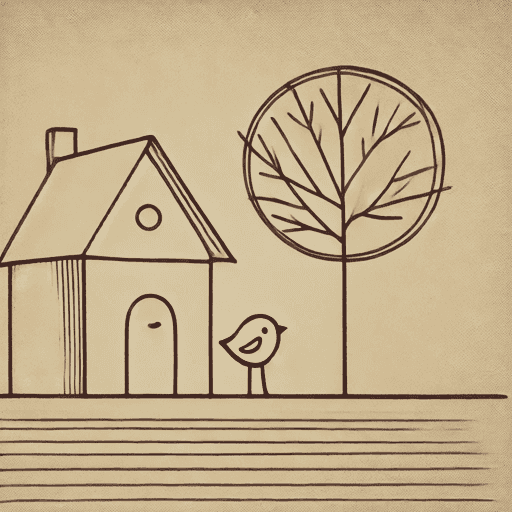
Strange Pictures
51 pages • 1-hour read
Uketsu, Transl. Jim RionStrange Pictures
A modern alternative to SparkNotes and CliffsNotes, SuperSummary offers high-quality Study Guides with detailed chapter summaries and analysis of major themes, characters, and more.
Chapter 2Chapter Summaries & Analyses
Content Warning: This section of the guide includes discussion of death, child abuse, and graphic violence.
Chapter 2 Summary: “The Smudged Room”
Six-year-old Yuta Konno remembers a time just before his father’s death three years previously. His father took him to the cemetery near his home, though he cannot remember what his father said during that visit. The woman caring for Yuta, Naomi Konno, cooks dinner, wrestling with her conscience regarding whether she spoke too harshly to Yuta earlier when he drew on the floor with permanent marker. When Naomi goes into the living room to tell Yuta that dinner is ready, he watches her closely, trying to decide, “[Is] Mama feeling better, or still angry?” (59) Naomi gentles her voice as she urges him to come and eat.
Later that night, exhausted from her day, Naomi wonders whether she is still young enough to raise a child on her own. She struggles to make enough money to care for Yuta at her part-time job as a grocery clerk, and she worries about how she will manage financially as he gets older. She is also worried because she thinks that someone has been following her lately. A car followed her and Yuta as they walked home earlier in the day and then sped away once she and Yuta gained the safety of their apartment lobby. She looks at the Buddhist altar in the corner of the room and wishes that Yuta’s father, Haruto, were still alive.
After a tiring shift at the grocery store the next day, Naomi rushes to Yuta’s nursery school to pick him up. His teacher, Miho Haruoka, asks Naomi to talk for a moment and shares with her a drawing of Yuta’s. The drawing, featured on Page 65, is of an apartment building. Next to the building are two large human figures, intended to represent Yuta and Naomi. At the top of the building, the windows of the central apartment are scribbled over and smudged with a large dark mark. This, Naomi admits, is the apartment where she and Yuta live.
Haruoka explains that Yuta will not tell her why he scribbled out the apartment and says that she is concerned about what might be going on in his life. She stresses that she does not believe the child is upset with his “Mama” because if he were, he would not have taken such care to draw her a pretty face. Naomi notices that Yuta has signed the drawing using kanji; Haruoka explains that the children are just now being introduced to this system of writing.
On their way home, Naomi notices the car following her and Yuta again. She grips Yuta’s hand and tells him to run. This time, the man gets out of his car and follows them into the building, but Naomi is able to get Yuta upstairs and into the safety of their apartment before the man catches up with them. Naomi is terrified when she realizes that the man now knows exactly which apartment is theirs. She considers calling the police but decides that no actual crime has been committed. Moreover, she has “her own reasons for avoiding the police” (74).
The next morning, Naomi is horrified to discover that Yuta is missing. She calls the nursery school to see if Yuta has made his own way there, but the staff has not seen him. Naomi then goes to the apartment building’s manager; he shows her a security recording of Yuta leaving the building early that morning. Yuta was alone and clearly left of his own accord.
At the nursery school, Haruoka takes out Yuta’s drawing again and thinks back to a lecture she attended in college, in which a child development expert talked about interpreting children’s drawings. She explained that they often draw an emotional interpretation of what they see rather than a literal depiction. Haruoka experiments with making a drawing similar to Yuta’s, trying to imagine what he was feeling. She also gathers information from another child about Yuta’s drawing process.
Eventually, she concludes that the smudge on Yuta’s drawing resulted from him trying to cover up what he initially drew; the apartment building is just another drawing he created to distract from his initial drawing. She can see that the first drawing was a triangle. Since the assignment asked the children to draw pictures of their mothers, Haruoka decides that, for some reason, Naomi “feels like” a triangle to Yuta, with a “sharpness” that is so dangerous and secret that he had to cover it up. She imagines that Naomi must be abusing Yuta.
Haruoka calls Naomi. Her veiled accusations infuriate Naomi, who hangs up on Haruoka. However, after the teacher’s explanation of Yuta’s drawing, Naomi is sure that she knows where the boy is. She walks to the cemetery near their apartment and finds Yuta there, searching for his mother’s grave. Yuta has gone there after learning the kanji for his last name at school; seeing the name written down has jogged his memory of the day he spent in the cemetery with his father years before, when he saw the same name on a triangular grave marker. It was the name of his birth mother, Yuki Konno.
When Naomi finds Yuta, she embraces him. She is so relieved to have found him that she cannot even scold him. She takes him home, thinking that she must try even harder to keep him safe. After putting Yuta to bed, Naomi takes her makeup off, thinking that she looks even older than her 64 years. She remembers telling her son, Haruto, not to put personally identifying information on his blog and how proud he was of the clever way he had come up with the pseudonym “Raku.”
Her doorbell rings. When she looks through the peephole, she sees that it is the man who has been following her and Yuta. She goes to the kitchen and gets a knife. She thinks about how there is no security camera in the hallway as she opens her door and asks the man to step inside. Naomi quickly stabs him in the belly. As he falls to the floor, she thinks that she recognizes him from somewhere, but she has no idea where.
Chapter 2 Analysis
Chapters 1 and 2 are in chronological order, but there is about a year’s gap between them, and there is at first no obvious connection between the two stories these chapters tell. For quite a while, Chapter 2 focuses entirely on the relationship between Naomi and Yuta—two characters unrelated to Sasaki and Kurihara, the main characters in Chapter 1. Naomi is the protagonist of Chapter 2, and the novel presents her in a sympathetic context, as a hardworking older woman raising a small child on her own after the death of the child’s father. The use of close third person, in which the narrator takes Naomi’s perspective, sharing her worries and insecurities as well as her deep love for Yuta, supports this characterization. In addition to the burden of raising Yuta, Naomi is frightened of a man who seems to be following her, and she is doing her best to protect Yuta from this mysterious danger. The combination of these factors—Naomi’s age, her struggles to raise a child on her own, her love for Yuta, and the background menace of a man following them with uncertain intentions—frames Naomi as vulnerable and creates an atmosphere of suspense and slowly building terror.
In this context, Naomi’s decision not to call the police is an aberration that heightens the mystery while also foreshadowing her true nature. Her reluctance to deal with the police is acknowledged but not explained; the novel merely says that she “[has] her own reasons for avoiding the police” (74). Her attitude hints at a later twist, as it will become clear that Naomi avoids the police because she has murdered three people and caused the death of a fourth through deliberate medical negligence. Naomi stabbing the man who comes to her door at the end of the chapter similarly foreshadows her true character. In the context of the frightening situations she has encountered throughout Chapter 2, Naomi’s decision to stab the man is an extreme and violent choice, but one that is clearly motivated by her fear and her love for Yuta. Nevertheless, the act reveals her capacity for violence.
The stabbing also illustrates The Violent Contradictions of Parental Love: Naomi already feels overburdened by the task of raising Yuta, but when his safety seems threatened, she is willing to go to extreme lengths to protect the child. This becomes another of the threads that connect the seemingly separate stories in the novel’s four chapters. Indeed, it is familial relationships that provide the narrative throughline. The revelation that Yuta is Yuki’s child clarifies how Chapters 1 and 2 are related: Yuta is the baby that Yuki died giving birth to in Chapter 1, which implies that Yuta’s deceased father, Haruto, is also “Raku,” the author of the blog featured in Chapter 1, and that Naomi is the shadowy figure that Sasaki and Kurihara sensed lurking in the background of the Konno household. Near the very end of the chapter, Naomi’s reminiscences confirm as much. That parent-child relationships anchor the mystery further subverts conventional expectations surrounding parental love, heightening its ambiguity.
In particular, Chapter 2’s foreshadowing of Naomi’s true nature invites questions about her potential involvement in Yuki’s death, as does her decision to raise Yuta believing that his grandmother is his “Mama.” The nursery school teacher’s discomfort about discussing the exact nature of the relationship between Naomi and Yuta is another indicator that something unusual and troubling has taken place in their household. When another teacher assumes that Naomi is Yuta’s grandmother, Haruoka’s response is telling. She “[freezes] for an instant” (102), feeling unable to “convey the complexities of the Konno household” (103). Her hesitation communicates unease with the subterfuge surrounding Naomi and Yuta’s relationship.
This unease is what makes it so easy for Haruoka to misinterpret Yuta’s drawing and jump to the conclusion that Naomi is abusing Yuta. In a darkly comedic callback, she thinks about a child development expert who spoke in her college classes about how to interpret children’s drawings. This is a reference to Tomiko Hagio, from the story’s prologue. Haruoka’s belief that she can analyze Yuta’s drawing and come to accurate conclusions about his thoughts and feelings reflects Hagio’s teachings. Unfortunately for Haruoka, neither she nor Hagio can see fully into an artist’s mind based solely on the artist’s work. Her misinterpretation of Yuta’s drawing reinforces the novel’s claims about Artistic Creations as an Opaque Window into the Mind and How Perspective Shapes Perception.

Unlock all 51 pages of this Study Guide
Get in-depth, chapter-by-chapter summaries and analysis from our literary experts.
- Grasp challenging concepts with clear, comprehensive explanations
- Revisit key plot points and ideas without rereading the book
- Share impressive insights in classes and book clubs