Strange Pictures
A modern alternative to SparkNotes and CliffsNotes, SuperSummary offers high-quality Study Guides with detailed chapter summaries and analysis of major themes, characters, and more.
Summaries & Analyses
Quizzes
NEWReading Tools
Games
Prologue-Chapter 1Chapter Summaries & Analyses
Content Warning: This section of the guide includes discussion of death, physical abuse, and child abuse.
Prologue Summary
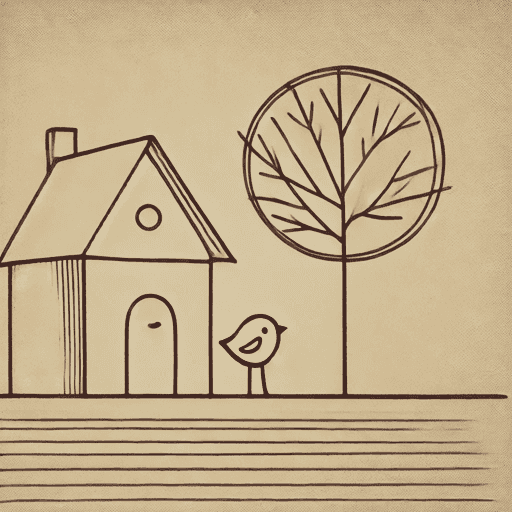
On the Prologue’s facing page, there is a rectangular image of a child’s line drawing. On the far left of the drawing is a house. Just to the right of center, a smiling child almost as tall as the house stands with her hands at her sides, facing out toward the viewer in her floral-print dress. On the far right is a tree. Its rounded top is supported by sharp, spiky branches, and in its trunk, there is a round opening. Inside this darkened opening, a white bird sits facing toward the child.
Dr. Tomiko Hagio lectures her psychology class about this drawing. The drawing was made by one of her patients, she says. This patient, “Little A,” was 11 years old at the time she was accused of murdering her own mother. Hagio draws her students’ attention to particular features of the drawing and explains what, in her expert opinion, these features indicate about the child’s state of mind.
The child’s blurry smile indicates that she worked hard to ensure the expression’s correctness; Hagio suggests that, in her abusive home, the child had to smile “right,” lest she receive a beating for not performing happiness correctly. The lack of a door on the house shows that the girl is trying to hide her interior life from the outside world. The sharpness of the branches indicates an aggressive capacity for self-defense. The bird in the tree reveals the child’s desire to protect the weak and to grow into a nurturing person. From all of this evidence, Hagio concluded that Little A could be rehabilitated. She tells her students that today, Little A is a grown woman “living happily as a mother” (8).
Chapter 1 Summary: “The Old Woman’s Prayer”
Chapter 1’s title page includes a drawing of an elderly woman on her knees, her head bent and her hands lifted, clasped together as if in supplication. To her right is the number “2” inside a small circle.
Shuhei Sasaki, a college student, is reading a blog that his friend Kurihara told him about. The two young men are part of a college club devoted to the paranormal, and Kurihara told him to check out a blog called Oh No, not Raku! because there is “Something strange about it” (14). The most recent post is on the blog’s front page. In it, the author—who uses the pseudonym Raku—addresses “the one [he loves] most” and says that this will be his final post because he finally understands the message hidden in three drawings (16). He believes that he has uncovered a terrible, secret sin that he cannot forgive.
As Sasaki reads through more posts, he follows the early days of Raku’s marriage to a woman named Yuki. Raku shares a picture of himself drawn by Yuki, a former professional illustrator. Yuki becomes pregnant, and Raku is filled with excitement about the progress of the pregnancy. During her pregnancy, Yuki creates several more drawings, which Raku shares. The first is a drawing of a baby. The second is a young child. The third is a young woman. The fourth is a young man. The final drawing is the drawing of the elderly woman kneeling. Each drawing has a small, circled number, but the numbers do not correspond to the order in which they were drawn.
A post from October of 2009 reveals that, after an emergency cesarean due to the baby’s breech positioning, Yuki died in childbirth. Raku is devastated. There are no more posts until November of 2011. This is the date of the final post that Sasaki has already read. Sasaki is saddened for Raku and puzzled about what information Raku discovered in the drawings.
Sasaki meets with Kurihara, who points out that some of the language in Raku’s posts hints that a third adult was living with Raku and Yuki; however, Raku seems to have taken some trouble to obscure this person’s presence. He also points out that there were almost certainly entries between 2009 and 2011 but that Raku deleted them for some reason. Sasaki has worked out that the pictures need to be rotated and layered, centered on the numbers they contain. Kurihara explains that the drawings need to be returned to their original sizes in order for the layering to work. Several diagrams explain the process of Kurihara and Sasaki’s reasoning and track their progress in reconstructing the layers of Yuki’s drawings.
When the drawings are all correctly sized and placed, they realize that there are actually two composite images. The first is of a deceased Yuki lying on her back while an elderly woman removes a baby from an incision on Yuki’s abdomen. The second is of Raku walking hand-in-hand with a child. They deduce that Yuki somehow had a premonition of her own death. They wonder if Yuki was murdered deliberately by someone on the hospital staff and posit that, if she knew in advance that she was in danger, she must have remained silent, making this the terrible secret that Raku refers to in his blog post. Sasaki makes Kurihara promise that, if he ever figures out what really happened, he will let Sasaki know.
Prologue-Chapter 1 Analysis
The story’s Prologue establishes the interrelated premises that art is a valuable source of information about the artist and that viewers can be like detectives, searching the text’s drawings for clues. This supports the novel’s mystery structure, explains the presence of its illustrations, and introduces thematic ideas that the rest of the narrative will more fully develop.
Hagio’s confidence in her diagnosis of Little A establishes this theme of Artistic Creations as an Opaque Window into the Mind. Her confidence does not at this point seem misplaced because the only evidence the reader has so far is the drawing itself and Hagio’s academic and professional experience. Presenting Hagio’s ideas in the context of her role as a university professor—i.e., during a lecture—underscores this credibility. This sets up the expectation that, within the world of the novel, pictures can be relied upon as clear reflections of an artist’s interior life—an expectation that subsequent events will reveal to be somewhat flawed.
Ironically, Hagio herself notes that the lack of a door on the child’s image of a house suggests that Little A is trying to hide the truth of herself from the outside world. Hagio does not view herself as truly “outside” the house, however; she believes that as a trained interpreter of art, she is able to see inside her patient’s mind regardless of the defenses Little A has erected. Hagio thus has difficulty seeing past her own status as an expert in this situation, believing that her training and experience make her perspective more than just a personal angle of vision. In other words, her expertise makes her less sensitive to How Perspective Shapes Perception. She does not see herself as what she really is—just the first in a line of investigators who will each come away with a slightly flawed understanding of the small part of the story they have access to.
Uketsu hammers this point home with further irony. Hagio believes that her final comments to her class—that she “[remains] confident in [her] diagnosis” and that Little A is “now living happily as a mother” (8)—demonstrate the effectiveness of her methods (8). However, the emphasis on Little A’s status as a mother actually foreshadows that the murderous child Little A is Naomi, a murderous adult responsible for many more deaths, all motivated by her strong maternal instincts. Hagio’s closing comments thus lay groundwork for the theme of The Violent Contradictions of Parental Love while also demonstrating how Hagio’s beliefs (in this case, about motherhood) shape her interpretation of people and events.
Chapter 1 introduces two amateur sleuths—Sasaki and Kurihara—whose investigations into “Raku’s” blog introduce what appears to be a brand-new mystery: the meaning of Raku’s final blog post, and how Yuki’s drawings figure into it. At this point, the only element that appears to connect the Prologue to Chapter 1 is the idea that art can reveal the mind of the artist. Chapter 1 offers qualified support for this idea. Raku successfully decodes the pictures Yuki left behind—but his success also depends on his knowledge of context and his intimacy with Yuki. Sasaki’s and Kurihara’s struggles to understand what the art means show how much these factors matter. They have several false starts, and even once they decode the message in Yuki’s art, they arrive at a conclusion that is only partially correct.
Chapter 1’s use of diagrams reinforces the idea that visual representations can be deceptive. The diagrams that chart the two men’s deductions and document their process as they solve the puzzle of Yuki’s drawings are in an entirely different style from the drawings created by Little A and Yuki. Sharp, clean lines, simple layouts with numbers and directional arrows, and word-processed explanatory text are all clues that these are meant to be taken as helpful, objective documents. Despite their appearance, however, these diagrams add little to the reader’s understanding. They often simply duplicate clear explanations already given in the narrative or document Sasaki’s false starts and misunderstandings. Like the more subjective and esoteric drawings by Little A and Yuki, these diagrams offer less information than they appear to.
Another function of these diagrams is to reinforce the sense that, despite the apparently paranormal nature of Yuki’s premonition of her death, there is a logical solution to the puzzle that the two young men are working on. Chapter 1 will not offer this solution, however: Its function is merely to offer the reader a first glimpse of the central mystery that unites the entire text. As Chapter 1 ends, this mystery seems to center on Yuki’s death, but later chapters will expand the scope of the mystery, building more suspense and tension as more victims are revealed and the threads connecting each of the chapters become more apparent.
As connections emerge, the narrative’s atmosphere of horror also grows. Midway through Chapter 1, when Yuki’s death in childbirth is revealed, a second set of ideas emerges to connect the Prologue with Chapter 1: the joy of motherhood juxtaposed against the awful truth that children—intentionally or not—sometimes kill their mothers. Little A deliberately kills her mother and then, apparently, grows up to be a happy mother herself. Yuki seems destined to be the happiest of mothers, but her child’s birth ends her life. The slow revelation of the meaning of Yuki’s eerie drawings amplifies the horror of this situation.

Get in-depth, chapter-by-chapter summaries and analysis from our literary experts.
- Grasp challenging concepts with clear, comprehensive explanations
- Revisit key plot points and ideas without rereading the book
- Share impressive insights in classes and book clubs
Related Titles
By these authors