Strange Pictures
51 pages • 1-hour read
Uketsu, Transl. Jim RionStrange Pictures
A modern alternative to SparkNotes and CliffsNotes, SuperSummary offers high-quality Study Guides with detailed chapter summaries and analysis of major themes, characters, and more.
Chapter 4Chapter Summaries & Analyses
Content Warning: This section of the guide includes discussion of death, death by suicide, animal cruelty, rape, graphic violence, bullying, emotional abuse, physical abuse, illness, and child abuse.
Chapter 4 Summary: “The Bird, Safe in the Tree”
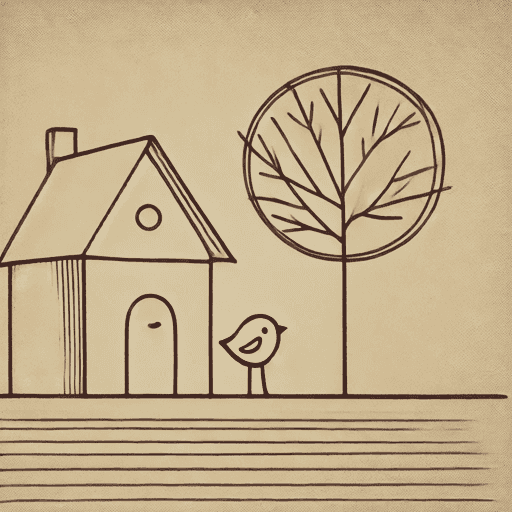
Chapter 4’s title page repeats Little A’s childhood drawing of the house, child, tree, and bird.
After stabbing the man at her door—Isamu Kumai—Naomi sits in jail, reflecting on her life. She recalls her childhood and how, after her beloved father’s death by suicide, her mother’s cold and abusive nature showed itself. Her mother would verbally and physically abuse Naomi for the slightest perceived infractions. One day, her mother tried to punish Naomi by attempting to kill Naomi’s pet finch, Cheepy. To save the bird, Naomi knocked her mother down and then battered her with a playhouse that she and her father had constructed for Cheepy. Finally, she jumped on her mother’s belly with all her strength and then stomped on her mother’s neck, breaking it. She felt great joy when she realized that her mother was dead and Cheepy was alive.
Naomi was sent to juvenile detention. She was allowed to keep Cheepy with her because Tomiko Hagio felt that Naomi could be rehabilitated through “contact with animals and children” due to the “maternal love seated deep in [Naomi’s] heart” (189), revealed by the bird drawing. After her release, Naomi trained as a midwife. She worked part-time at a cafe near an art school. At the cafe, she met an art student named Yoshiharu Miura and his friend Nobuo Toyokawa. Both men seemed interested in Naomi romantically, but she was only interested in Miura. After they graduated, they married and moved to Miura’s hometown, where he had accepted a job teaching art. Naomi worked as a midwife at a local hospital. When she became pregnant, she was worried that she would end up like her own mother, but she eventually decided that she would avenge herself on her mother by being an excellent mother. In giving birth, she felt the same joy she felt after murdering her mother.
Her son, Haruto, was a quiet child and rarely communicated with anyone other than Naomi. Worried about Haruto’s lack of friends and disinterest in most childhood activities, Miura often scolded the child. By contrast, Naomi indulged him. The two argued constantly about how to raise Haruto. One day, Miura slapped Haruto for sticking out his tongue at his father and refusing to do what Miura asked him to do. After that, Miura “started regularly hitting Haruto” and forcing him to go on camping trips and other outings the boy disliked (195). However, Naomi realized that if she initiated a divorce, the court would learn about her childhood conviction, which she had always kept secret from Miura. Miura might be granted full custody of Haruto. She decided that the solution was to kill Miura.
The narrative shifts to Kumai’s perspective. He is in a hospital, healing from his stab wound. A new patient—a young man with a broken leg—arrives to share his room. Kumai recalls how terrible he felt at Iwata’s funeral. He felt guilty for allowing Iwata to investigate Miura’s murder, and he felt like a coward for not having done it himself. The police concluded that Toyokawa was responsible for both Miura’s and Iwata’s deaths, but Kumai did not believe in the evidence of a word-processed suicide note. He decided that it was his responsibility to find out the truth.
It took Kumai 10 years to solve the mystery of what had happened to Iwata. Kumai focused his attention on Iwata’s drawing of the view from the mountain. This image is featured on page 199 and is very similar to Miura’s drawing of the same view—but not identical. Based on the drawings, Kumai deduced the force-feeding and the attempt to confuse the time of death, which initially made him suspicious of Yuki Kameido. Eventually, however, he realized that Miura could have drawn the scene from memory. He then understood that Naomi made more sense as the killer; she had a reason to leave the drawing at the scene instead of taking it with her, as the drawing gave her an alibi for the time of death.
Kumai began to investigate Naomi in more depth and learned about her murder of her mother. He interviewed Hagio and understood what Hagio did not: Naomi’s protective instincts could lead Naomi to kill again and again. The only thing that he could never understand was Miura’s motive for making the drawing that gave his killer an alibi.
In jail, Naomi recalls the days following Miura’s murder. She realized that she would have to do whatever was necessary to stay out of jail, which would leave Haruto without either parent. This led her to Miura’s motive for creating the mountain scenery drawing: It provided an alibi for Haruto’s only remaining parent so that Haruto “would not end up alone” (206).
Both Yuki Kameido and Nobou Toyokawa began coming to the Miura house regularly. Yuki wanted to help Naomi with the household, and Naomi noticed that Haruto opened up to Yuki in a way he had previously only opened up to Naomi herself. Toyokawa’s motives were not so benign. He revealed that he knew Naomi had killed Miura, and he repeatedly forced Naomi to have sex with him, threatening to expose her crime if she did not. Once, he even manipulated events so that Haruto would see them having sex, and for the first time, Naomi thought of killing him.
In his hospital bed, Kumai recalls his own mother, who was sometimes cheerful and sometimes terrifying. He remembers a time when she flew into a rage at the father of a boy who had beaten up Kumai. He knows that she was close to assaulting the man, and he wonders whether anything really separates his own mother from Naomi.
Naomi eventually discovered from Yuki that Iwata was looking into Miura’s murder. She decided to kill Iwata and then to kill and frame Toyokawa. Afterward, she moved with Haruto to Tokyo. Years later, Haruto and Yuki ran into one another in the city and began a romance. A year later, they married, and Yuki moved in with Naomi and Haruto. When Yuki became pregnant, Naomi discovered that she was jealous. She wanted to be a mother again herself.
Naomi took charge of Yuki’s prenatal care. She knew that Yuki’s age—35—and her high blood pressure made the pregnancy risky. Desperate to see herself as a mother rather than as a grandmother, she secretly gave Yuki salt that would raise her blood pressure even higher. Naomi did not think it would work, but it did: During the delivery, a blood vessel in Yuki’s brain burst, and she died. Naomi persuaded Haruto that it would be best for the child, Yuta, to grow up calling her “Mama,” and she took over as Yuta’s primary caretaker. Eventually, Haruto decoded the drawings Yuki had left behind. Distraught over his mother’s actions, Haruto died by suicide.
Kumai thinks about his recent discovery that his cancer has returned. After the diagnosis, he felt compelled to bring Naomi to justice. He met with the police and proposed that, since they did not have enough evidence to try Naomi for Miura’s, Iwata’s, and Toyokawa’s deaths, he himself would confront her and goad her into committing a crime that they could arrest her for. He did not care if she actually killed him because he was sure he would die of the cancer anyway. The police were waiting outside Naomi’s apartment when she stabbed Kumai, and this is how she ended up in jail.
When Tomiko Hagio reads about Naomi’s arrest, she finds the drawing of the house, child, tree, and bird in her files. She realizes that she misinterpreted the drawing all those years ago. The spiked tree branches, she now thinks, are evidence that Naomi is capable of great violence to protect what she loves. She is “ashamed of her past short-sightedness” (230).
Kumai learns that he will soon be released from the hospital. The young man sharing his room congratulates him. When the young man learns that Kumai does not plan to return to the hospital to be treated for his cancer, he urges Kumai to reconsider. He tells Kumai to think of Yuta, who is all alone now and would benefit from Kumai looking out for him. The young man’s knowledge of details of the case surprises Kumai, but the young man—Kurihara—explains that he has been investigating the case for years. Kurihara tells Kumai about the Oh No, not Raku! blog and explains about Yuki’s death. The blog’s title, he says, is an anagram for “Raku’s” real name, Haruto Konno. Kumai decides to get treatment for his cancer, finish the investigation, and become Yuta’s guardian.
Chapter 4 Analysis
Chapter 4 begins a few days after Chapter 2 ends. It opens with the revelation that Naomi is in jail and that the man she stabbed in her apartment was Kumai. This information retrospectively adds a great deal of significance to the end of Chapter 2: Kumai was at Naomi’s not to harm her but to bring her to justice. As Naomi is now in jail, it becomes clear that the end of Chapter 2 was the narrative’s climax. Chapter 3’s flashback functions as an expository interruption that prolongs suspense and gives critical background information on both Naomi and Kumai, and Chapter 4 contains the story’s falling action and resolution. This nonlinear structure reflects the novel’s interest in perspective, as the full significance of events becomes clear only when they are contextualized in relation to one another.
In particular, the novel’s final chapter explains how Kumai came to be standing outside Naomi’s apartment in the first place and fills in details that complete the picture of Naomi Konno’s life. To do so, the narrative’s perspective shifts between Naomi and Kumai, both of whom are thinking about the past while they lie helpless in bed (in prison and a hospital, respectively). This structural choice indicates that Kumai and Naomi are of equal importance—protagonist and antagonist in a battle for justice.
The novel has previously indicated that Naomi’s behavior as a mother reflects her experiences as a child, but Chapter 4 fully contextualizes it. The manner in which Naomi kills her mother represents Naomi’s rage at her mother’s failure to nurture and love Naomi. Naomi batters her mother with a playhouse—an object that symbolizes both Naomi’s father’s love for her and her love for Cheepy—and then jumps on her mother’s belly in a clear attack on the woman’s status as a mother (the use of the playhouse, which is an ordinary household object, also reinforces the text’s motif of horror lurking behind the everyday). The irony, however, is that Naomi’s actions as a mother are as violent as her own mother’s behavior; they simply find a different outlet. That she experiences the same pleasure in giving birth that she did in killing her mother underscores this point, as does her approach to parenting as a form of “revenge.” Naomi’s love for Haruto is real, but it is intertwined with her feelings toward her mother in a way that proves destructive even before she begins killing: She is unable to stop herself from raising Haruto to be spoiled, dependent, and immature. This illustrates the novel’s theme of The Violent Contradictions of Parental Love.
This theme is also evident in Miura’s characterization. Naomi realizes that, although she disagrees with Miura’s abusive approach to raising Haruto, Miura, too, is motivated by love for Haruto. Miura’s final action—creating the drawing that gives Naomi an alibi to prevent Haruto from being alone in the world—shows how deep Miura’s love for Haruto really is. That Naomi’s interpretation is correct is reinforced by Miura’s final thoughts in Chapter 3. Although his conviction that “He had to draw. To keep them safe” is cryptic at the time (110), Naomi’s explanation of Miura’s likely thought process in Chapter 4 unlocks the passage’s meaning.
The two sides of Naomi’s love for Haruto—its generous side and its selfish side—are evident as Yuki and Toyokawa become fixtures in the Miura household. Naomi’s memory of Haruto opening up to Yuki in a way previously reserved for Naomi herself foreshadows the eventual romance between Haruto and Yuki. This provides an additional motive for Naomi’s eventual contribution to Yuki’s death: jealousy. Meanwhile, Toyokawa’s sexual assaults on Naomi further demonstrate the extremes to which she will go to protect Haruto. It is significant that she first thinks of killing Toyokawa after he orchestrates Haruto’s discovery of the ongoing rapes; this draws a clear line between her eventual decision to murder Toyokawa and her intense, protective love for Haruto. However, Naomi’s dark plot against Yuki tips the balance decisively in favor of selfishness, demonstrating clearly that Naomi’s identity as a mother is more important to her than any child; she destroys her own son’s happiness and damages Yuta’s by orchestrating Yuki’s death.
Tomiko Hagio’s brief appearance at the end of the chapter parallels the Prologue, bookending the story’s consideration of Artistic Creations as an Opaque Window into the Mind and How Perspective Shapes Perception. In the novel’s Prologue, her confidence that her expertise makes her insightful and objective enough to peer directly into Naomi’s mind through the lens of her drawing introduces these themes. At the end of Chapter 4, Hagio learns about Naomi’s career as a serial killer and feels deeply ashamed of her earlier hubris. She now understands her misinterpretation of Naomi’s art and realizes how difficult it really is to see into another person’s mind. As Naomi’s thoughts and actions throughout the story demonstrate, even the “artist” themself may not know the complete story of who they are and what they are capable of.

Unlock all 51 pages of this Study Guide
Get in-depth, chapter-by-chapter summaries and analysis from our literary experts.
- Grasp challenging concepts with clear, comprehensive explanations
- Revisit key plot points and ideas without rereading the book
- Share impressive insights in classes and book clubs