Strange Pictures
51 pages • 1-hour read
Uketsu, Transl. Jim RionStrange Pictures
A modern alternative to SparkNotes and CliffsNotes, SuperSummary offers high-quality Study Guides with detailed chapter summaries and analysis of major themes, characters, and more.
Important Quotes
Content Warning: This section of the guide includes discussion of death, death by suicide, animal cruelty, graphic violence, and child abuse.
“Like they say, ‘Painting is a mirror of the soul,’ and a drawing can often offer valuable insight into the mind of its artist.”
(Prologue, Page 5)
Hagio’s comment to her class in the opening of the Prologue immediately establishes one of the narrative’s central themes: Artistic Creations as an Opaque Window into the Mind. Hagio metaphorically compares art to a mirror that clearly reflects the truth inside its creator. She does not doubt the accuracy with which an interpreter can understand the interior life of an artist simply by looking at the artist’s work. Much later in the narrative, she will have cause to revise this opinion.
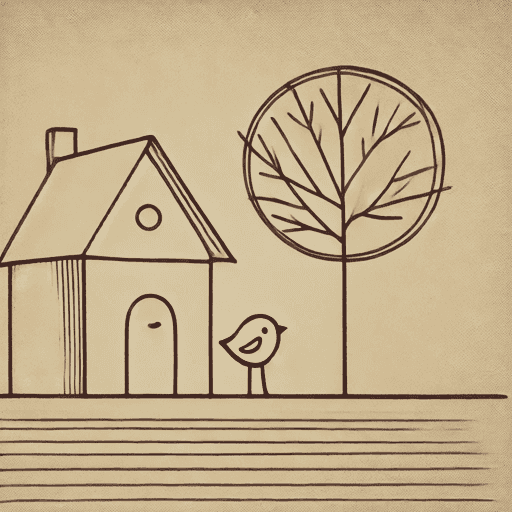
“Deep inside Little A’s thorny, aggressive exterior beat a kind heart. If we gave her a chance to interact with animals or small children, we could foster that kindness and possibly overcome her aggressive spirit.”
(Prologue, Page 8)
Hagio suggests that the thorny tree represents Little A’s (Naomi’s) “aggressive exterior” and that the bird nestled in the tree’s hollow represents the child’s desire to nurture and protect. Later events prove that this interpretation is accurate to a point but that the conclusion Hagio draws from the interpretation is badly mistaken. Naomi’s initial crime—the murder of her mother—is motivated by a threat to an animal. Her subsequent murders are all motivated by her desire to be a mother and perceived threats to children she considers her own. In other words, giving her “a chance to interact with animals [and] small children” dangerously increases her aggression, demonstrating The Violent Contradictions of Parental Love.
“It’s called Oh No, not Raku! At first glance, it’s perfectly innocent, but there’s something there. Something strange about it. I can almost guarantee a chill, at the very least.”
(Chapter 1, Page 14)
Kurihara’s recommendation of the blog to Sasaki stresses the appearance of innocence that hides something “strange.” In the context of a horror novel called Strange Pictures—which operates within a tradition of kaidan, or “strange narratives”—this diction adds significantly to the novel’s eerie atmosphere. The blog’s appearance of innocence reinforces the sense that horrific things can lurk in unexpected, everyday encounters and arrangements.
“And that exaggerated ‘Oh no’ was such a weak attempt at humor. The kind of uninspired silliness that was the hallmark of your average diary.”
(Chapter 1, Page 15)
Sasaki’s conviction that the blog’s title is hyperbolic whimsy is an instance of How Perspective Shapes Perception in ways that are often incorrect; the title is actually an important clue, as it turns out to be an anagram of Haruto Konno’s name. The anagram Haruto chooses does have a tone of naive, good-natured humor—all character qualities that Raku’s blog entries confirm. Sasaki’s scornful dismissal of this type of humor, by contrast, characterizes him as more cynical and pragmatic than Haruto, reinforcing his role as a foil for Haruto.
“Today’s vision of the future is a distant one. Apparently, it’s supposed to be the baby as an old woman. She’s dressed all in white, and praying, I guess?”
(Chapter 1, Page 26)
Raku’s beliefs about the picture Yuki has drawn will prove to be ironic: The future Yuki is predicting is not “distant” at all, but a matter of days away. His inability to see his mother clearly is evident in that he immediately sees that Yuki’s pictures bear a striking resemblance to Yuki and himself yet does not see that the elderly woman is his own mother, Naomi. The old woman’s white clothing foreshadows Naomi’s role in Yuki’s death, as Naomi is a practicing Buddhist, and Buddhists associate the color white with death. Ironically, the “praying” gesture that innocent “Raku” sees in the picture is actually Naomi pulling Yuta from Yuki during Yuki’s final moment of life. Raku’s innocent perspective influences him to see something positive in a drawing that actually expresses something horrific, showing how perspective shapes perception.
“It’s hard, but I have to be strong for the baby.
I will do my best to raise our child.”
(Chapter 1, Page 27)
Raku’s words conclude the entry in which he announces Yuki’s death with two short, separate sentences, emphasizing the importance of each idea to him. He is shattered by Yuki’s death, but he closes the entry with a focus on his child and a vow to do his best to be there for Yuta as a strong role model. This statement becomes laden with irony when he dies by suicide, leaving Yuta in Naomi’s care.
“‘Did you look at the numbers scattered around?’
‘Of course.’
‘Those numbers are right at the heart of it.’”
(Chapter 1, Page 37)
Kurihara’s superior intelligence and humility show in the way that he is always one step ahead of Sasaki but does not jump in and boastfully show off the answer to the riddle. Instead, he leads his friend to find the solution for himself. Here, Kurihara points to the numbers and then gives a coded hint: The numbers are “right at the heart of it.” Later, Sasaki will understand that Kurihara means this both literally and figuratively. The numbers are metaphorically “at the heart” of the problem in that they are central to solving the riddle. They are also literally central to solving the riddle in that they must be physically centered one above the other to successfully layer the images.
“Yuki had secretly drawn a picture of her own death.”
(Chapter 1, Page 50)
Although both Sasaki and Kurihara try to explain Yuki’s foreknowledge of her own death logically, there remains a touch of the paranormal about the young woman’s prediction of how she would die. This is the text’s only nod to the tropes of precognition and paranormal occurrences common in Japanese horror—unlike much of the genre, Strange Pictures is almost entirely grounded in realism.
“I’m not so young any more. Can I really raise this boy on my own?”
(Chapter 2, Page 60)
Yuta has been taught to call Naomi “Mama,” inviting the reader to assume that she is his mother. Her concern with her age, however, foreshadows the revelation at the end of Chapter 2 that she is actually Yuta’s grandmother. Moreover, Naomi contributed significantly to Yuta’s mother’s death, and it was her involvement in Yuki’s death that caused the despair that led to Yuta’s father’s death. It is thus entirely Naomi’s responsibility that she is raising Yuta alone, making her qualms at this point darkly ironic.
“Oh, but I’m sorry for speaking like some kind of expert or anything!”
(Chapter 2, Page 67)
Haruoka’s humble and courteous nature shows in her concern that she is presenting her conclusions about Yuta’s drawing as if she were an expert in child psychology and art. This is ironic, as she will soon become convinced that she does have real insight into Yuta’s drawing and will jump to the erroneous conclusion that Yuta is being abused. Another irony is that the narrative does contain an actual expert in child psychology and art—Tomiko Hagio, who is not much better at interpreting Naomi’s childhood art than Haruoka is at interpreting Yuta’s.
“Naomi’s mouth gaped in a silent scream. Her voice would not come.”
(Chapter 2, Page 75)
The image of Naomi’s mouth open in a silent scream vividly conveys her terror at Yuta’s disappearance. Despite her concerns about her capacity to raise the child, at this moment, it is clear that she loves him desperately. Her ambivalent feelings demonstrate the violent contradictions of parental love.
“She needed to be able to switch between the calm of the Buddha and the frightfulness of an ogre as skillfully as a Peking-opera performer changing masks.”
(Chapter 2, Page 78)
Haruoka’s analogy, comparing her opposing approaches to the children to “the calm of the Buddha and the frightfulness of an ogre,” reveals her belief that fear is sometimes the only way to get children to behave. Her comparison of herself to “a Peking-opera performer changing masks” contributes to the novel’s horror, as it implies that behind every beloved teacher’s mask of compassion is the face of a monster.
“Adults can draw what they see, the real thing, in their pictures. Children, though, draw the ‘idea’ of what appears in their heads. Like an artist. People sometimes say that every child is an artist, and I feel that is not far from the truth.”
(Chapter 2, Page 82)
The unnamed child development expert whom Haruoka recalls speaking to her class is implied to be Tomiko Hagio, whose beliefs about art are echoed here. This creates foreshadowing, as Haruoka is about to let her overconfidence in her ability to interpret Yuta’s art lead her into a significant misinterpretation—just as Hagio’s overconfidence in her ability to interpret Naomi’s art led her into a misinterpretation years before.
“He did not move, just stood there staring silently at the blade. Naomi felt another chill.”
(Chapter 2, Page 105)
At this point, the reader does not know that Naomi—not the unnamed man—is the source of danger in this encounter. Much later, it will be revealed that the man is a reporter who has decided to risk his life to provoke Naomi into doing exactly what she does here—committing a crime that will expose her violent nature. Without this context, the man’s silent stillness is what seems menacing, and the “chill” that Naomi feels seems like a natural response to the physical danger the man represents. When the scene is presented again, in Chapter 4, it becomes clear that the man’s silence and stillness are born not of menace but of courage. It will also be clear that what Naomi fears is not a physical attack but the possibility of being brought to justice for her crimes.
“From the moment he became a teacher, Yoshiharu Miura hardly spared a moment for himself.”
(Chapter 3, Page 109)
Miura’s view of himself contrasts sharply with others’ views of him, creating dramatic irony. After his death, his wife, students, and long-time friend Toyokawa all say that he was self-centered and short-tempered. This contributes to the novel’s consideration of how perspective shapes perception and adds to the story’s atmosphere of horror: It suggests not only that people can never fully understand others but that they also cannot fully understand themselves.
“[W]hat spread out before him was a vision of hell. It was a scene of despair; a sight that turned his entire life into a lie. Miura teased a pen from his pocket. He had to draw. To keep them safe.”
(Chapter 3, Page 110)
Because the reader has seen the mountain scenery drawing Miura is about to create, diction like “spread out before him” and “scene” appears to refer to the view from the mountain. This language is deliberately misleading, however; in Chapter 4, it becomes clear that Miura is actually looking at his wife preparing to murder him. This is what “[turns] his life into a lie,” as for the first time, he realizes that her perspective on his character and their marriage is entirely different from his own perspective. His final thought, that “He [has] to draw. To keep them safe,” is at this point obscure. This foreshadows that Iwata (and the reader) will end the chapter not fully in possession of the truth about why Miura drew the mountain scene. The deliberately opaque language points out that text, just like visual art, is at best a partial representation of truth.
“Reporting can be a dangerous business. […] You need experience, Iwata, and you don’t have any as a reporter at all. You’re barely an adult. You shouldn’t be taking these kinds of risks.”
(Chapter 3, Page 145)
Kumai’s warning foreshadows Iwata’s death at the hands of Naomi Konno just a few days later. Iwata is young and impulsive, and he does not always exercise the best judgment, but he does not see himself this way. Kumai’s perception of Iwata is more accurate than Iwata’s own perspective.
“Jagged, lumpy rocks the size of rabbits rolled about under foot, so that a moment of inattention could lead to a fall. Here and there Iwata spotted unsettling insects he’d never seen before.”
(Chapter 3, Page 159)
As Iwata heads up the mountain, the tone of the descriptive language used to convey his surroundings shifts and becomes more threatening. Whereas before he found the hiking easy and noticed things like flowers and trees, now he struggles and notices dangerous rocks and “unsettling insects” unfamiliar to him. This shift in tone foreshadows the danger that Iwata is approaching the higher he climbs.
“A shock ran through his body, his heart began racing and his skin prickled into goosebumps.”
(Chapter 3, Page 163)
Once Iwata is standing where Miura stood and has performed the actions Miura performed, he has a sudden flash of insight. This moment is so significant that Iwata reacts physically. The tactile imagery of feeling a “shock,” a “racing heart,” and prickling skin conveys how threatening Iwata’s insight is; he does not feel relief or triumph but something closer to alarm, as if on some subconscious level he is aware that his investigation has placed him in danger.
“It was the kind of trick that only worked in fiction. You couldn’t fool the police with something like that in the real world.”
(Chapter 3, Page 166)
Ironically, the supposedly transparent trick that Iwata is thinking of—falsifying the time of death through manipulating what Miura ate—works within the “real world” of the text and does “fool the police.” Of course, the “real world” of the text is a fictional creation that only partially represents the “real world” of the reader. This darkly humorous moment thus draws attention to the novel as a work of fiction—an example of metafiction that is part of a pattern of drawing attention to both language and visual art as creations that mediate between minds and reality.
“It had been several days since that man…that Kumai…had come to her home and shattered her family’s peace. A peace that had been threatened over and over again. There was always someone getting in the way.”
(Chapter 4, Page 181)
After attempting to kill Kumai, Naomi feels no guilt. She feels entirely justified in stabbing him because of the threat he represented to “her family’s peace.” Ironically, Naomi shows no recognition that she is the real threat to her family’s peace. She herself set the events of the story in motion when she chose to kill her husband. This left Haruto without a father and increased his dependence on her, leaving him all the more devastated when she next engineered the death of her daughter-in-law, Yuki. Haruto’s death was a result of this devastation and left Yuta without either his biological father or mother. Naomi’s perspective on these events is sharply limited by her self-serving perception of herself.
“Her mother had been able to stand there, smiling gently, because Father was next to her. She had merely played at being the caring mother for Father’s sake, to ensure his love.”
(Chapter 4, Page 186)
Naomi’s memories of her mother again evoke the idea of horror lurking behind the everyday. After Naomi’s father’s death, it became clear to Naomi that her mother—who had always seemed to be gentle and caring—had secretly hated Naomi all along. Naomi would never have guessed what horrific abuse her mother was capable of until this mask was discarded.
“Her heart was filled to bursting with warmth and love. Naomi sat next to her mother’s corpse, weeping tears of joy.”
(Chapter 4, Page 188)
This passage juxtaposes images of Naomi experiencing extreme happiness with the image of her mother’s corpse. Naomi’s reaction stems from her love for Cheepy and the torment her mother has subjected her to, but her total lack of remorse or despair after brutally murdering her own mother also reinforces the atmosphere of horror.
“I am going to become a grandmother. I will be a withered old thing, always smiling, always gentle, spoiling my grandchild. Is that enough? There was only one answer. No. Absolutely not. I am…I am a mother.”
(Chapter 4, Page 218)
Naomi’s thoughts about Yuki’s pregnancy reveal that her entire identity is wrapped up in being a mother. She loves Haruto desperately, but what she loves most is the idea of herself as a mother, and she protects this even more fiercely than she protects Haruto. This helps to explain her choice to cause Haruto misery by facilitating Yuki’s death; doing so protects her even more urgent desire to avoid shifting her role from mother to grandmother.
“Hagio’s whole body began shivering. She was ashamed of her past short-sightedness. If she asked Naomi to draw a tree today, what would it look like? What manner of thorns would be sprouting from the tree in her heart now?”
(Chapter 4, Page 230)
Hagio’s visceral reaction to her mistake conveys how deeply ashamed she is and how radically her perspective on Naomi and art have shifted. She now sees the tree in Naomi’s drawing as symbolic of Natalie’s thorny heart—capable of inflicting great damage on anything Naomi sees threatening those she loves. Ironically, she still does not have a completely clear perspective on Naomi’s motivations. As Naomi’s thoughts make clear throughout Chapter 4, what Naomi is most devoted to protecting is her own idea of herself as a mother, not her children.

Unlock every key quote and its meaning
Get 25 quotes with page numbers and clear analysis to help you reference, write, and discuss with confidence.
- Cite quotes accurately with exact page numbers
- Understand what each quote really means
- Strengthen your analysis in essays or discussions